Amazon Autos Explained: What Sellers and Vendors Should Know
Salevoyant Editorial · August 25, 2026
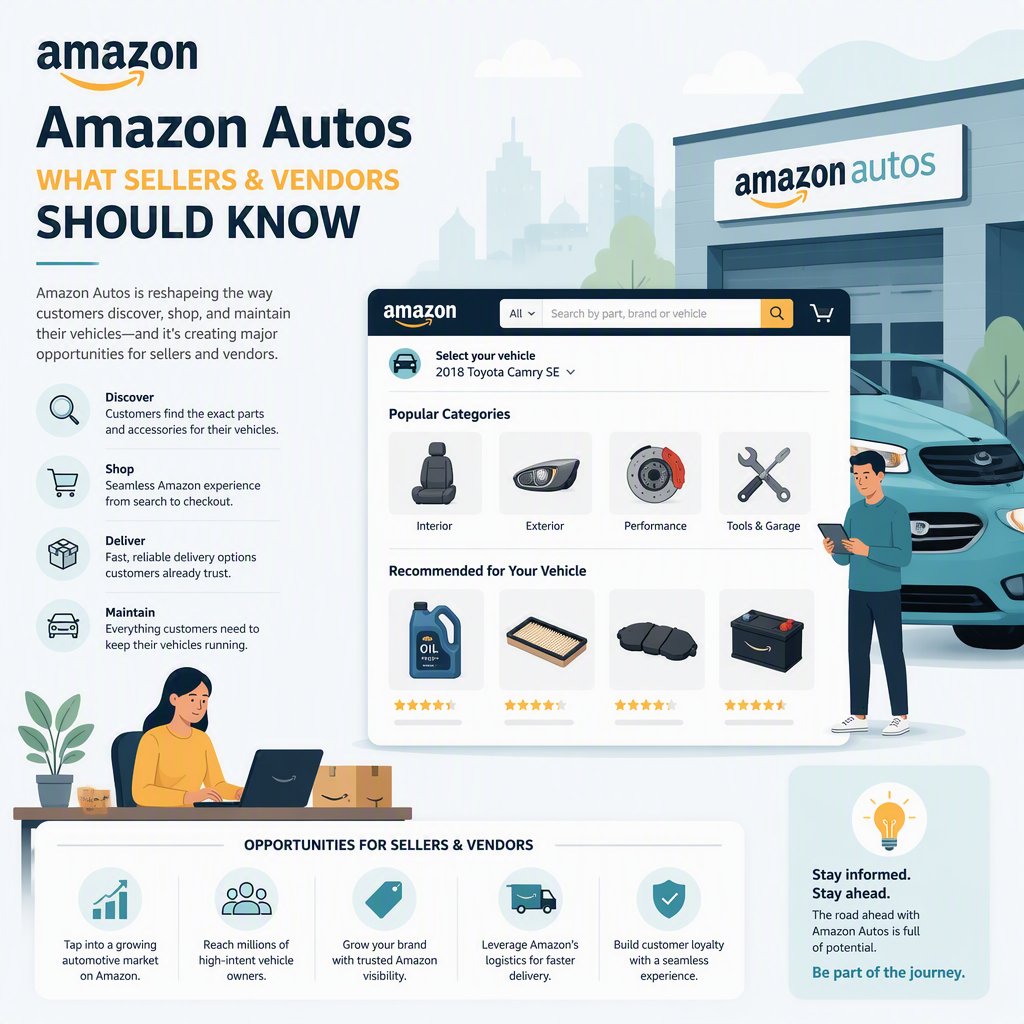
Introduction
Amazon’s car-buying push looks odd at first glance, but it fits a pattern the company has been building for years: turn big, high-friction purchases into structured digital commerce. Amazon Autos now spans more than 1,000 participating dealers in over 130 U.S. cities, which makes this more than a pilot. It’s a signal that Amazon wants to own more of the transaction layer, not just the discovery layer.
For Amazon sellers, Vendor Central teams, and marketplace operators, this matters because it shows how Amazon keeps extending its retail operating model into categories that used to resist standard e-commerce workflows.
Core Development
Amazon Autos now lets shoppers browse new, used, and certified pre-owned vehicles, compare offers, arrange financing, and complete most of the paperwork online before picking up at a dealership. The customer still buys from a real dealer, but Amazon provides the front end, the comparison experience, and much of the transaction flow.
The expansion is the key story. Amazon started with new Hyundai vehicles in December 2024, then added more brands and more inventory types, including Chevrolet, Jeep, Kia, Subaru, Mazda, GMC, Cadillac, Dodge, Ram, Ford CPO inventory, and used cars from Hertz and participating dealers. That’s a pretty fast rollout for a category that’s normally slow, regulated, and operationally messy.
A few details stand out:
- Dealer network depth: over 1,000 participating dealers
- Geographic coverage: more than 130 U.S. cities
- Search radius: listings shown within 75 miles of a shopper’s location
- Return policy for used and CPO vehicles: minimum 3-day/300-mile window
- Warranty baseline: at least 30 days or 1,000 miles for used and CPO vehicles
- Pricing model: dealer-set upfront pricing, no Amazon transaction fees or commissions charged to the customer
That’s not just a convenience layer. It’s Amazon applying marketplace logic to a category that historically depends on negotiation, manual paperwork, and dealership-specific financing.
Technical Deep Dive
Amazon Autos is best understood as a transaction orchestration layer built on top of dealer inventory systems, financing partners, and local fulfillment through pickup. It doesn’t replace the dealer. It standardizes the customer-facing workflow.
How the workflow is structured
The customer journey is designed to reduce friction at each step:
-
Inventory discovery Search results are filtered by ZIP code and geography, then narrowed by make, model, price, features, and vehicle condition.
-
Offer comparison Buyers can review financing, leasing, or cash purchase options in one interface. That means Amazon is aggregating multiple lending partner responses into a single decision point.
-
Trade-in valuation A customer enters vehicle details and gets an estimated trade-in value before committing.
-
Deposit and order lock Once the shopper chooses a vehicle, they place a deposit and schedule pickup.
-
Digital paperwork E-contracts are sent in advance, while any documents requiring a wet signature are finished at the dealership.
This flow matters because it compresses the parts of car buying that create drop-off. In e-commerce terms, Amazon is reducing checkout friction and pushing the least scalable tasks to the very end.
Why the architecture is interesting
Amazon Autos likely depends on tightly integrated APIs and dealer management system connections. That raises a few technical challenges:
- Inventory normalization: Vehicle listings need consistent metadata across dealers, brands, and conditions. A used Honda, a certified pre-owned Ford, and a new Kia don’t share the same attributes or decision tree.
- Pricing consistency: The dealer sets the price, but Amazon has to display it with itemized taxes, fees, and optional products in a way that’s understandable and compliant.
- Geolocation filtering: The 75-mile radius creates a local inventory graph, not a national catalog. That’s very different from standard Amazon retail search.
- Financing workflow integration: Lending partner offers have to be matched to a shopper profile, then presented in a clear comparison format.
- E-signature and contract state management: The system needs to track what’s signed, what still needs a physical signature, and what’s pending at the dealership.
That’s a lot of state management for a high-value purchase. The platform has to keep data accurate across parties that don’t all operate on the same tech stack.
What this says about Amazon’s commerce stack
Amazon has spent years refining features like pricing transparency, recommendation engines, and checkout completion rates in standard retail. Autos extends those same ideas into a much more complex category.
In practical terms, Amazon is testing whether its marketplace infrastructure can handle:
- high-value purchases
- regulated financing
- local inventory dependence
- physical fulfillment handoff
- dealer-controlled final sale terms
That’s a useful experiment because if Amazon can make a car transaction feel like a normal online purchase, it strengthens the case for similar workflows in other categories, such as powersports, boats, recreational vehicles, and even complex B2B equipment.
Industry Impact
For the broader Amazon ecosystem, Autos is less about cars and more about control of the customer journey.
For sellers and marketplace participants
Amazon sellers may not sell vehicles, but they should pay attention. Amazon keeps proving that its marketplace model works best when it reduces uncertainty for the buyer. The same pattern shows up in retail categories with high comparison behavior, complex specs, or expensive return risk.
Expect three ripple effects:
- Higher expectations for transparency Buyers now expect upfront pricing, clear fees, and fewer surprises. That pressure spills into every category, from electronics to furniture.
- More demand for structured content If Amazon can do this for vehicles, the bar rises for product detail pages everywhere. Clean attributes, consistent item data, and variant completeness matter even more.
- More local and hybrid commerce models Amazon isn’t forcing everything into a warehouse-to-door model. It’s mixing digital discovery with physical pickup. That same hybrid pattern could keep showing up in categories with local service or installation.
For Vendor Central teams
Vendor-side teams should note the operational philosophy here. Amazon isn’t trying to own every step. It’s trying to own the part that scales best, the interface and the transaction logic, while letting local partners handle inventory and final delivery.
That has direct parallels to Vendor Central and retail media:
- Amazon wants clean inputs from partners
- It wants standardized item content
- It prefers predictable operational handoffs
- It values conversion clarity over negotiation
For vendors, that means the quality of product data, availability feeds, and content compliance keeps getting more important. If Amazon is this strict with vehicle listings, it’s easy to see why catalog quality matters so much in every other vertical.
For consumers
The consumer benefit is obvious. Less haggling. Less time at the dealership. More confidence before committing.
But the real market shift is psychological. Amazon is training shoppers to believe that expensive purchases can still feel simple if the information is organized well enough. That changes expectations, and expectations are hard to roll back.
Implementation Considerations
If you work in e-commerce tech, marketplace operations, or Amazon integration, there are a few lessons here that are worth taking seriously.
1.
Structured data is the real product
Amazon Autos only works if every vehicle can be described accurately and consistently.
For teams managing Amazon listings, the lesson is simple:
- tighten attribute completeness
- reduce catalog mismatch
- keep pricing and fee logic explicit
- validate inventory updates in near real time
Even in ordinary Seller Central workflows, messy data creates conversion loss. Autos makes that painfully obvious.
2.
State tracking matters more than ever
A car sale has many checkpoints: browsing, financing, deposit, contract review, pickup, signature completion, and return eligibility. That’s a state machine, not a simple checkout.
In marketplace systems, similar complexity shows up in:
- preorder fulfillment
- custom products
- bundled services
- large-ticket returns
- warranty enrollment
If your operations rely on manual reconciliation, this is the wrong direction. Amazon’s model favors event-driven tracking and clear status visibility.
3.
Local inventory needs strong SLA discipline
Because results are bounded by a 75-mile radius, stale inventory data becomes a direct customer trust problem. If a vehicle appears available when it isn’t, the experience breaks fast.
That same issue shows up in other local or hybrid Amazon models. If you’re managing feed-based inventory, latency and accuracy are business issues, not just technical ones.
4.
Financing and compliance are part of the UX
Amazon Autos is not just a shopping interface. It’s a regulated transaction environment.
Teams building similar systems need to think about:
- lending disclosures
- contract versioning
- state-specific return rules
- dealer-specific compliance requirements
- audit trails for digital signatures
That’s especially relevant for vendors in high-ticket categories who may want to work with Amazon on richer financing or installment options.
The important takeaway is this: the front end may look like e-commerce, but the back end behaves more like fintech plus compliance software.
Future Outlook
Amazon Autos is still selective and geographically limited, but the trajectory is clear. Amazon is building the infrastructure to handle more categories where shoppers want online research, transparent pricing, and a low-friction handoff to a local partner.
That could point to a broader strategy with a few likely outcomes:
- More dealer and partner integrations Amazon will probably keep expanding the network rather than trying to own inventory directly.
- Better financial product orchestration Expect tighter bundling of loan offers, trade-ins, warranties, and protection plans.
- More category experiments Anything with high consideration, local fulfillment, and opaque pricing is a candidate.
- Stronger pressure on traditional retail The more Amazon normalizes complex purchases online, the harder it gets for legacy retailers to defend manual, negotiation-heavy processes.
For Amazon itself, Autos also helps deepen Prime-era consumer trust in big-ticket purchases. If shoppers feel safe buying a car through Amazon, they’re more likely to trust the platform for other major decisions too.
Conclusion
Amazon Autos is bigger than a car-shopping tool. It’s a clear example of Amazon applying marketplace design to a category that once seemed resistant to digital simplification. The company is using dealer partnerships, structured pricing, financing integration, and local pickup to reduce friction in one of retail’s most complicated purchases.
For sellers and vendors, the lesson isn’t to start selling cars. It’s to watch how Amazon keeps raising the bar for catalog quality, pricing transparency, workflow automation, and consumer trust. Those standards will keep spreading across the rest of the marketplace.
If you manage Amazon operations, now’s a good time to ask a simple question: how much friction is still hiding in your own product data, checkout flow, or post-purchase process? Amazon’s answer, as usual, is to remove it.