Amazon AWS Signs $410 Million AI Deal: What Sellers Should Know
Salevoyant Editorial · July 28, 2026
Introduction
Amazon Web Services just signed a multi-year, $410 million agreement with Recursive, a startup building self-improving AI systems. That’s a huge number on its own, but the real story is what it says about where AI development is headed: not just bigger models, but continuous research loops that demand serious cloud capacity.
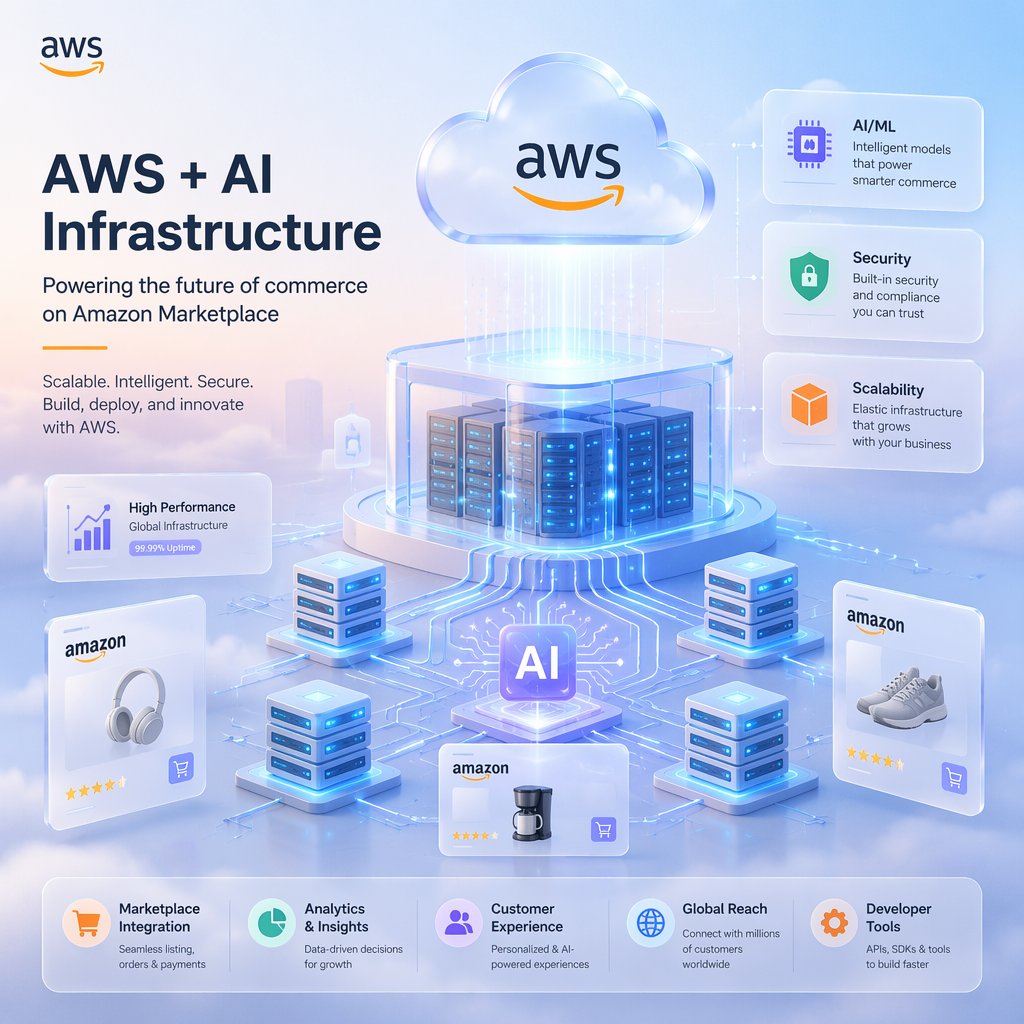
For Amazon sellers, Vendor Central teams, and e-commerce operators, this matters because AWS is becoming the backbone for the next wave of automation tools, forecasting systems, and content generation engines that will shape marketplace competition.
Core Development
Recursive announced that it will run its automated AI research system on AWS under a multi-year agreement worth $410 million. The company says its system is designed to conduct experiments on how to improve itself safely, then use each result to choose the next research step. In plain English, it’s building an AI that can do AI research, over and over again, with less human intervention.
This isn’t just another startup cloud contract. Recursive came out of stealth in May at a $4.65 billion valuation, backed by GV, Greycroft, AMD Ventures, and NVIDIA. Its founding team includes former leaders from OpenAI, Google DeepMind, Meta AI, Salesforce AI, and Uber AI, which tells you this isn’t a side project. It’s a serious bet on automated discovery.
The company says its first public results already beat a two-year human leaderboard record and outperformed a live human-AI collaborative effort across three benchmarks:
NanoChatNanoGPT SpeedrunSOL-ExecBench
AWS, in turn, says Recursive’s workflow creates a compounding demand for compute, since each research loop leads to the next experiment. That’s the key commercial idea here. The more the system learns, the more it runs. And the more it runs, the more infrastructure it needs.
The real value isn’t just in training one model. It’s in keeping hundreds or thousands of experiments moving at once without bottlenecks.
Technical Deep Dive
What Recursive is building is closer to an autonomous research pipeline than a traditional model training setup. Instead of a one-time training run followed by deployment, the system reportedly:
- Proposes an experiment
- Runs the experiment
- Evaluates the output
- Learns from the result
- Selects the next test
That kind of loop creates a heavy operational load. You need flexible orchestration, fast access to GPUs and other accelerated compute, resilient storage, and clean experiment tracking. If one loop fails, you can’t just lose a single batch job. You risk breaking a chain of discovery.
AWS is a natural fit here for a few reasons:
- Elastic compute: Recursive can scale experiments up or down as needed.
- Purpose-built hardware: AWS has a broad mix of instance types for training, inference, simulation, and data processing.
- Reliability and security: Research systems that modify themselves need tight controls, auditability, and isolation.
- Distributed experimentation: Parallel execution matters more than ever when one loop generates the next.
The technical challenge is not just raw compute. It’s also workflow coordination. A self-improving system needs strong MLOps and likely AIOps style tooling to manage experiment lineage, reproducibility, checkpointing, and rollback. Without that, you get a black box that’s expensive, hard to debug, and risky to operate.
There’s another interesting angle here. Recursive says it wants to co-develop infrastructure with AWS for large-scale automated AI research. That suggests AWS may be interested in shaping the tooling layer itself, not just renting out servers. If that happens, we could see new services or patterns emerge around:
- experiment scheduling
- model mutation tracking
- safe self-improvement guardrails
- automated benchmark evaluation
- cost-aware compute routing
That would matter far beyond Recursive. It would mean AWS is helping define the operating system for recursive AI research.
Industry Impact
This deal is about more than one startup. It shows that frontier AI is moving from model-centric competition to infrastructure-centric competition.
For Amazon, that’s strategically important. AWS already competes hard for AI startups, enterprise AI workloads, and foundation model teams. A headline deal like this does three things at once:
- It reinforces AWS as the cloud for ambitious AI workloads.
- It creates a reference customer for large-scale autonomous research.
- It signals to the market that AWS can support both training and experimentation at extreme scale.
For the broader e-commerce ecosystem, the indirect effects could be substantial. As AI research becomes more automated, the tools built on top of it tend to arrive faster and with better performance. That can affect:
- Seller Central analytics tools
- advertising optimization platforms
- catalog enrichment services
- review and sentiment analysis engines
- demand forecasting products
- pricing automation systems
- vendor replenishment forecasting
In other words, the machine learning tools Amazon sellers use every day may get smarter faster, but they may also become more competitive and more expensive to keep up with.
Vendor Central teams should pay attention too. Large brands already rely on algorithmic planning for replenishment, content optimization, and retail readiness. If automated AI research keeps accelerating, vendors will face stronger pressure to modernize their own data pipelines. Static reporting won’t cut it when competitors are using systems that continuously refine ad copy, inventory decisions, and buy box strategies.
For Amazon itself, this kind of infrastructure demand supports a wider strategy. AWS doesn’t just sell cloud. It wants to be the default platform for serious AI builders. Deals like this help prove that AWS can handle advanced workloads where uptime, GPU availability, and orchestration matter as much as raw scale.
Implementation Considerations
If you’re a seller, vendor, or marketplace software builder, the lesson isn’t that you need to build self-improving AI tomorrow. It’s that your data and systems need to be ready for a much faster AI cycle.
Here’s what to think about:
1.
Clean data matters more than ever
AI systems improve faster when they get clean inputs. If your listings, ad data, inventory feeds, and A+ content are messy, any downstream automation will struggle.
Focus on:
- normalized product attributes
- consistent catalog taxonomy
- accurate inventory feeds
- clean keyword and search term data
- structured sales and margin reporting
2. API readiness is becoming a business issue
If you use third-party software for Amazon operations, ask how it handles:
- rate limits
- data refresh latency
- error handling
- model retraining schedules
- experiment rollback
- audit logs
The better systems will expose API-first workflows and versioned outputs. That matters when AI starts making recommendations at scale.
3.
Cost control will separate winners from strugglers
Automated AI research is expensive. So are the tools built on it. For sellers, that means you should watch the ROI on:
- ad automation software
- listing optimization platforms
- demand forecasting tools
- pricing engines
- content generation services
If a tool saves time but doesn’t improve conversion, margin, or inventory turns, it’s not helping much.
4. Human review still matters
Even the best AI systems can drift, overfit, or optimize for the wrong metric. In Amazon commerce, that can mean keyword stuffing, bad price moves, or inventory decisions that look smart in a dashboard but hurt long-term performance.
Keep humans in the loop for:
- major catalog changes
- pricing exceptions
- compliance checks
- ad budget shifts
- vendor chargeback disputes
5.
Watch for infrastructure-driven product changes
When AWS co-develops infrastructure with a frontier AI company, the knock-on effect often shows up later in the form of new cloud services, better GPU access, or more automation features. Marketplace software vendors should keep an eye on AWS announcements because they often foreshadow what becomes cheaper and easier to build next.
Future Outlook
This deal points to a future where AI companies are judged not only by model quality, but by how fast they can run the next experiment. That’s a big shift. The winners won’t just have strong researchers. They’ll have systems that make research itself more automated, more repeatable, and more scalable.
For AWS, that means frontier AI is becoming a strategic workload category, one that justifies specialized infrastructure, more aggressive startup partnerships, and probably more custom tooling. For Amazon’s commerce ecosystem, it means sellers and vendors will see smarter software appear faster, and competition will get sharper.
A few likely outcomes stand out:
- More AI tooling for Amazon operations will be built on AWS.
- Experiment-heavy AI startups will demand specialized compute contracts.
- Marketplace software will become more adaptive, not just more automated.
- Sellers who clean up their data now will get more value from future AI tools.
- Vendors with strong internal analytics will react faster to algorithm-driven changes in retail performance.
The pace matters here. Recursive says it already produced benchmark results in months that outpaced years of community optimization. If that pattern holds, the software stack around commerce could evolve much faster than many sellers expect.
Conclusion
Recursive’s AWS deal is a strong signal that AI is moving into an era of continuous, self-directed experimentation. That requires more than model training capacity. It needs durable, scalable, and tightly managed infrastructure that can keep hundreds of research loops moving without breaking.
For Amazon sellers and Vendor Central users, the practical takeaway is simple. The next generation of marketplace software will be more automated, more data-hungry, and more dependent on cloud performance. If your catalog data, reporting, and workflows aren’t structured for that future, you’ll feel it in slower decisions and weaker margins.
The companies that prepare now will have an easier time adopting faster AI tools later. The ones that wait may find themselves reacting to competitors who are already running on a much better engine.