Amazon Brand+ and Performance+ Explained: More AI, More Control
Salevoyant Editorial · July 22, 2026
Introduction
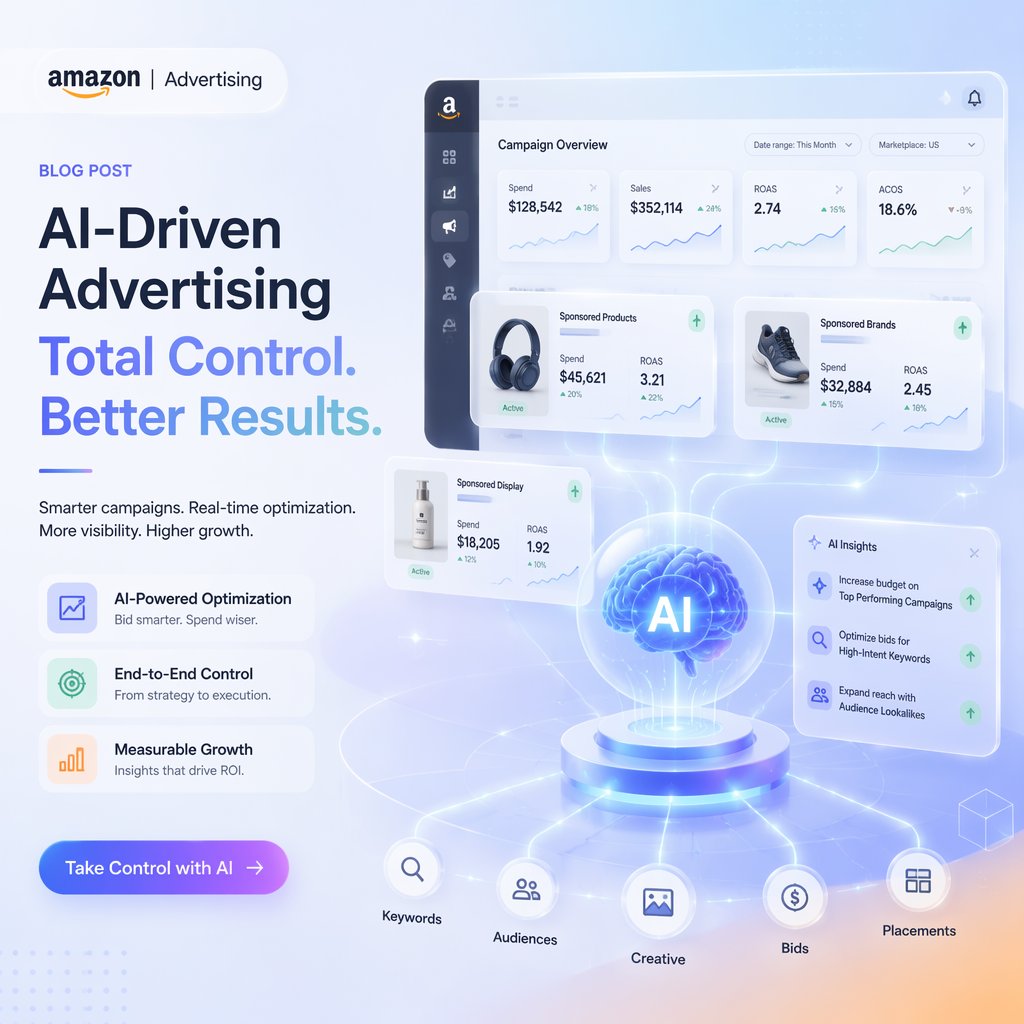
Amazon just gave advertisers a more interesting tradeoff: more automation, but with more room to steer the machine. The latest Brand+ and Performance+ expansion adds first-party audience signals, new audio inventory, smarter streaming TV deal selection, and tighter model-driven optimization across formats.
For sellers, vendors, and media teams, this matters because Amazon is clearly pushing its ad stack toward a model where your data improves the system, but doesn’t confine it. That’s a big shift in how campaign control works inside Amazon’s ecosystem.
Core Development
Amazon’s July 20 update expands Brand+ and Performance+ with ten new capabilities, many of them in Open Beta or General Availability.
The headline changes fall into three buckets:
- Simplicity through first-party data
- Scale through new formats and supply
- Performance through better model inputs and signal processing
The most important addition is Audience Signals for both Brand+ and Performance+ through Ads Data Manager (ADM). Advertisers can now connect first-party audiences as optimization inputs, including audiences built from AMC, DMPs, or custom segments. Amazon is careful here. These are not hard targeting filters. They’re signals that guide the model.
That distinction matters.
Amazon also expanded Audio support, bringing Brand+ Audio to GA with broader 3PX open exchange supply across 16 locales, while Audio for Performance+ enters Open Beta. On the video side, Automatic Deal Selection for Brand+ STV is now available in Open Beta, enabling Amazon to auto-activate and optimize a group of streaming TV deals instead of relying on a single preselected package.
Then there are the model upgrades under the hood:
- Brand Outcome Optimization for predicting brand-relevant actions
- Prime Video Signal Integration for better relevancy on Prime Video Ads supply
- Asynchronous Remarketing for richer bid-time valuation in Performance+
- Expanded Conversion Support for App Ads, including "Other" conversion types from MMPs
Amazon is also extending access through a Managed Service Campaign Proposal Builder, which brings Brand+ and Performance+ into AMG workflows.
The message is pretty clear. Amazon wants these campaign types to be easier to use, broader in reach, and smarter in how they spend.
The big shift isn’t just more automation. It’s Amazon turning advertiser data into a model input layer instead of a rigid audience wall.
Technical Deep Dive
The most interesting part of this release is how Amazon is handling first-party data inside automated campaign logic.
With ADM-based audience signals, Amazon is not saying “target only these users.” Instead, it’s saying “train the model with these signals.” That leaves room for probabilistic discovery, which is how Amazon preserves scale while still honoring advertiser intent. In practical terms, the system can learn from a customer cohort, then find similar users outside that exact list.
This is a very different architecture from old-school audience targeting. It’s closer to feature enrichment than direct segmentation. The model gets more context, then makes bid and placement decisions using that context along with real-time inventory signals.
Why that matters technically
Amazon’s ad stack has always been strong when it can combine commerce intent, retail behavior, and media exposure. These updates deepen that advantage by letting more advertiser-owned data flow into the optimization layer.
A few technical implications stand out:
- Better cold-start performance for new campaigns, because audience signals reduce the amount of random exploration needed
- Improved convergence on high-value users, since the model can identify patterns faster
- Less manual segmentation overhead, which is useful for teams running multiple ASINs, brands, or vendor portfolios
- A cleaner data pipeline, since ADM acts as the integration layer for conversion events and audience inputs
For Brand+, this is especially relevant in upper-funnel prospecting. Amazon can use audience signals to accelerate learning without locking the system into a narrow list. For Performance+, the same logic applies to Customer Acquisition and Unified Consideration, where the model needs enough context to balance cost efficiency with reach.
The audio and STV changes also tell us a lot about Amazon’s bidding architecture. When Amazon adds Audio for Performance+, it’s not just adding a new ad format. It’s extending the same optimization framework across a media type with different user behavior, supply patterns, and completion metrics. Audio inventory tends to be contextual and session-based, so the model has to account for fewer visual signals and more placement-level and listener-level proxies.
Similarly, Automatic Deal Selection for Brand+ STV is a supply orchestration move. Instead of forcing advertisers to pick a single deal, Amazon can dynamically choose from a group of premium streaming TV deals using audience context and campaign targeting dimensions. That suggests the system is now capable of handling more complex supply decisions at runtime, probably using a ranking layer that weighs reach, relevance, and expected incremental lift.
The new Brand Outcome Optimization capability is also worth watching. Amazon says it predicts the likelihood of brand-relevant actions like branded search, detail page views, and add-to-cart. Those are downstream signals, but they’re stronger than simple reach metrics. In other words, Amazon is training the system to look beyond impressions and think in terms of commerce-adjacent outcomes.
That’s a smart move. It lines up the ad stack more tightly with retail performance, which is where Amazon has always had an edge over most DSPs.
Industry Impact
This update has implications well beyond the ad console.
For sellers, Brand+ and Performance+ become more viable for campaigns that previously required a lot of manual tuning. If you’re running a brand launch, product line expansion, or re-engagement strategy, Amazon now gives you a cleaner way to fold your customer lists into automation without micromanaging bids and placements.
For vendors, the Managed Service proposal workflow matters because a lot of national brand spend still flows through managed teams and agency partners. Amazon is making the planning process less fragmented. That can speed up approvals and reduce the gap between media strategy and execution.
For Amazon ecosystem teams, this is another sign that Amazon Ads is becoming more like a full-funnel decisioning system. It’s not just about sponsored product bids anymore. Amazon is trying to unify identity, conversion, audience data, and media format optimization across display, OLV, STV, audio, and Prime Video.
That puts pressure on competing retail media networks. A lot of them can offer audience targeting or ad inventory. Fewer can combine first-party commerce signals with media optimization across this many formats.
There’s also a broader marketplace effect. Better ad efficiency can reshape keyword competition, ASIN visibility, and demand distribution. If Brand+ and Performance+ improve conversion quality, then sellers who feed the system cleaner audience data may see more stable acquisition costs over time. But the flip side is that weaker brands with messy catalog data, poor conversion rates, or thin first-party audiences may struggle to keep up.
Implementation Considerations
If you’re operating in Seller Central, Vendor Central, or through an agency, here’s what to think about before turning this on.
1. Audit your data quality
Audience signals are only as good as the lists and conversion events behind them. Check:
- Match rates in Ads Data Manager
- Consent and data governance for customer files
- Audience freshness
- Duplicate or fragmented segment logic
If your lists are stale or inconsistent, the model may learn the wrong patterns.
2.
Separate signal inputs from hard targeting strategy
Don’t assume ADM audiences work like traditional retargeting. They’re optimization inputs, not strict fences. That means you should expect discovery beyond the seeded cohort. Good for scale, but different from the controls many media buyers are used to.
3. Test creative and inventory mix
With Audio and STV now playing a bigger role, creative assets need to fit the format. A display-first message won’t always translate to audio. Likewise, STV creative should be built for attention and recall, not just a quick click-through.
4.
Watch incrementality, not just CPA
Amazon’s automation can make campaigns look efficient on paper while shifting credit across touchpoints. Measure:
- Branded search lift
- New-to-brand behavior where available
- Detail page view growth
- Add-to-cart rate
- Repeat purchase or retention signals
5. Don’t ignore app advertisers
The expanded MMP conversion support for app ads is a quietly important change. Non-endemic app brands now have a clearer path into Performance+ Remarketing. If you run app installs, subscriptions, or in-app actions, this widens the usable conversion set.
6. Plan for fewer manual knobs
That’s not a bug. It’s the product direction. These campaign types work best when teams trust the system enough to reduce over-management. If your workflow depends on constant bid edits, you may need to change how you evaluate success.
Future Outlook
Amazon is heading toward a media model where data portability, automation, and inventory orchestration all sit inside one optimization layer. Today that means audience signals, audio expansion, and smarter deal selection. Next, it likely means even tighter cross-format decisioning, more retail-aware predictive modeling, and better synchronization between commerce data and media outcomes.
Expect Amazon to keep expanding ADM integrations, especially for brands that already use AMC or have mature customer data pipelines. I’d also watch for deeper connections between sponsored ads and full-funnel programmatic buying, since Amazon keeps pushing the same intelligence layer across more surfaces.
The strategic direction is pretty obvious. Amazon doesn’t want advertisers choosing between control and automation. It wants them to feed the machine better inputs, then let the machine do more of the work.
That’s efficient, but it also raises the bar. Teams with clean data, strong measurement, and clear audience strategy will get the most out of it. Everyone else may find the system harder to read, even if it’s doing more behind the scenes.
Conclusion
Amazon’s Brand+ and Performance+ update isn’t just a feature release. It’s another step toward a more unified, AI-driven ad stack built around advertiser data and automated optimization.
For sellers and vendors, the practical takeaway is simple:
- Clean up your first-party data
- Use ADM thoughtfully
- Test audio and STV where it fits your audience
- Measure beyond last-click outcomes
- Expect less manual control, but potentially better efficiency
If Amazon executes well, these campaign types could become the default path for brands that want reach and performance without spending all day inside campaign settings. And if you’re in the marketplace, that’s worth paying attention to.