Amazon Business Hits $60 Billion: What Sellers Should Know
Salevoyant Editorial · July 23, 2026
Introduction
Amazon Business just crossed an annualized gross sales run rate of $60 billion, and that number deserves more attention than it usually gets. It’s not just a scale story. It shows how Amazon is steadily turning its consumer marketplace infrastructure into a B2B procurement system that’s starting to matter nearly as much as advertising.
For sellers, vendors, and marketplace operators, this is worth watching now because the growth is coming from a segment with different buying behavior, higher order values, and more repeatable demand. That changes the economics of selling on Amazon in ways that aren’t always obvious from the standard Seller Central dashboard.
Core Development
Amazon says Amazon Business has reached $60 billion in annualized gross sales, up from $35 billion in 2023 and $25 billion in 2021. The figure is global and spans 11 countries, so it doesn’t map neatly to a single regional marketplace. Still, as a standalone business, it would rank among the largest e-commerce marketplaces in the world.
The growth pattern is interesting. It’s been remarkably steady, hovering around 18% annual growth across the last several years. That’s solid, but it’s also slower than the early hype suggested. A few years ago, Amazon Business looked like it might sprint toward
00 billion. Instead, it’s compounding at a disciplined pace.
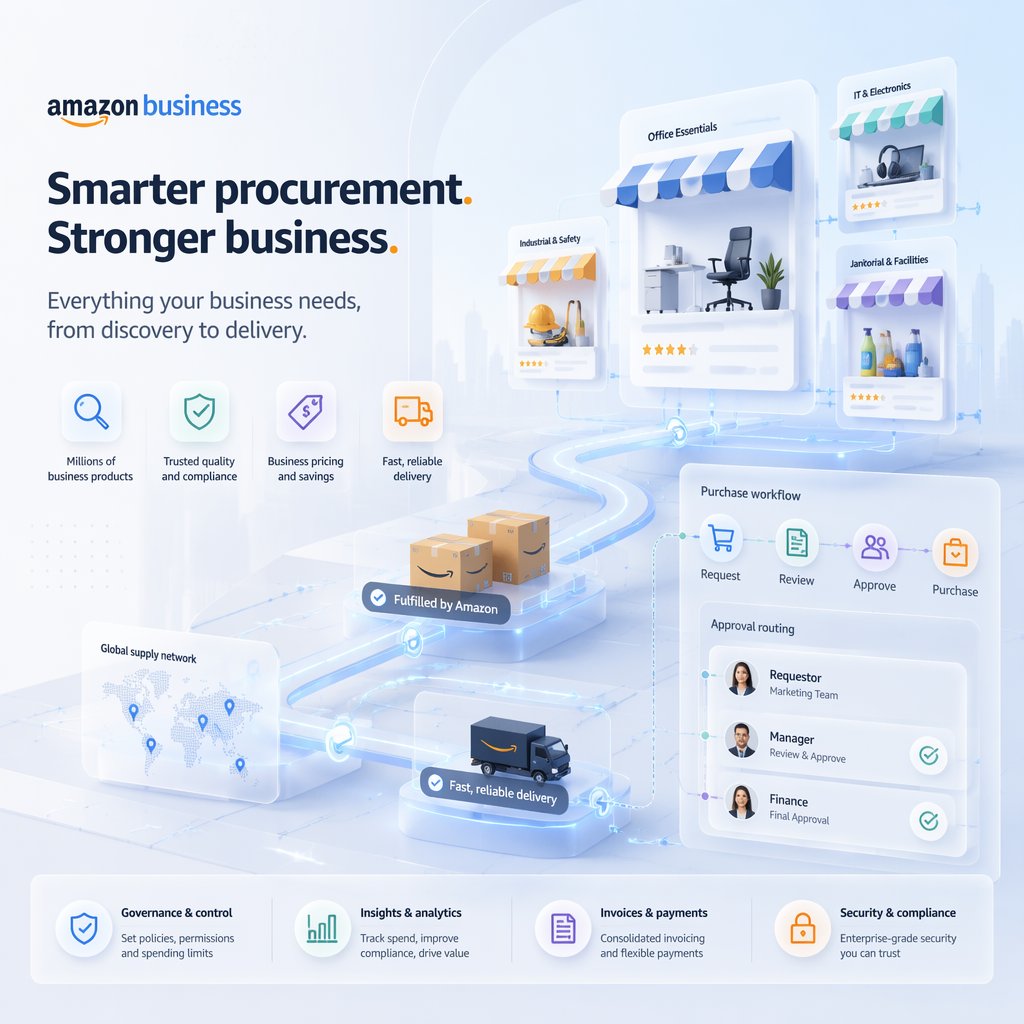
That makes sense when you think about what Amazon is actually selling here. B2B commerce isn’t just consumer commerce with larger carts. It needs:
Approval workflows
Purchase orders
Tax-exempt purchasing
Net payment terms
Contract pricing
Multi-user account controls
Spend visibility and controls
Amazon didn’t need to invent commerce here. It needed to digitize procurement without breaking the buying habits that already exist inside companies, schools, hospitals, and public-sector organizations.
The big story isn’t just that Amazon Business is large. It’s that Amazon has spent years building a procurement layer on top of its marketplace, and that layer is finally starting to compound at scale.
Technical Deep Dive
Amazon Business works because it reuses the same marketplace rails that power consumer commerce, but layers in B2B-specific logic on top. That’s a big deal technically. Amazon didn’t build a separate stack from scratch. It extended existing infrastructure for catalog, pricing, fulfillment, and identity, then added procurement features around it.
At the buyer level, the experience is where most of the recent product work has gone. Amazon says it has introduced:
An assistant for account questions
Savings Insights for spend analysis and bulk discount opportunities
Spend Anomaly Monitoring to flag unusual purchases
Dedicated delivery trucks in 13 states for docks and mailrooms
Expanded Prime Business bundles with services like CrowdStrike, Gusto, and QuickBooks
That tells you a lot about Amazon’s strategy. It’s not trying to out-market a procurement suite like Coupa or Ariba on day one. It’s trying to make buying inside Amazon feel operationally safer and easier for business users.
From a systems perspective, these features depend on several layers:
1. Identity and role-based access
Amazon Business accounts usually support multiple buyers under one organization, with different permissions. That means Amazon has to maintain:
User-level access control
Organization-level billing rules
Approval chains
Buyer and administrator separation
This is a different model from standard consumer accounts, where one login usually equals one buyer. For enterprise procurement, role separation matters. A staff member can browse and create a cart, but not always place the final order.
2.
Business pricing and catalog segmentation
Sellers enrolled in Amazon Business can set:
Business-only pricing
Quantity discounts
Business-only offers
Responses to custom quote requests
These are not flashy features, but they’re very effective. They let sellers present the same SKU differently depending on the buyer type and order size. That’s useful for everything from office supplies to industrial consumables.
The catalog logic needs to handle price visibility correctly. Business customers often see pricing that consumer shoppers never do. That requires more than a UI toggle. It’s a rules engine tied to buyer verification, offer eligibility, and quantity thresholds.
3.
Spend analytics and anomaly detection
Tools like Savings Insights and Spend Anomaly Monitoring imply a more data-heavy back end. Amazon needs to analyze purchase history at the account level, identify procurement patterns, and flag deviations.
That probably includes:
SKU-level frequency analysis
Baseline spend comparisons
Threshold-based alerts
Category grouping for recurring purchases
Multi-user purchase behavior across an organization
This kind of analytics layer is what moves Amazon Business from “a place to buy things” to “a system someone’s finance team can monitor.”
4.
Fulfillment and delivery mechanics
The dedicated delivery trucks Amazon mentions are more than a logistics footnote. B2B delivery often looks different from consumer last-mile delivery. Loading docks, office buildings, mailrooms, and restricted-access sites all introduce friction.
Amazon’s logistics network already has scale, but business delivery needs more predictable handling at the destination. That can mean better route planning, more accurate delivery windows, and fewer failed drop-offs. In practice, that improves reliability for high-frequency buyers.
Industry Impact
This growth matters because Amazon Business is starting to pull demand from a buyer segment that behaves differently from consumers. Businesses order in larger baskets, repeat the same SKUs, and often care more about consistency than discovery.
For sellers, that’s attractive. Amazon estimates more than half of Amazon Business sales come from third-party sellers, and Marketplace Pulse suggests roughly $30 billion of the business may flow to sellers if the split holds. That’s a meaningful sales stream, especially when you compare it to the margin pressure sellers already face from ads and fees.
A few implications stand out:
Higher average order values can improve efficiency even if margins stay tight.
Quantity-based selling works better than pure one-unit retail.
Repeat purchasing can lower the need for constant ad spend.
Business buyers often have more predictable replenishment cycles.
For Vendor Central partners, the picture is mixed. Amazon Business can support broader wholesale volume, but it also raises the bar on availability, compliance, and price stability. Vendors selling into Amazon’s retail supply chain need cleaner forecasting and tighter fill rates, because business customers are less tolerant of stockouts on routine items.
For the marketplace overall, Amazon Business also changes how we should think about competition. It’s not trying to win every B2B category through giant enterprise contracts. Instead, it’s inserting itself into everyday procurement, one recurring order at a time. That’s much harder for rivals to dislodge once the habits form.
There’s also a structural market point here. Amazon’s consumer business may get most of the attention, but B2B is a bigger market in absolute terms. Procurement has long been fragmented, manual, and full of friction. Amazon’s advantage is that it already owns the catalog, the payment rails, the fulfillment network, and the buyer habit loop.
Implementation Considerations
If you sell on Amazon, this is where the opportunity gets practical.
For sellers in Seller Central
If your products fit office, maintenance, healthcare, education, industrial, or institutional use cases, Amazon Business deserves a closer look. You don’t need a separate catalog. You need to configure the catalog you already have more intelligently.
Focus on:
Business pricing for verified buyers
Tiered quantity discounts
Pack sizes that make sense for replenishment
Parent-child structures that support bulk order variations
Clear product data so buyers can compare specs fast
Inventory stability, because business buyers hate churn
If you’re running ads, don’t assume the business sale always comes through a sponsored click. Many of these customers buy from repeat lists and internal procurement routines. Visibility still matters, but the conversion mechanics differ from consumer impulse buying.
For Vendor Central teams
Vendors should watch how Amazon Business affects replenishment and assortment planning. Business demand can look steadier, but it also creates pressure for:
Better demand forecasting
Tighter carton and case pack alignment
Reliable lead times
Accurate tax and compliance setup
Consistent availability across SKUs with recurring usage
If your catalog includes consumables, think in terms of reorder cadence. A business customer who buys monthly can be more valuable than a one-time consumer buyer, even if the basket size seems modest at first glance.
For developers and marketplace operators
Amazon Business is also a reminder that procurement features are becoming API and workflow problems, not just storefront problems. The interesting opportunities are around:
Spend analytics integrations
ERP and accounting sync
Approval workflow automation
Reorder prediction
Contract pricing systems
Tax-exemption validation
If you build tools for Amazon sellers or business buyers, this segment is ripe for software that reduces manual admin. The more Amazon Business behaves like a procurement platform, the more room there is for operational tools around it.
Future Outlook
Amazon Business probably won’t become the flashiest part of Amazon’s story. It doesn’t need to. At 18% growth, it’s already compounding into something large enough to matter on its own terms.
The bigger signal is strategic. Amazon keeps expanding adjacent businesses on top of infrastructure it already owns. First consumer retail. Then ads. Now B2B procurement, which sits quietly inside the same ecosystem and shares the same logistics backbone.
That pattern has a few likely outcomes:
More business-only buyer tools
More integration with finance and procurement software
Better delivery handling for commercial addresses
Expanded seller tools for bulk and contract-based pricing
More pressure on rivals to modernize B2B buying flows
For Amazon, the path to
00 billion in Amazon Business sales looks less like a moonshot and more like a steady systems project. A lot of the heavy lifting is already done. The next phase is about tightening the buyer experience, reducing friction, and converting recurring procurement into a habit.
Conclusion
Amazon Business hitting $60 billion is a milestone with real strategic weight. It shows that Amazon isn’t just scaling consumer retail and ads, it’s building a serious B2B commerce layer inside the marketplace.
For sellers, the takeaway is simple. If your catalog fits repeat business purchasing, Amazon Business is worth optimizing for. For vendors, it means procurement-grade reliability matters more than ever. And for anyone watching Amazon’s next growth engines, this is one of the clearest signals that the company keeps compounding in places most shoppers never notice.
The opportunity is already there. The sellers who treat Amazon Business like a side channel may miss it. The ones who build pricing, inventory, and catalog strategy around recurring business demand could find a cleaner path to growth than they get from consumer traffic alone.