Amazon Business Prime in Spain: AI Updates for Spend Tracking and Alerts
Salevoyant Editorial · July 13, 2026
Introduction
Amazon Business is quietly tightening its grip on enterprise purchasing. On July 13, 2026, the company announced a fresh round of improvements to Business Prime in Spain, with AI now playing a bigger role in spend visibility and anomaly detection.
That sounds like a finance-team feature on the surface, but it has wider implications. When Amazon sharpens the control layer around business buying, it changes how companies order, how they monitor suppliers, and how much operating data flows through Amazon’s ecosystem.
Core Development
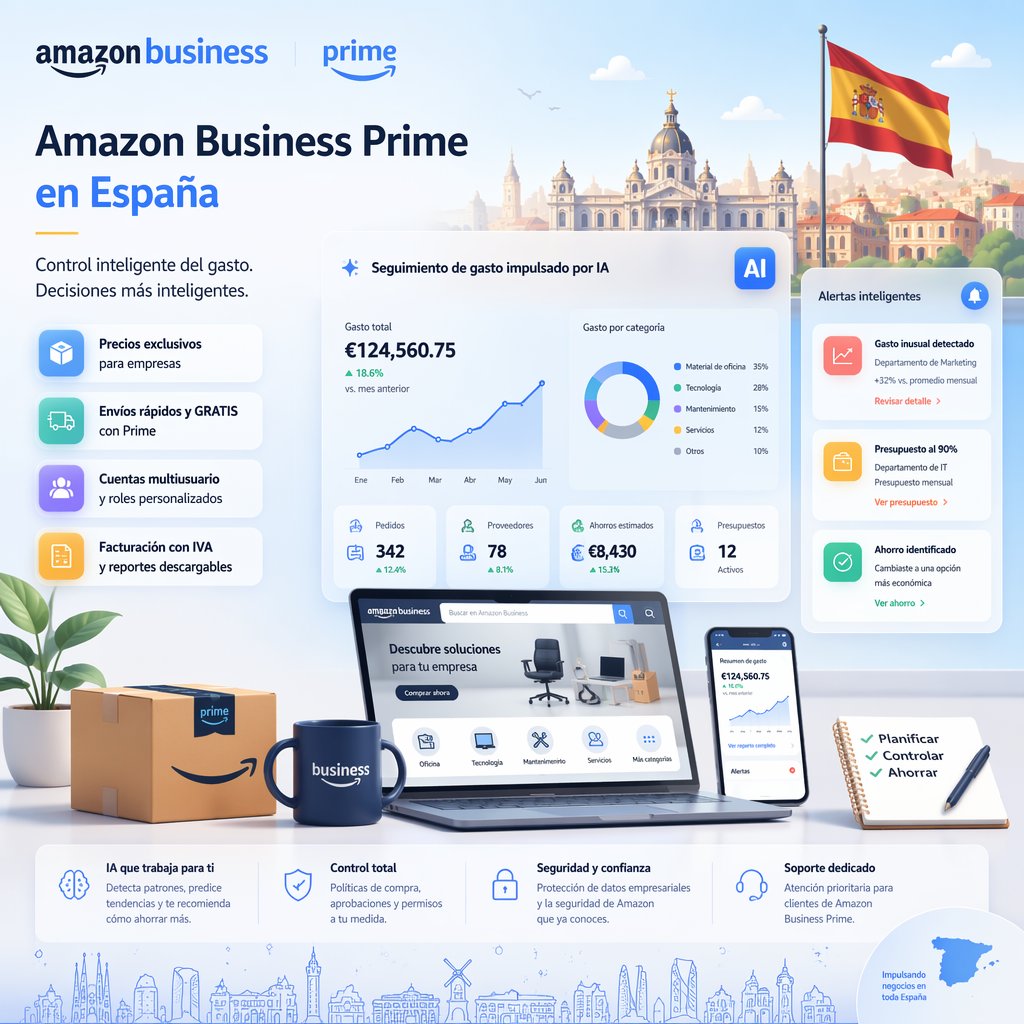
Amazon Business has upgraded two Business Prime tools in Spain: Spend Visibility and Spend Anomaly Monitoring. Both are designed for procurement, finance, and operations teams that want tighter control over corporate purchasing inside Amazon Business.
The first update, Spend Visibility, now includes:
- A cleaner, more integrated user interface
- Broader access for admins
- 24 months of historical data instead of 12
- More KPIs and richer dashboard data
- Near real-time refreshes aligned with Amazon Business Reports
The second feature, Spend Anomaly Monitoring, uses AI to flag unusual transactions in real time. It looks for patterns like:
- Suspicious category purchases
- Split orders
- Abnormal repurchases
- Non-standard shipping addresses
- Excessive daily spend
Amazon also expanded access for this tool to finance and group admin roles, and introduced weekly email summaries so the right people can act faster.
At a business level, the message is clear: Amazon doesn’t just want to be a place where companies buy things. It wants to be the operating system that watches the spend, compares it to policy, and surfaces problems before they become invoice headaches.
The company is also tying these features to broader Business Prime value. Amazon says Business Prime users saved more than $750 million in shipping costs globally in 2024, and in 2025 nearly half of orders were delivered same-day or next-day. That’s not just a logistics pitch. It’s a total cost of ownership argument.
Amazon is building a procurement stack, not just a storefront.
Technical Deep Dive
The most interesting part of this announcement is how it blends analytics, policy enforcement, and AI-driven pattern detection into one business workflow.
1.
Spend Visibility is moving from reporting to decision support
The updated Spend Visibility tool now offers two years of historical purchasing data. That matters because one year of history is useful for reporting, but two years starts to support real operational analysis.
With 24 months of data, teams can:
- Compare year-over-year spend by category
- Spot seasonal purchasing behavior
- Measure the effect of policy changes
- Analyze supplier consolidation opportunities
- Track savings trends over time
That matters for procurement teams because buying patterns in B2B are rarely flat. Office supplies spike in certain quarters. IT refresh cycles cluster around budget windows. Medical and cleaning categories can swing based on headcount and compliance changes. A 12-month chart often hides that. A 24-month window makes it visible.
The near real-time refresh also helps reduce a classic pain point: dashboard drift. If a procurement dashboard lags behind the report engine, finance teams stop trusting it. By aligning Spend Visibility with Reports, Amazon is trying to reduce reconciliation work and build confidence in the numbers.
2.
Anomaly detection is a policy engine with AI on top
Spend Anomaly Monitoring is more than a simple rules-based alert system. Amazon says it uses artificial intelligence to analyze transactions in real time and detect deviations from account behavior.
That suggests a few technical layers:
- Baseline modeling of normal account behavior
- Feature extraction from transaction data
- Pattern scoring for abnormal activity
- Alert generation when thresholds or model confidence levels are exceeded
The five monitored categories are telling. They’re exactly the sort of issues that create procurement leakage:
- Split purchases, often used to bypass approval thresholds
- Unusual category purchases, which can indicate off-policy buying
- Abnormal repurchases, which may signal duplicate orders or inventory mismatch
- Non-standard shipping addresses, which can be legitimate or suspicious
- Excessive daily spend, which can catch runaway orders fast
In practical terms, Amazon is moving toward a system that doesn’t just log what happened. It makes a judgment call about whether the purchase fits the account’s normal behavior.
That’s a big shift for enterprise commerce. Traditional procurement systems often rely on manual review after the fact. Amazon is trying to surface exceptions while they’re still actionable.
3.
Role-based access is expanding, which changes governance
The access changes are easy to overlook, but they matter. Spend Visibility used to be more limited. Now it’s open to any number of users with admin permissions. Spend Anomaly Monitoring is also available to finance and group admin roles, not just top-level administrators.
That’s a sign Amazon is adapting the tools to real organizational structures. Large customers rarely have a single procurement owner. They have finance controllers, department admins, regional approvers, and category managers. If the controls are too rigid, teams work around them.
By broadening permissions, Amazon is trying to make the tools usable inside actual enterprise operating models. That’s good for adoption, but it also means administrators need sharper internal governance. More access means more responsibility for role design, review cadence, and escalation paths.
Industry Impact
This update matters well beyond Amazon Business customers in Spain.
For enterprise procurement, it pushes Amazon further into the territory once dominated by classic e-procurement systems. The company is increasingly offering a package that includes:
- Catalog access
- Role-based approvals
- Spend analytics
- Policy monitoring
- Shipping optimization
- Tax and billing controls
That combination is sticky. Once a company builds reporting, approvals, and compliance around Amazon Business, switching costs go up.
For vendors and suppliers, this is also a signal. Amazon is helping buyers become more data-driven and more selective. If Spend Visibility makes it easier to measure local supplier spend, category concentration, or policy compliance, procurement teams may use those dashboards to justify supplier consolidation. Vendors that can show reliability, speed, and policy fit will have an edge.
For marketplace participants, the line between consumer buying and B2B buying keeps getting thinner in terms of platform mechanics, but the control layer is getting more sophisticated. That’s a clue about Amazon’s broader strategy. It wants to own not just retail demand, but the workflows around approval, auditing, and spend control.
For Seller Central and Vendor Central observers, the lesson is broader than Business Prime itself. Amazon keeps investing in tools that reduce friction on the buyer side while increasing data visibility on the platform side. That usually means better demand capture for Amazon and more dependence from the customer.
Implementation Considerations
If you work with Amazon Business, Seller Central, Vendor Central, or adjacent procurement systems, there are a few practical takeaways.
For sellers serving Amazon Business customers
- Expect buyers to be more sensitive to policy alignment and repeatability
- Product pages, pricing structures, and shipping promises matter even more in B2B contexts
- Large buyers may use spend data to assess which SKUs and categories get standardized
- Faster delivery and stable fulfillment become part of the procurement argument, not just a customer service perk
If your catalog supports business buying, make sure listings are clean, tax settings are correct, and pack sizes make sense for corporate procurement. B2B buyers don’t want to spend time fixing messy detail pages.
For Vendor Central teams
- Improved analytics on the buyer side can increase pressure on fill rates, lead times, and category performance
- Finance and procurement teams may demand better proof of value from preferred vendors
- If your items are frequently reordered, watch for how Amazon Business customers compare savings, shipping speed, and stock reliability
Vendor managers should also be ready for tougher questions about assortment rationalization. If a customer can see 24 months of spend history, they’re more likely to ask why they should keep ten similar suppliers instead of three.
For developers and systems teams
If your company integrates with Amazon Business workflows, review:
APIand reporting latency- Role and permission mapping
- Alert routing for finance and procurement owners
- Reconciliation between Amazon Business reports and internal
ERPorprocurementsystems - Exception handling for split shipments, multi-entity billing, and departmental approvals
The more Amazon automates spend detection, the more important clean internal data becomes. Bad vendor master data, duplicate user identities, and inconsistent category mappings can create false positives or hide real issues.
For finance teams
Set a review process for anomaly alerts. Weekly summaries are useful, but only if someone owns the response. Decide in advance:
- Who reviews alerts
- Which thresholds trigger escalation
- How exceptions get documented
- When to audit recurring patterns
Otherwise, the system becomes another inbox artifact nobody reads.
Future Outlook
This is probably not the end state. It looks more like a step in Amazon’s longer play to turn Business Prime into a smarter enterprise control plane.
Expect more of the following:
- Deeper integration between spend analytics and approval workflows
- Stronger AI models that learn category-specific behavior
- More automated policy enforcement
- Tighter links between procurement data and supplier performance
- Expanded reporting for regional and multi-entity accounts
Amazon has a strong incentive to go further here. Every time it helps a business save time, reduce leakage, or improve visibility, it becomes harder for competitors to displace. And in B2B, habit matters.
The bigger trend is clear too. Procurement is becoming more data-rich, more automated, and more central to cost control. Companies want systems that catch issues early, not after month-end close. Amazon is positioning itself directly in that gap.
Conclusion
Amazon’s Business Prime update in Spain is more than a product refresh. It’s a sign that Amazon Business is becoming a more serious enterprise procurement platform, with AI-assisted spend monitoring and better historical analytics at its core.
For sellers and vendors, that means customers are getting more disciplined and more data-savvy. For finance and procurement teams, it means better visibility and fewer surprises. And for Amazon’s ecosystem overall, it reinforces a simple reality: the company keeps expanding from commerce platform into business infrastructure.
If you sell to Amazon Business buyers, now’s a good time to review your catalog quality, fulfillment consistency, and pricing structure. If you manage procurement, the bigger lesson is even simpler. The tools are getting smarter, so the process around them has to get cleaner too.