Amazon Marketplace: Alexa+ Tablets and Google Play Access Explained
Salevoyant Editorial · October 12, 2026
Introduction
Amazon’s October 12, 2026, news roundup puts Alexa+ at the center of a new tablet lineup, pairs Android with full Google Play access, and expands its family-focused devices. For sellers, vendors, and developers, the significance isn’t just new hardware: it’s Amazon’s attempt to bring its services into more everyday activities without requiring customers to give up familiar Android apps.
The same roundup includes community-focused data center investments and a six-year agreement to stream the Emmy Awards, showing how Amazon is pursuing infrastructure, devices, and audience reach in parallel.
Core Development
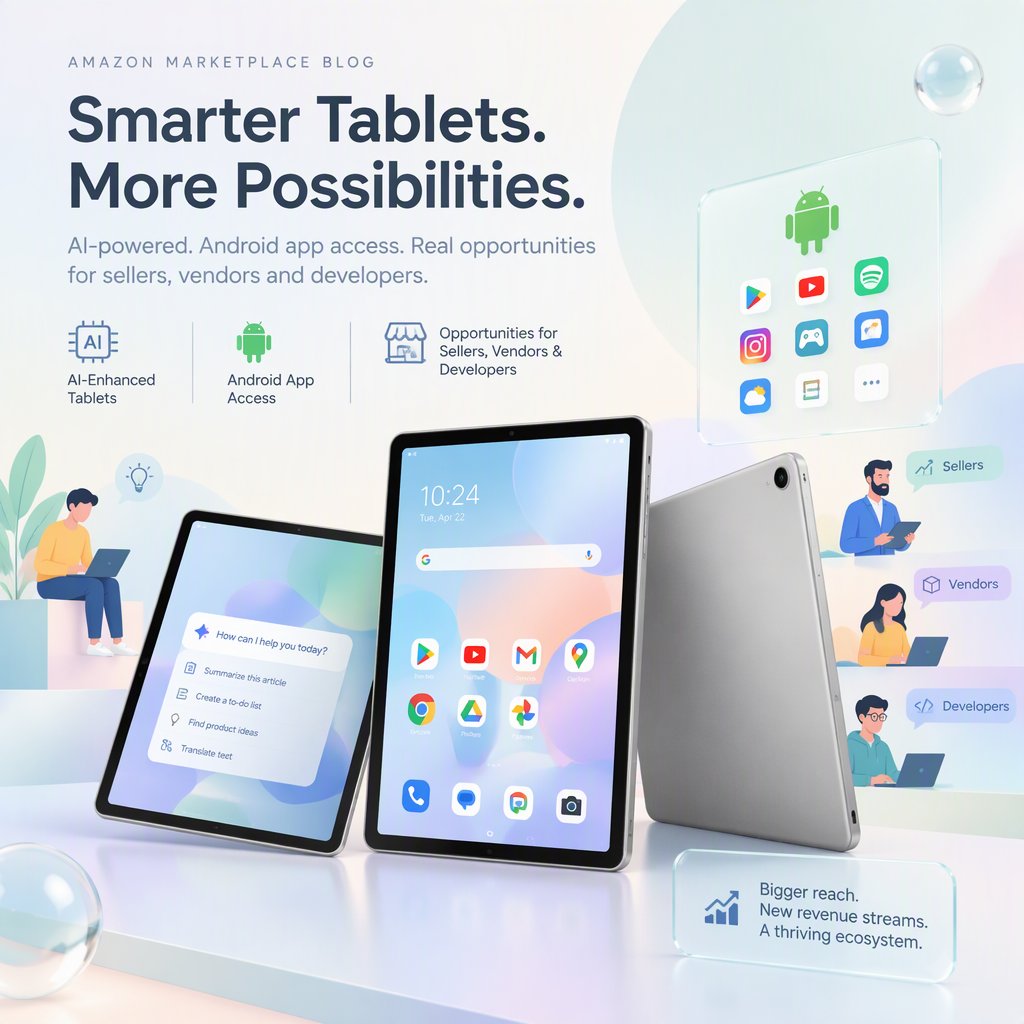
According to Amazon’s October 12 news roundup, the new Alexa Tablets come in three models: the 12 Pro, 11, and 8. The lineup starts at $229 and features aluminum construction, high-resolution displays, Android, full Google Play Store access, built-in Amazon apps, and Alexa+.
Amazon also introduces Kindle Sanctuary mode, described as a distraction-free reading experience with up to 20 hours of battery life. That figure needs context: it’s associated with the reading mode, not a promise of 20 hours of video streaming, gaming, or continuous assistant use.
A separate Kids Tablets family offers 8.7-inch and 11-inch devices, with models designed for ages 3+ and 6+. These include protective cases, one year of Kids+, parent-managed Google Play access, and a Parent Dashboard for screen time, filtering, and activity monitoring.
Two other announcements broaden the picture:
- Built Together is a new investment program for data center communities, announced alongside Amazon’s commitment to community-focused development.
- Prime Video’s Emmy Awards agreement runs for six years beginning with the 2027 ceremony. The awards will stream live and free, without a subscription, in more than 240 countries and territories.
None of these announcements establishes a new Seller Central or Vendor Central workflow. Their immediate relevance lies in potential customer behavior, accessory demand, app compatibility, and future media planning.
Technical Deep Dive
The most consequential device detail is full Google Play access.
For an app business, that offers a familiar distribution route and reduces the need to treat Amazon’s tablets as an entirely separate software market. Existing Android apps may have a shorter path to these devices, although developers still need to test compatibility rather than assume it.
Store access doesn’t guarantee identical behavior across hardware. Teams should check:
- Android version and supported
APIlevels. - Authentication, subscriptions, and in-app purchases.
- Push notifications and background processing.
- Layouts across different screen sizes and orientations.
- Accessibility, microphone permissions, and audio interruptions.
Amazon’s summary doesn’t provide processor specifications, memory configurations, software support periods, or performance benchmarks. Without those details, claims about multitasking capacity or demanding workloads would be premature.
Alexa+ creates a separate integration question. A built-in assistant could make voice a more common starting point for finding information or completing tasks. But the announcement doesn’t establish that third-party apps, marketplace listings, or seller services receive new Alexa+ integration access.
Developers should distinguish between an assistant being present on a device and an assistant offering a documented interface their software can use. Those aren’t the same thing.
A new customer interface isn’t automatically a new seller channel. Documented integrations, transaction flows, and measurable attribution have to come first.
Kindle Sanctuary mode introduces another trade-off. A distraction-free reading environment could support longer reading sessions, but publishers and app teams shouldn’t assume they can reproduce its battery performance. Display settings, connectivity, background activity, and workload all affect power consumption.
The kids’ lineup adds an authorization layer. Parent-managed access means successful installation doesn’t necessarily translate into unrestricted use. Developers need clear behavior when permissions, content, or purchasing options are unavailable, without treating parental controls as obstacles to bypass.
Industry Impact
Amazon’s approach combines broader app compatibility with built-in services. That can make its hardware more attractive to buyers who want Amazon experiences but don’t want to surrender their existing Android routines.
For marketplace sellers, the clearest near-term opportunity is device-specific accessories: cases, screen protectors, stands, sleeves, and charging products with verified compatibility. The risk is equally concrete. A case for an older tablet shouldn’t be marketed for a new model simply because both carry an “11” designation.
Dimensions, camera placement, button positions, connector clearance, and attachment mechanisms determine fit. Getting those details wrong creates returns, poor reviews, and avoidable support costs.
Vendor Central users face similar issues at a different operational scale. New-device demand can justify assortment discussions, but purchase-order volume isn’t proof of sustained consumer demand. Vendors should evaluate sell-through, inventory exposure, packaging readiness, and contribution margin before committing to a broad range.
The Emmy agreement matters more indirectly. Free global availability removes a subscription barrier to the event and could introduce more viewers to Prime Video. It doesn’t, by itself, confirm advertising inventory, sponsorship packages, or commerce integrations.
Likewise, the data center announcement points to Amazon’s infrastructure priorities, not a specific AWS capacity increase or service guarantee. Community investment may support relationships around development, but Amazon’s summary doesn’t quantify the program’s effect on construction schedules or operating capacity.
Implementation Considerations
Start with decisions that don’t depend on speculative integrations.
For sellers, verify the product before scaling the listing. Obtain physical samples or authoritative dimensions, confirm each supported model, and make compatibility explicit in titles, bullets, images, and packaging. Keep materially different products separate unless the category’s variation rules permit grouping them.
Use Seller Central’s existing operational data to test the opportunity:
- Track return reasons and customer complaints for fit problems.
- Monitor conversion and advertising performance by product.
- Compare demand with replenishment lead times.
- Review account health and listing compliance as the assortment expands.
ROI should include the cost of being wrong. An accessory generating $8 in contribution before advertising can become unattractive if customer acquisition costs reach $6 and returns absorb another $3 per order on average. Initial sales volume can hide that problem.
For Vendor Central teams, align item setup, product content, packaging, and supply commitments before a launch push. Review available retail performance reporting alongside purchase orders, and account for applicable allowances and deductions when calculating margin.
For developers, build a device test matrix rather than relying on Android compatibility alone. A reading app should test font scaling, orientation changes, offline downloads, and long sessions. A shopping app should examine checkout reliability, sign-in persistence, keyboard behavior, and payment redirects.
Measure p95 response times as well as averages. Slow tail performance can derail checkout even when a dashboard’s headline number looks healthy.
Scale backend capacity against observed adoption, not an assumed launch spike. Authentication and checkout endpoints deserve particular attention because failures there directly affect revenue.
For child-facing experiences, review applicable privacy requirements and current platform policies. Keep parent-facing and child-facing flows distinct, minimize unnecessary data collection, and make restrictions understandable.
Future Outlook
The tablet announcement suggests Amazon sees less tension between an open app ecosystem and prominent Amazon services. Google Play supplies breadth; Alexa+, Kindle, Kids+, and other built-in experiences give customers reasons to return to Amazon’s products.
The commercial question is whether that combination changes shopping behavior.
If customers increasingly ask assistants to compare products, compatibility and product attributes may become more important inputs to discovery. Clear dimensions, consistent model naming, accurate materials, and well-maintained catalog data would help support that shift.
That’s a plausible direction, not a confirmed ranking change. Amazon hasn’t established new Alexa+ seller optimization rules in this roundup.
The Emmy deal creates a different possibility: a large, free entertainment event that brings viewers into Prime Video. Sellers and advertisers should watch for concrete commercial offerings rather than budget against an assumed connection between viewing and shopping.
Conclusion
Amazon’s October 12 announcements show a company expanding how customers encounter its services, through Android tablets, family devices, entertainment, and infrastructure investment. They don’t announce new Seller Central APIs or Vendor Central operating requirements.
The practical response is to verify accessory compatibility, test apps on the actual hardware, maintain accurate catalog data, and evaluate demand through margins and returns rather than launch excitement.
Prepare for new customer behavior, but invest against confirmed capabilities. That distinction keeps a promising opportunity from becoming an expensive assumption.