Amazon Marketplace Brief: Where Amazon Stands on Oregon Data Center Rules
Salevoyant Editorial · November 20, 2026
Introduction
Amazon is making its case for how Oregon should regulate data centers ahead of the state’s 2027 legislative session. Its November 20 policy statement backs energy and water reporting and says large power users should cover the infrastructure costs they create, but it also asks lawmakers to give utilities and operators flexibility in how they meet those goals. For sellers and vendors, this isn’t a Seller Central or Vendor Central update. It’s a look at what can constrain the cloud capacity their commerce tools depend on.
Core Development
In a November 20 policy statement, AWS Vice President of Public Policy Shannon Kellogg outlines Amazon’s preferred rules for data center growth in Oregon. Amazon supports consistent, aggregated reporting on energy and water use, public input before key siting decisions, and utility agreements that protect households and small businesses from the costs of serving large new loads. It also wants faster permitting and grid connections for new carbon-free power and supports letting major customers fund the resources needed to serve them.
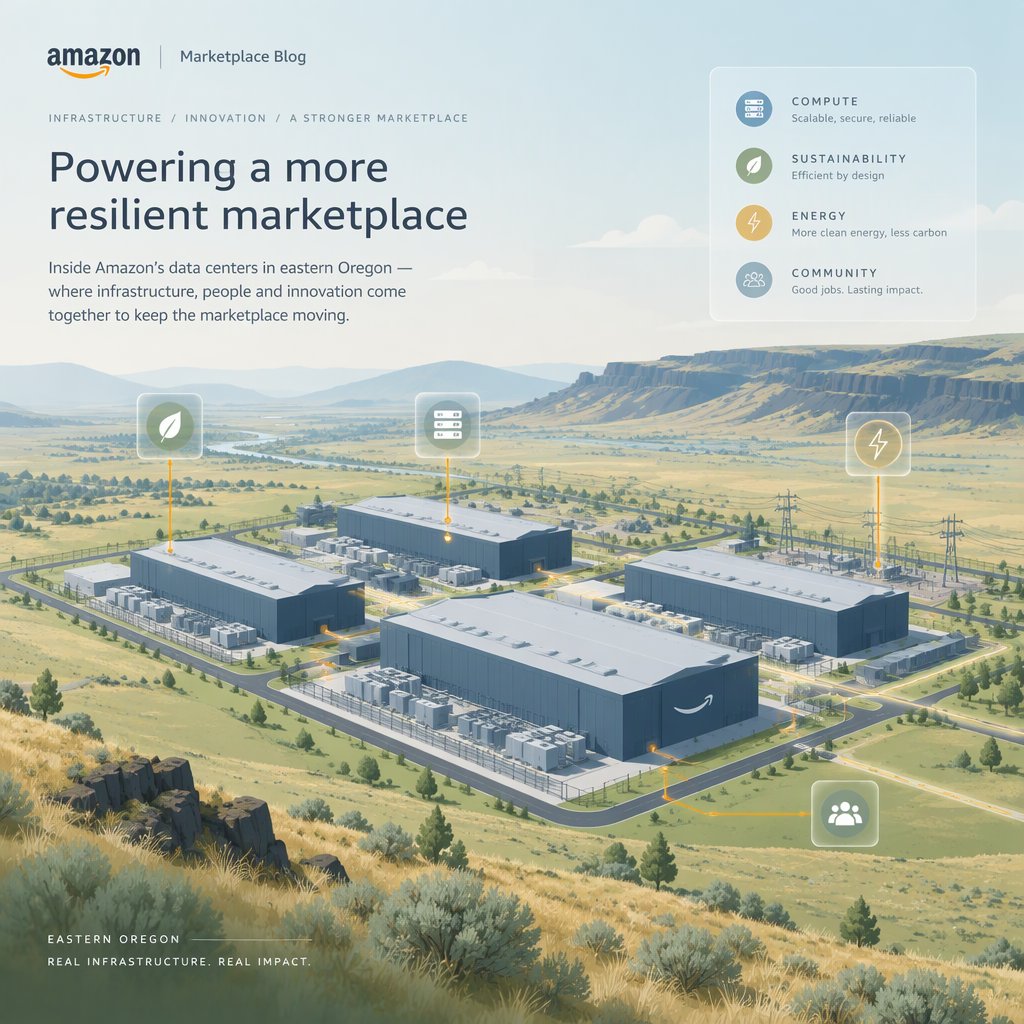
Amazon has operated data centers in Oregon for more than 15 years and says it has invested $54.8 billion in eastern Oregon data center infrastructure since 2011. That gives the company a sizable stake in how Oregon writes its rules. This is Amazon’s policy position, not a new law or a commitment to a specific AWS expansion. The distinction matters because the statement tells us what Amazon wants the state to do, not what utilities or customers will ultimately pay.
Technical Deep Dive
Power is a delivery problem, not just a purchasing problem
A data center needs electricity at its site when its servers and cooling equipment demand it. A power purchase or investment in generation doesn’t, on its own, create spare capacity on a congested transmission line or get a facility connected to the grid. That’s why Amazon’s support for a bring-your-own-energy model comes with a second ask: make it easier to permit and connect generation, storage, and transmission.
Amazon says it has invested in 1,330 megawatts of solar and wind and 1,200 megawatts of battery storage in Oregon. Those figures describe different capabilities. The storage number is a power rating in MW, not an energy rating in MWh, so it doesn’t tell you how long the batteries can discharge at that output. Nor do the figures show how much power reaches a particular campus during a peak-demand hour.
There’s also a financial risk even when the engineering works. A utility might build a substation for a projected load that arrives late or never reaches its forecast. A financial guarantee can protect against some of that exposure, while direct funding can cover specified construction costs upfront. The important detail is who pays if actual demand falls short, not just who pays for the electricity once the facility is running.
Cooling shifts costs between water and electricity
Amazon says its average data center building in eastern Oregon uses about 5.1 million gallons of cooling water annually and that its cooling systems use water less than 7% of the year. Those averages don’t tell a water provider how much demand to plan for on the hottest days. A facility can use water infrequently and still draw heavily when local supplies are under the most pressure.
Amazon argues that a blanket closed-loop mandate could cut onsite water use while increasing electricity demand in some configurations. The distinction is in how the system rejects heat. A closed loop recirculates coolant, but it can still reject heat through equipment that consumes water. A design that instead relies on dry cooling or more mechanical refrigeration can require more electricity under certain conditions. The useful comparison is peak water draw, peak electrical demand, and year-round performance, not the cooling label alone. Replenishment projects are worth tracking separately because they don’t necessarily return water to the same place at the same time it’s drawn.
Industry Impact
Marketplace analysis: Oregon’s infrastructure rules matter most directly to sellers, vendors, and software providers that run their own workloads in AWS or buy tools from companies that do. Think inventory forecasting, catalog synchronization, order ingestion, and advertising analytics. If power or grid connection timelines slow the addition of compute capacity, teams with large or time-sensitive workloads may have fewer deployment options. Amazon’s statement doesn’t establish that any such constraint exists today.
There’s a separate question about Amazon’s managed commerce platforms. Sellers can’t infer where Seller Central or Vendor Central runs from an AWS policy statement, and nothing in this announcement changes fees, API limits, or portal functionality. Moving your own integration to another AWS region also won’t fix a Selling Partner API outage or raise an API rate limit. That distinction can save engineering teams from spending money on the wrong kind of resilience.
Treat Oregon’s policy debate as a signal to review your own infrastructure dependencies, not as a reason to change how you sell on Amazon.
Implementation Considerations
- Map the systems you control. Trace an order or inventory update from the Amazon interface through your integration, queue, and ERP or warehouse system. If a marketplace endpoint throttles requests, use bounded retries with backoff and jitter. Persist checkpoints and make replay idempotent so a recovered queue doesn’t post the same order twice.
- Keep peak-season jobs from competing for capacity. Give order and inventory feeds priority over reporting backfills and forecast retraining. Track
queue_ageand end-to-end sync lag, not just CPU utilization. A server can look healthy while inventory updates sit in a backlog long enough to create oversell risk. - Test the recovery plan before buying more infrastructure. Ask integration providers how they recover from regional outages and whether they’ve tested recovery. For your own stack, compare the cost of a second region, including replication, data transfer, and testing, with the cost of stale stock counts or delayed fulfillment. A daily reporting job may only need a reliable replay procedure. An order feed with a tight warehouse cutoff may justify a faster recovery target.
Future Outlook
The first thing to watch in Oregon’s 2027 session is how lawmakers translate broad principles into enforceable terms. Aggregated reporting can protect sensitive facility details, but its usefulness will depend on whether it shows enough about seasonal demand and local resource pressure. Ratepayer protections will depend on what utilities can recover if a project shrinks or stalls. And faster generation permits won’t help a project on schedule if interconnection or transmission work remains the bottleneck.
For AWS customers, those details are more informative than investment totals alone. They’ll help show whether Oregon can turn proposed energy projects into deliverable power and whether data center operators bear the financial risk of building ahead of demand. They won’t, by themselves, tell sellers what cloud services will cost or where Amazon will add capacity.
Conclusion
Amazon wants Oregon to require more disclosure and hold large electricity users accountable for their costs, while leaving room for utilities and operators to choose how they meet those requirements. For marketplace businesses, the immediate action is simpler: identify which commerce workflows can tolerate delays, test how you replay failed updates, and spend on redundancy where downtime has a measurable cost. Watch the Oregon debate for what it says about future cloud capacity, not for changes to Seller Central or Vendor Central.