Amazon Marketplace: Csquare Short-Seller Claims and Seller Risk Explained
Salevoyant Editorial · October 25, 2026
Introduction
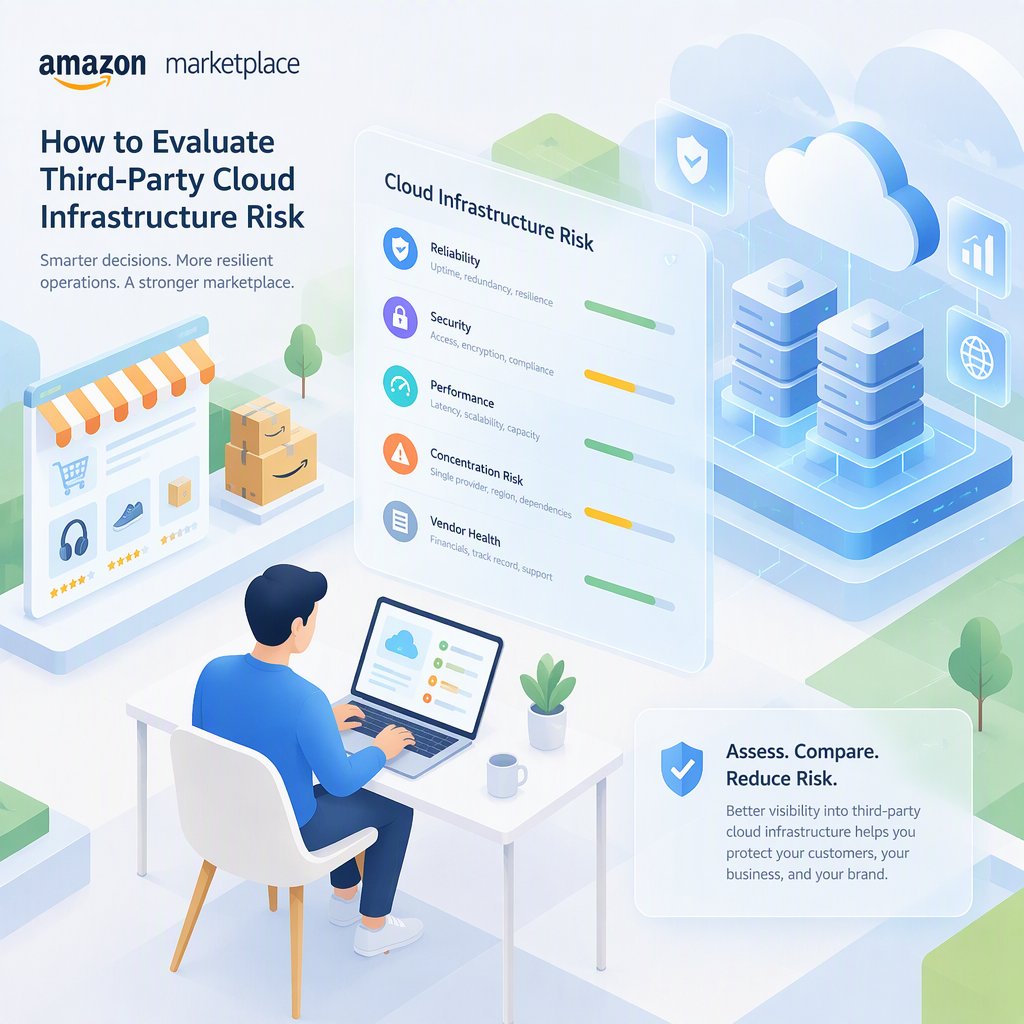
A short seller’s attack on a data center company isn’t a Seller Central update, but it raises a question worth asking: how exposed is your Amazon business to infrastructure providers you rarely think about? Data Center Dynamics reports that a short seller is betting against Csquare and claims the company’s shares are worthless. For marketplace operators, the useful response isn’t to speculate about the stock. It’s to examine the dependencies behind inventory synchronization, order processing, and vendor integrations.
Core Development
The available source is summary-only. The Data Center Dynamics headline, distributed through Google News, says a short seller has taken a position against Csquare and argues that its shares have no value.
The supplied material doesn’t identify the short seller, explain the valuation argument, provide Csquare’s response, or establish operational problems. It also doesn’t document any relationship between Csquare and Amazon, AWS, or marketplace software providers.
That distinction matters. A claim about equity value isn’t evidence of a service outage. Short sellers have a financial interest in falling share prices, although that interest alone neither proves nor disproves their allegations.
For Amazon professionals, the connection is therefore analytical rather than reported: financial uncertainty around an infrastructure supplier can prompt a review of business continuity. It doesn’t justify claiming that Seller Central, Vendor Central, or AWS faces disruption.
Treat the headline as a reason to ask better supplier questions, not as proof that your Amazon operations are at risk.
Technical Deep Dive
An Amazon integration typically spans more than Amazon’s own systems. A seller might connect an inventory platform to Amazon’s Selling Partner API, or SP-API, through an application hosted by a software vendor. That application may depend on a database, message queue, hosting provider, and external monitoring service.
Each dependency introduces a different failure mode.
Availability isn’t the same as transaction completion
A working Seller Central dashboard doesn’t guarantee that a third-party application is processing orders correctly. The application could lose database access while Amazon remains available. Conversely, an API request can fail because of authentication, throttling, or malformed data without any data center problem.
Monitoring should separate:
- Connectivity: Can the application reach the service?
- Authorization: Are credentials and permissions valid?
- Acceptance: Did Amazon accept the request?
- Completion: Did the intended update finish processing?
- Freshness: How old is the latest successful inventory or order synchronization?
That last measure often tells an operator more than a green uptime indicator.
Retries need business safeguards
Consider a hypothetical merchant whose inventory connector pauses for 30 minutes. When connectivity returns, the application has a backlog of stock updates.
Blindly replaying every update can create problems. An older quantity might overwrite a newer one if the connector doesn’t preserve ordering or reconcile against current inventory. Repeated order-processing actions can also produce duplicate downstream work.
Developers should use idempotency, where supported, and maintain their own transaction records when it isn’t. An idempotent operation produces the same intended result when repeated, rather than creating another shipment or duplicate record.
Retry logic also needs bounded exponential backoff, jitter, and respect for applicable API usage limits. More retries don’t automatically mean faster recovery. They can prolong congestion.
Redundancy must cover the whole path
Running two application instances won’t help if both depend on the same unavailable database. Likewise, separate hosting locations may still share a network provider or control system.
Effective resilience requires mapping shared dependencies. For AWS-hosted applications, distributing components across Availability Zones can reduce exposure to some localized failures, provided the database, queues, and routing support that design. It doesn’t guarantee uninterrupted operation, and it doesn’t fix errors in application logic.
None of these mechanisms is documented in the Csquare summary. They’re general engineering considerations for marketplace systems.
Industry Impact
Amazon sellers increasingly manage their businesses through connected software: repricers, warehouse systems, advertising tools, accounting applications, and catalog services. That creates a practical tension. Automation reduces manual work, but it also concentrates operational responsibility in suppliers whose infrastructure customers may not understand.
For merchant-fulfilled sellers, a broken integration can delay order retrieval or leave inventory quantities stale. FBA sellers have a different exposure: Amazon handles fulfillment, but external software failures can still interfere with replenishment planning, pricing, and reporting.
Vendor Central users face their own dependency questions. Where vendors use EDI or API-based workflows, they need to understand how their systems handle purchase orders, acknowledgments, and shipment information during an interruption. Exact requirements depend on the integration and commercial arrangement.
The broader marketplace implication is trust. Customers don’t care whether a cancellation starts with a hosting failure, a warehouse mismatch, or a connector bug. They experience an unavailable product or a late shipment.
From a strategy perspective, this helps explain the importance of dependable interfaces and clear processing states across Amazon’s ecosystem. Third-party applications extend Amazon’s operational reach, but their reliability isn’t identical to Amazon’s own service availability.
The supplied report announces no change to that ecosystem.
Implementation Considerations
Start with a dependency review, not an emergency migration.
Ask providers specific questions
A useful supplier questionnaire should establish:
- Where production applications and customer data are hosted.
- Which components share a single failure domain.
- How queued transactions survive an interruption.
- Whether backups are tested through actual restoration.
- How customers receive incident notifications.
- Whether transaction history and configuration can be exported.
If a provider reports financial concerns, ask about continuity arrangements and support capacity. Don’t infer insolvency from a short-seller headline.
Set recovery targets around business loss
Two useful measures are recovery time objective, or RTO, and recovery point objective, or RPO.
RTO defines the target time to restore a service. RPO defines the acceptable amount of lost data, measured in time. A daily reporting dashboard and an order-routing service rarely deserve identical targets.
For example, a hypothetical seller processing 120 orders per hour accumulates 60 orders during a 30-minute interruption. That isn’t necessarily lost revenue. The impact depends on dispatch deadlines, backlog processing speed, and whether orders remain safely retrievable.
This is where resilience spending needs an ROI test. Compare the cost of standby infrastructure, restoration testing, and engineering time with plausible losses from cancellations, manual recovery, and missed operational deadlines.
Test recovery without risking live transactions
Use controlled exercises to confirm that:
- Pending work remains recoverable after a worker restarts.
- Duplicate events don’t create duplicate business actions.
- Inventory updates resume in the correct sequence.
- Alerts detect stalled processing, not just unavailable servers.
- Staff know when to pause automation and reconcile manually.
Any fallback workflow should use authorized access and preserve an audit trail. Scraping dashboards or sharing credentials isn’t a sound continuity plan.
Future Outlook
The Csquare headline alone doesn’t establish a wider data center problem. Assessing the company requires the underlying short report, financial disclosures, operational evidence, and its response.
For marketplace businesses, the longer-term issue is clearer: as automation expands, supplier transparency becomes part of operational risk management. Buyers should expect software providers to explain recovery capabilities, data portability, and shared infrastructure dependencies.
More redundancy isn’t always the best answer. A smaller seller may gain more from tested backups and a documented manual procedure than from an expensive multi-region deployment. A high-volume operator may justify automated failover, but only if it regularly tests transaction consistency.
The right design follows the business consequence of failure.
Conclusion
The reported short-seller claim against Csquare is an allegation about valuation, not a confirmed warning about Amazon infrastructure. There’s no documented Amazon connection in the supplied summary.
Still, it offers a useful prompt: identify who hosts your marketplace tools, measure transaction freshness, and test how operations recover. Sellers and vendors don’t need to react to every infrastructure headline. They need enough visibility to know which headlines actually affect them.