Amazon Marketplace: Google Play Comes to Kids Tablets in Japan
Salevoyant Editorial · October 8, 2026
Introduction
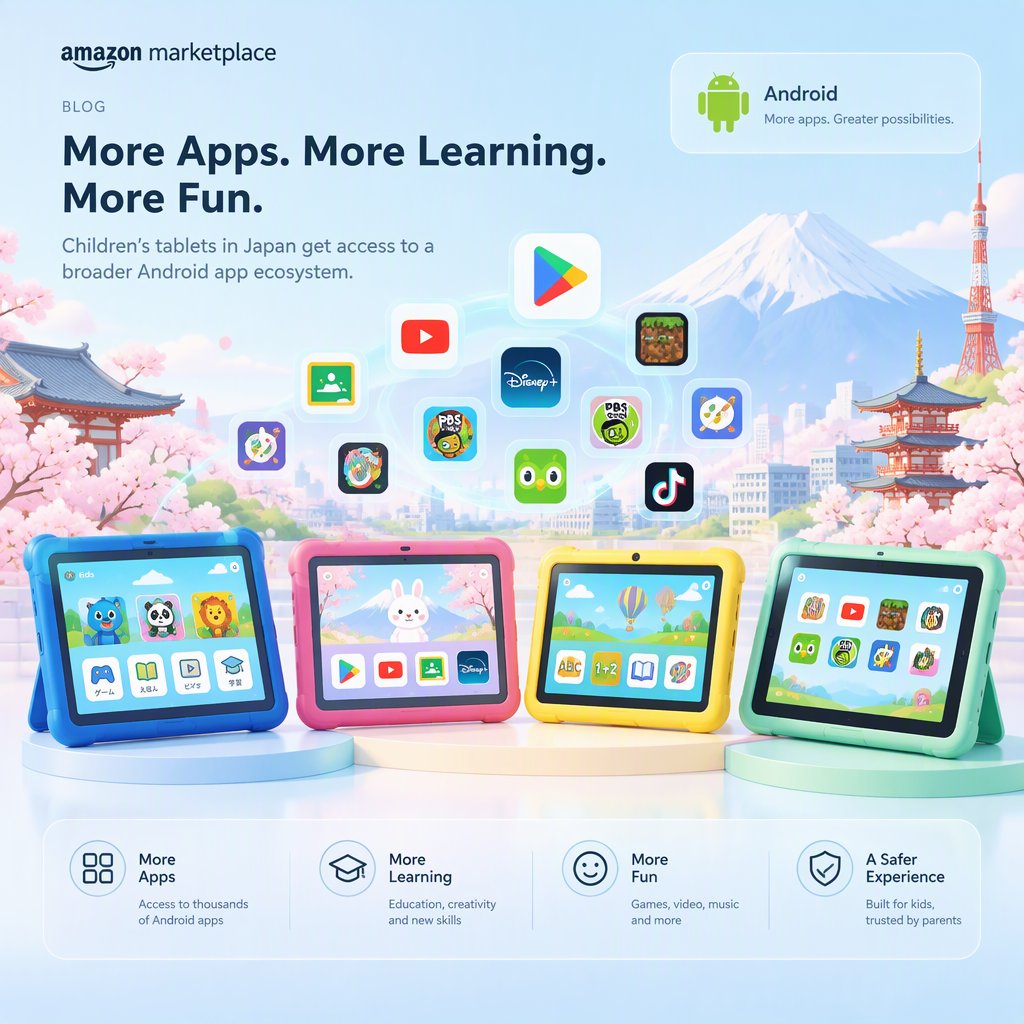
Amazon’s new kids tablets bring Google Play support to its tablet lineup for the first time, according to the company’s October 8, 2026, announcement in Japan. Preorders open today on Amazon.co.jp, with shipments scheduled to begin October 14. For sellers, app developers, and content publishers, the significance goes beyond another hardware launch: Amazon is pairing its family-focused services with access to Google’s app distribution ecosystem.
Core Development
The new Amazon Kids Tablet series runs Android and supports the Google Play Store. Amazon’s established Fire tablet approach uses Fire OS, an Android-derived operating system, with apps distributed through Amazon’s own store rather than officially supported Google Play access.
That distinction matters. Parents can now choose from Amazon Kids+ content and approve apps available through Google Play, reducing a familiar purchasing concern: whether a child’s preferred learning app or game will work on an Amazon tablet.
The Japan announcement outlines:
- Two age groups: models intended for children ages 3 and older, and ages 6 and older.
- Two screen sizes: 8.7 inches and 11 inches for each age group.
- Included services and accessories: one year of Amazon Kids+, a protective case, and parental controls.
- Character designs: a Paw Patrol cover for younger children and a Japan-exclusive Chiikawa edition for the older group.
- Portrait support: covers for the older group support vertical placement, a first for Amazon’s kids tablets.
Amazon also says it’s adding more than 200 Chiikawa video and book titles to Kids+, alongside other educational and entertainment content.
After the included year, Kids+ automatically renews into a paid subscription. The announced monthly rates in Japan are JPY 780 for Prime members and JPY 980 for nonmembers.
One qualification deserves attention: Google Play’s advertised catalog of more than two million apps represents the store’s total inventory. It doesn’t mean every app is available within a child’s profile.
Technical Deep Dive
The technical shift is official Google Play support, not simply the presence of Android underneath the interface.
For developers, distribution through Google Play can reduce the need for a separate Amazon-specific release path to reach these particular devices. It doesn’t eliminate device testing, though. A successful installation says little about tablet layouts, child-account restrictions, subscription flows, or sustained performance.
Amazon hasn’t specified the Android version, processor, RAM, storage, or detailed compatibility characteristics in the supplied announcement. That limits what engineers can conclude about demanding games, offline downloads, and multitasking.
Parental controls need careful testing
Amazon describes controls for approving apps and a Parent Dashboard for reviewing usage, setting time limits, managing learning time, and configuring individual child profiles. Its footnotes also say Google Play requires a Google account and that parents can individually approve and manage apps through Google Family Link.
The announcement doesn’t explain exactly how these two control systems interact.
That’s an important implementation question. Families may encounter separate controls for app installation, content access, screen time, and purchases. Developers should test what happens when an app is installed but unavailable to a child, when authentication requires parental involvement, or when a permitted app opens an external link.
Google Play support expands app choice. It doesn’t remove the need to validate the complete child-and-parent experience.
Tablet compatibility is more than screen size
The 8.7-inch and 11-inch models introduce different layout needs. Developers should test responsive interfaces, orientation changes, touch-target sizes, and readable text rather than scaling a phone interface.
Portrait-capable covers make vertical reading and educational apps particularly relevant. An app that assumes landscape orientation may work technically but feel awkward during everyday use.
Where an app depends on Google Play services, purchases through Google Play, or account-based synchronization, those functions need testing on the actual hardware and child-account configuration. The announcement doesn’t establish how every dependency behaves under parental restrictions.
Performance remains an open question. Teams should measure startup time, memory consumption, download size, and offline behavior before making device-specific claims.
Industry Impact
Amazon appears to be separating two sources of value: access to apps and management of a family-oriented device experience.
Official Google Play access makes the hardware more flexible. Kids+, protective covers, character licensing, and parental controls still give Amazon ways to distinguish the package. The commercial logic is straightforward: fewer app-availability objections could help sell devices, while the included subscription gives families a year to establish a Kids+ habit.
There’s a trade-off. A broader app catalog also brings more competition for children’s attention. Kids+ must compete on curation, convenience, and content quality rather than relying on limited alternatives.
For marketplace participants, the effects vary:
- Accessory sellers have potential opportunities around compatible screen protectors, travel accessories, and other complementary products.
- Publishers and licensing partners gain another route to reach families through a combination of hardware, subscriptions, and recognizable characters.
- App developers can evaluate these devices through their Google Play distribution strategy, subject to testing and eligibility.
- Vendor Central suppliers should assess whether launch-related demand justifies new inventory or changes to existing assortments.
This isn’t a Seller Central or Vendor Central policy update. Amazon hasn’t announced changes to fees, listing rules, advertising tools, or vendor terms here. The relevance is category demand and product positioning, not a new account-management requirement.
The Japan-only Chiikawa cover also shows why regional merchandising matters. A locally relevant character can help distinguish hardware that might otherwise compete mainly on price and specifications.
Implementation Considerations
Start with compatibility, not forecasts.
For sellers, the new 8.7-inch and 11-inch sizes create a risk of confusion with existing Fire tablet accessories. Matching a diagonal measurement doesn’t establish case compatibility. Camera placement, ports, buttons, chassis dimensions, and mounting points all matter.
Before publishing or revising listings:
- Verify fit against the exact model and physical dimensions.
- Use clear model names in titles, bullets, and compatibility images.
- Avoid suggesting older Fire accessories fit without testing.
- Check variation structures so shoppers can identify the correct size.
- Use licensed character artwork only when you have authorization.
Because protective cases are included, replacement-case demand may be less attractive than it initially appears. Sellers should evaluate complementary accessories and differentiated use cases rather than assume every tablet purchase creates another case sale.
Developers need a similarly disciplined checklist: installation approval, first launch, sign-in, purchase handling, parental restrictions, portrait layout, and offline recovery. Child-directed apps should also review applicable Google Play policies and children’s privacy requirements. Availability through a store doesn’t replace those obligations.
For vendors and sellers, ROI calculations should account for the full cost of serving the category:
- Testing and sample purchases
- Advertising and launch-period competition
- Returns caused by compatibility mistakes
- Character-licensing costs, where applicable
- Inventory exposure across screen sizes and designs
Seller Central reports can help sellers track conversion and returns where available. Vendors can use their available retail reporting to compare sell-through with inventory commitments. Keep forecasts conservative until actual demand and product specifications are clearer.
Future Outlook
This launch suggests Amazon is willing to offer a more open app experience when it supports the hardware proposition. It doesn’t establish that the company is moving its entire tablet portfolio to Google Play.
The confirmed scope is a kids tablet series announced in Japan. There’s no stated timetable for other markets or a broader Fire tablet transition.
Three developments are worth watching: how clearly Amazon explains the relationship between its controls and Family Link, how reliably popular apps work in child profiles, and whether Kids+ retains subscribers after the included year.
That last measure matters commercially. A device sale creates immediate revenue, but subscription retention depends on whether families keep finding value once paid renewal begins. Google Play access may improve the purchase proposition while making retention more demanding.
For developers, broader app availability also raises expectations. Families are less likely to accept missing features or awkward tablet layouts when competing apps are only an approval away.
Conclusion
Amazon’s new kids tablets combine official Google Play access with the company’s existing family subscription and parental-control offering. It’s a meaningful distribution change, but not evidence of a marketplace policy shift or a worldwide tablet overhaul.
Sellers should verify accessory fit before committing inventory. Developers should test child-account workflows and tablet performance, not just installation. Vendors and publishers should examine the opportunity through regional demand, content appeal, and subscription economics.
The practical takeaway is simple: more app choice strengthens the hardware pitch, but compatibility and family usability will determine its lasting value.