Amazon Marketplace India Grocery Growth: What Sellers Need to Know
Salevoyant Editorial · August 18, 2026
Introduction
India’s online grocery market is changing, but not in the way many people assumed. The latest analysis from Redseer and Amazon’s own expansion plans suggest the next wave isn’t just about shaving delivery time down to minutes, it’s about reaching millions of value-focused shoppers outside the metros.
That matters for Amazon sellers, vendors, and marketplace operators because the fight is no longer only about speed. It’s about assortment, local relevance, fulfilment density, and whether the platform can serve different consumer segments without breaking unit economics.
Core Development
The big story here is that India’s grocery opportunity is splitting into two very different models.
In metro cities, quick commerce has trained shoppers to expect near-instant delivery, often within 10 to 20 minutes. That model works because of dense demand, high order frequency, and a customer base that’s willing to pay for convenience. According to the reporting, quick commerce already draws about 75% of its contribution from metros and grew more than 120% year over year in the last financial year.
Outside the metros, though, the picture is different. Tier-2, Tier-3, and smaller towns are still dominated by kirana stores, and consumers there care more about price, pack size, trusted brands, and discounts than ultra-fast fulfillment. Redseer argues that this segment, often called Bharat, is where the next online grocery growth may come from.
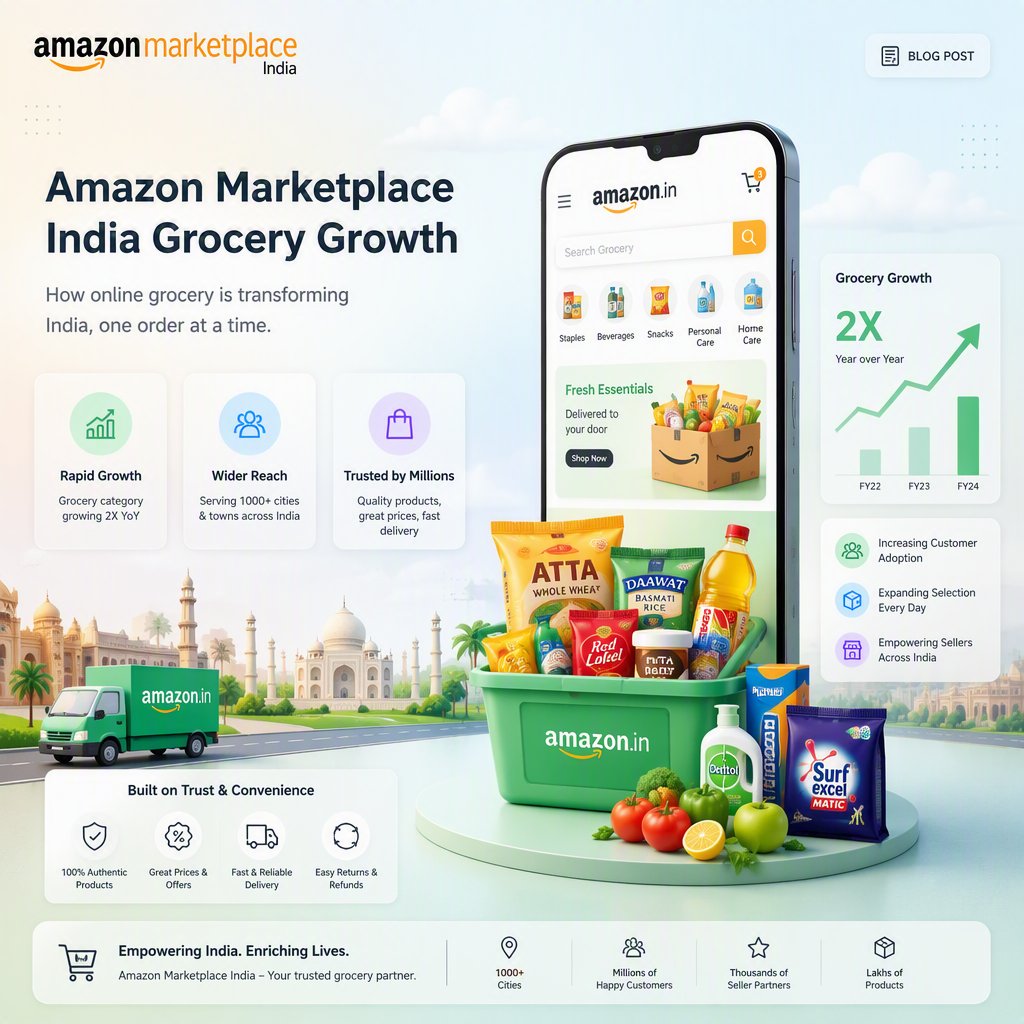
Amazon is clearly betting on both sides of this split. The company says Amazon Now already reaches more than 50 million customers across over 15 metro and non-metro cities, including Bengaluru, Delhi-NCR, Mumbai, Pune, Jaipur, Lucknow, and Kochi. It also plans to expand to more than 300 cities and scale its micro-fulfilment network to 1,000+ locations.
That’s not a small experiment. It’s a structural bet on a broader commerce model.
The real shift isn’t “online grocery vs offline grocery.” It’s “speed-led convenience vs value-led basket expansion.”
Amazon is also widening the scope beyond groceries. The company says it plans to launch over 100 Urban Fulfilment Centres to support minute-level delivery for categories like apparel, electronics, home and kitchen, and baby products. That’s important because grocery alone rarely carries the margins needed to support a dense quick-delivery network.
Technical Deep Dive
Quick commerce and value commerce sound similar on the surface, but the operating models are very different.
A quick commerce system depends on a highly distributed fulfilment architecture:
- Dark stores or micro-fulfilment centres placed close to dense demand clusters
- Rider fleets that can maintain short delivery windows
- Inventory localization to keep the most demanded SKUs on hand
- Order orchestration software that balances pick speed, dispatch timing, and route efficiency
- Demand prediction models that forecast very short-cycle buying patterns
This is a hard systems problem. The math only works when order density is high enough to keep inventory moving and delivery assets busy. If you spread the same model across lower-density towns without changing the operating assumptions, costs rise fast.
That’s why Redseer’s warning matters. Tier-2 and Tier-3 cities have smaller baskets, more dispersed households, and lower willingness to pay for speed. If a micro-fulfilment node doesn’t process enough orders per hour, inventory turns slip, picking labor becomes inefficient, and last-mile costs eat into margin.
Amazon’s expansion into 300 cities suggests it’s trying to solve this with network design rather than simply replicating the metro playbook. In practice, that means:
- Smaller node footprints
- More careful SKU selection
- Tighter assortment planning
- Better placement of fulfilment assets near demand pockets
- Shared inventory pools across categories to improve asset utilization
The Amazon Now model also hints at a broader architectural decision: converging quick commerce and marketplace fulfillment. If a fulfillment node can serve grocery, household goods, electronics accessories, baby essentials, and apparel basics, then the same infrastructure can carry more margin-bearing categories. That helps spread fixed costs across a wider basket.
For sellers and vendors, this has technical implications too. Amazon will need to refine catalog normalization, replenishment forecasting, and safety stock policies for fast-moving SKUs. Expect greater pressure on:
- Real-time inventory accuracy
- Low-latency OMS integration
- Stricter inbound compliance
- Faster replenishment cycles
- Assortment pruning based on velocity
A node network like this can’t tolerate sloppy catalog data. If weights, dimensions, pack sizes, or hazard attributes are off, fulfillment gets messy quickly. The more categories Amazon adds to instant delivery, the more important clean product data becomes.
Industry Impact
For the Amazon ecosystem, this is bigger than a grocery headline.
First, it changes how sellers think about category strategy. Brands that used to focus on search ranking and standard FBA availability now have to consider whether they’re relevant for hyperlocal demand nodes. Products with high repeat purchase rates, small form factors, and broad household appeal are best positioned for quick delivery. Think staples, personal care, snacks, phone chargers, batteries, and small home essentials.
Second, it shifts the economics of vendor planning. Vendor Central teams have historically optimized around forecast accuracy, fill rates, and retail readiness. In a quick commerce context, those KPIs become more time-sensitive. A stockout in a metro micro-fulfilment hub can cost Amazon immediate sales, and the replacement cycle is much shorter than in traditional retail.
Third, this expansion intensifies competition with kiranas and local distributors in smaller cities. But it’s not a simple substitution. A lot of Bharat consumers still use kiranas because of habit, credit, and trust. Amazon’s value proposition will have to be stronger than speed. It’ll need to show consistent pricing, good assortment depth, and frictionless shopping on mobile.
That’s especially relevant for marketplace sellers who depend on category visibility. If Amazon uses quick commerce as a discovery engine, sellers could benefit from higher frequency purchases and better repeat demand. But the bar will be higher. Products need to be available, replenishable, and competitively priced.
For Amazon’s advertising and search stack, the implications are also clear. Quick commerce usually increases browsing frequency and reduces the time between intent and purchase. That means stronger potential for:
- Sponsored product conversions on replenishable items
- Better attribution for repeat orders
- More localized merchandising
- Smarter recommendation models tied to purchase cadence
In other words, this isn’t just logistics. It affects ad performance, catalog velocity, and conversion behavior.
Implementation Considerations
If you’re a seller, vendor, or operations partner, there are a few practical things to watch.
1.
Review your SKU fit for quick delivery
Not every product belongs in a micro-fulfilment model. The best candidates usually share these traits:
- Small or medium parcel size
- High purchase frequency
- Low damage risk
- Predictable demand
- Strong price sensitivity
If you sell bulky, slow-moving, or highly variant-heavy products, the economics may not work as well.
2. Tighten product data quality
Quick commerce punishes bad catalog data. Make sure your listings have:
- Correct dimensions and weight
- Accurate pack counts
- Clean titles and variant mapping
- Reliable barcode data
- Clear expiration or lot tracking where needed
A small data error can ripple through inbound, storage, picking, and delivery.
3.
Prepare for faster replenishment cycles
Amazon’s micro-fulfilment model will likely favor vendors and sellers that can restock quickly and predictably. If your supply chain is built around weekly or monthly replenishment, you may need to rethink buffer stock, lead times, and reorder logic.
4. Watch margin pressure closely
Fast delivery networks are expensive. If Amazon pushes more categories into Amazon Now, it will look hard at which SKUs justify the fulfilment cost. Sellers should expect stronger pressure on price competitiveness and contribution margin.
5.
Use demand signals more intelligently
Search trends, basket composition, repeat purchase intervals, and regional buying patterns will matter more. Sellers who can align inventory to local demand clusters will have a better shot at winning placement and reducing stockouts.
The winners in this model won’t just be the cheapest sellers. They’ll be the ones with clean data, reliable supply, and the right SKU mix.
Future Outlook
Amazon’s expansion in India points to a market that won’t settle on one grocery model. Instead, we’re likely to see two parallel systems grow at once.
Metros will keep rewarding speed, convenience, and instant gratification. Non-metro India will reward value, assortment, and trust. Amazon’s challenge is to serve both without making either model too expensive to run.
If it gets this right, Amazon could turn quick commerce into more than a grocery play. It could become a broader demand layer for everyday commerce, where fast delivery changes buying habits across multiple categories. That would be especially powerful in India, where mobile shopping is already deep and the addressable market beyond metros is still expanding fast.
For the wider ecosystem, this means more pressure on rivals to improve fulfillment precision, better tools for sellers to manage fast-moving inventory, and stronger use of localized commerce data. It also means the old assumption that quick commerce is only for elite urban shoppers is getting weaker by the month.
Conclusion
Amazon’s India strategy shows that quick commerce isn’t just about getting milk delivered faster. It’s about building a fulfillment network that can serve very different customer segments, from metro shoppers who pay for convenience to value-conscious households in smaller cities that care far more about price and assortment.
For sellers and vendors, the takeaway is simple. Get your catalog, inventory, and replenishment logic ready for a faster, more localized commerce model. The opportunity is real, but so are the operational demands.
The next growth wave in India may not come from the fastest delivery promise. It may come from the smartest network.