Amazon Marketplace News: Puerto Rico’s First Delivery Station Explained
Salevoyant Editorial · November 16, 2026
Introduction
Amazon’s November 16, 2026 news roundup puts a concrete logistics expansion ahead of the holiday shopping rush: its first delivery station in Puerto Rico. For sellers and vendors, the significance isn’t simply a new building. It’s the potential for shorter delivery promises to change which products customers consider buying, how merchants measure demand, and where fulfillment performance becomes a competitive advantage.
Core Development
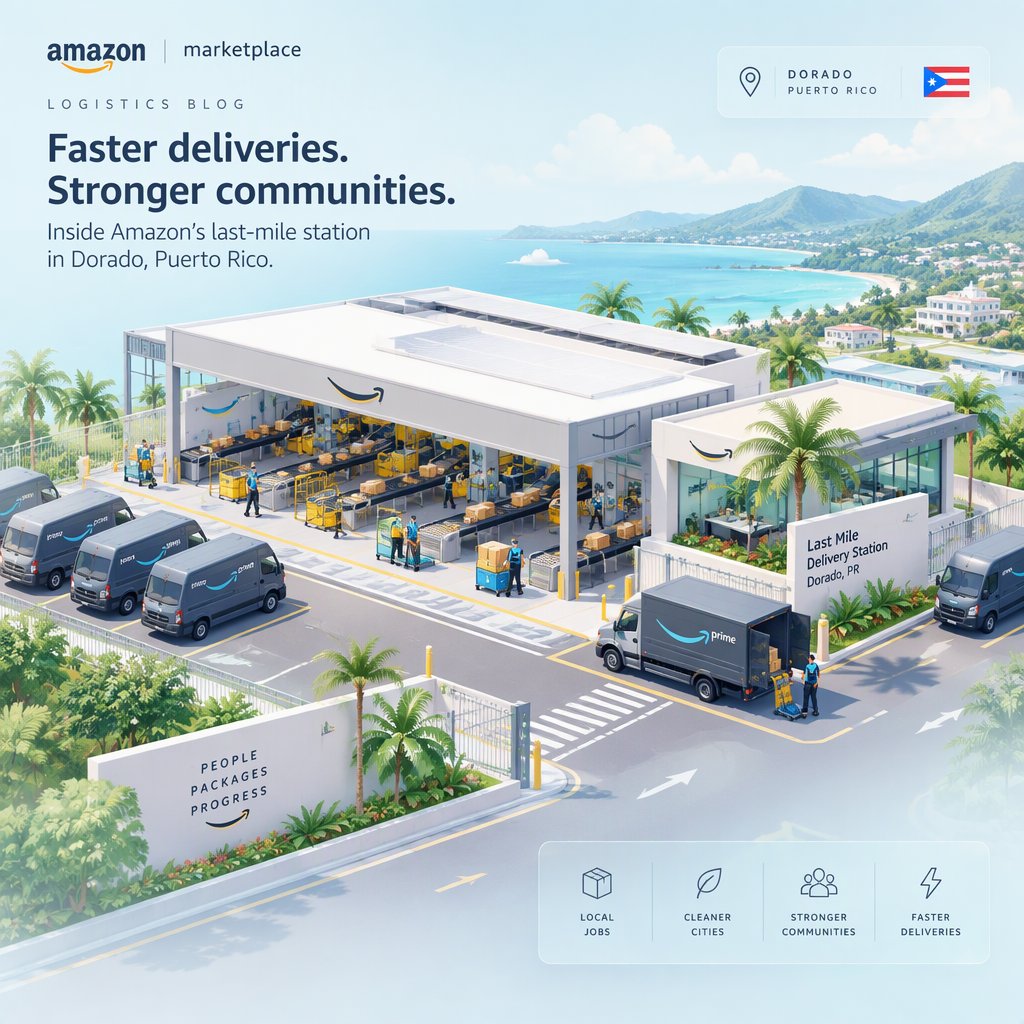
According to Amazon’s supplied news summary, the company has officially opened a 100,000-square-foot delivery station in Dorado, its first operations facility on the island.
The station serves customers across the San Juan metro area. Amazon says orders that previously took as long as two weeks can now arrive in about two days. Deliveries began in August, before the official November 16 opening.
That distinction matters. This isn’t a facility that starts serving customers only after its opening ceremony. Some operational effects may already appear in recent sales and delivery data.
The roundup also highlights DoorDash Labs’ use of AWS to develop an autonomous delivery robot and Prime’s holiday advertisement featuring Arnold Schwarzenegger. Those stories offer useful context, but the Puerto Rico expansion has the clearest immediate relevance for marketplace operators.
Scope matters: the supplied summary doesn’t establish island-wide two-day coverage, universal product eligibility, new FBA storage capacity, or changes to Seller Central and Vendor Central policies. Faster service in the San Juan metro area shouldn’t become a blanket shipping claim.
Technical Deep Dive
A delivery station isn’t a fulfillment center
A delivery station generally handles the downstream part of Amazon’s logistics network: receiving packages, organizing them for delivery routes, and dispatching them toward customers. A fulfillment center handles different work, including inventory storage, picking, and packing.
Amazon’s summary identifies Dorado as a delivery station, not a fulfillment center. It doesn’t describe the building’s equipment, package throughput, routing software, or upstream supply arrangements.
That means sellers shouldn’t assume they can send inventory to Dorado or that Amazon now holds their products locally.
The reported improvement from as long as two weeks to about two days describes a customer-facing result. It doesn’t reveal which parts of the journey account for the improvement.
In a typical delivery network, elapsed time includes:
- Inventory availability and order processing.
- Picking and packing at an upstream facility.
- Transportation toward the destination market.
- Local sorting and route preparation.
- Final delivery to the customer.
Analysis: a dedicated local station can reduce downstream delays and improve coordination. But faster service still depends on upstream inventory, transportation capacity, and reliable handoffs. Local infrastructure can’t compensate for a product that’s unavailable.
Capacity is more than square footage
The 100,000-square-foot footprint is useful context, but it isn’t a throughput figure. Processing capacity also depends on staffing, arrival schedules, sortation processes, dispatch windows, and delivery-route density.
Scalability brings trade-offs. More orders can improve route economics when deliveries cluster geographically. They can also create congestion if incoming packages arrive faster than teams can sort and dispatch them.
For sellers, the relevant performance measure is therefore not building size. It’s whether customers consistently see, and receive, a better delivery promise.
AWS robotics is a separate technical signal
The DoorDash item says engineers use AWS to put autonomous-car capabilities into a much smaller delivery robot. The supplied summary doesn’t identify specific AWS services, model architectures, or deployment results.
From an engineering perspective, autonomous delivery separates cloud workloads from onboard decisions. Training, simulation, and fleet-data analysis can use cloud infrastructure. Safety-sensitive movement needs timely local responses rather than dependence on uninterrupted network access.
That’s architectural analysis, not a disclosed DoorDash implementation. Nor is there evidence here that Amazon uses those robots in Puerto Rico.
Industry Impact
A shorter wait can change the economics of an online purchase. Customers who won’t wait two weeks for a household item may consider it when delivery takes about two days. Time-sensitive purchases become more practical.
For Seller Central users, this creates a reason to examine regional demand more closely. An existing listing might perform differently without any change to price, images, or advertising because its delivery promise has improved.
That doesn’t prove causation. Holiday demand, promotions, stock availability, and competitor activity can move sales at the same time.
Vendor Central users face a related question: does improved downstream delivery justify different replenishment priorities? Potentially, but a delivery station announcement alone doesn’t establish a new purchase-order pattern, routing requirement, or inventory allocation policy.
The Prime holiday advertisement reinforces the commercial message. Amazon describes Schwarzenegger ordering a Santa suit and receiving it quickly with Prime. The ad sells speed as part of membership value; the Dorado facility supplies a concrete example of investment behind faster service, though the stories don’t establish a direct operational connection.
The marketplace opportunity isn’t “Amazon opened a building.” It’s that eligible customers may now see a more competitive delivery promise on existing offers.
Local merchants may face stronger competition from Amazon on convenience. They can still differentiate through assortment, product expertise, immediate availability, and service that a shipping promise alone can’t replace.
Implementation Considerations
Verify the promise before changing the plan
Start with customer-facing evidence.
Check representative products using delivery addresses in the stated service area. Review multiple offers and repeat the checks over time. A single product showing faster delivery doesn’t establish coverage for an entire catalog.
Keep the fulfillment models separate:
- FBA offers: verify what Amazon displays for eligible products and destination addresses.
- Merchant-fulfilled offers: maintain delivery settings based on your own carrier capabilities and handling times.
- Vendor-supplied products: examine availability and replenishment signals without assuming a new inbound destination.
Don’t copy Amazon’s reported two-day improvement into a merchant-fulfilled shipping template. The announcement doesn’t change your carrier’s service.
Measure results without inventing precision
Where reporting permits, compare order volume and delivery outcomes for the affected area before and after August. Account for promotions, price changes, and stockouts.
A practical monitoring record might include order_date, destination_region, fulfillment_channel, promised_delivery_date, and actual_delivery_date, where those fields are available and permitted. These are suggested analytical fields, not a newly announced Amazon API schema.
Seller Central, Vendor Central, and connected reporting tools may offer different levels of geographic detail. Don’t manufacture a Puerto Rico conversion rate by dividing regional orders by account-wide traffic.
If precise regional traffic data isn’t available, treat order trends and sampled delivery promises as directional evidence.
Protect contribution margin
Faster delivery may support incremental demand, but increased sales aren’t automatically profitable sales.
Before increasing inventory or advertising, account for product cost, fulfillment charges, storage exposure, returns, and acquisition cost. Test in manageable increments rather than committing broadly on the strength of an opening announcement.
Developers integrating the Selling Partner API should also separate observed operational changes from documented interface changes. Nothing in the supplied roundup announces a new endpoint, notification type, or delivery-promise API.
Future Outlook
Analysis: Dorado signals Amazon’s interest in improving service in markets where long delivery waits limit shopping convenience. The important next questions concern coverage, consistency, and resilience.
Will more products qualify for shorter delivery times? Will the service area expand? Can the network maintain performance during peak demand or transportation disruptions? The supplied summary doesn’t answer those questions.
AWS-powered robotics points toward a different opportunity: making delivery technology more capable through cloud-supported development. Physical expansion and automation can complement each other, but neither removes the need for reliable inventory flow and sound route economics.
For marketplace businesses, the broader lesson is that fulfillment infrastructure can alter commercial performance without producing an obvious Seller Central feature announcement.
Conclusion
Amazon’s first Puerto Rico delivery station offers a meaningful service improvement for customers in the San Juan metro area. It’s not evidence of island-wide two-day delivery, new local inventory storage, or revised seller requirements.
Sellers and vendors should take three steps:
- Verify delivery promises for relevant products and addresses.
- Measure regional demand using available data, with seasonal factors in mind.
- Test inventory and advertising adjustments against contribution margin.
The strongest response isn’t a sweeping catalog change. It’s a disciplined check of where faster shipping actually changes the customer’s buying decision.