Amazon Marketplace Risk Explained: What the Wildberries Strikes Mean
Salevoyant Editorial · August 1, 2026
Introduction
A recent report about Ukraine targeting Wildberries, often described as Russia’s closest equivalent to Amazon, is more than a wartime logistics story. It’s also a reminder that marketplace power depends on infrastructure, and infrastructure can be disrupted faster than most brands expect.
For Amazon sellers and Vendor Central teams, this matters now because it shows how quickly fulfillment networks, catalog operations, and cross-border commerce can become fragile when physical and digital systems intersect.
Core Development
Wildberries is one of Russia’s largest e-commerce platforms, with a footprint that spans marketplace operations, fulfillment, delivery coordination, payments, and merchant onboarding. The recent strikes reported by The Independent are aimed at a company that sits near the center of Russia’s consumer commerce engine, which is why the attacks draw so much attention.
The key point isn’t just that a platform was hit. It’s that Wildberries operates as a high-volume retail and logistics network, not just a website. When a marketplace is this deeply tied to warehousing, line-haul transport, last-mile handoff points, and seller inventory flows, any disruption can ripple through the entire ecosystem.
For Amazon professionals, the takeaway is simple: the marketplace business is only as resilient as the physical systems behind it.
A marketplace may look digital on the surface, but its real strength comes from warehouses, routing systems, inventory visibility, and delivery continuity.
Wildberries has been widely compared to Amazon because of its scale and operational breadth. That comparison is useful here. Amazon’s own strength comes from a tightly orchestrated mix of software, supply chain data, and fulfillment infrastructure. When any part of that stack is strained, the effects show up quickly in seller performance, customer satisfaction, and conversion.
Technical Deep Dive
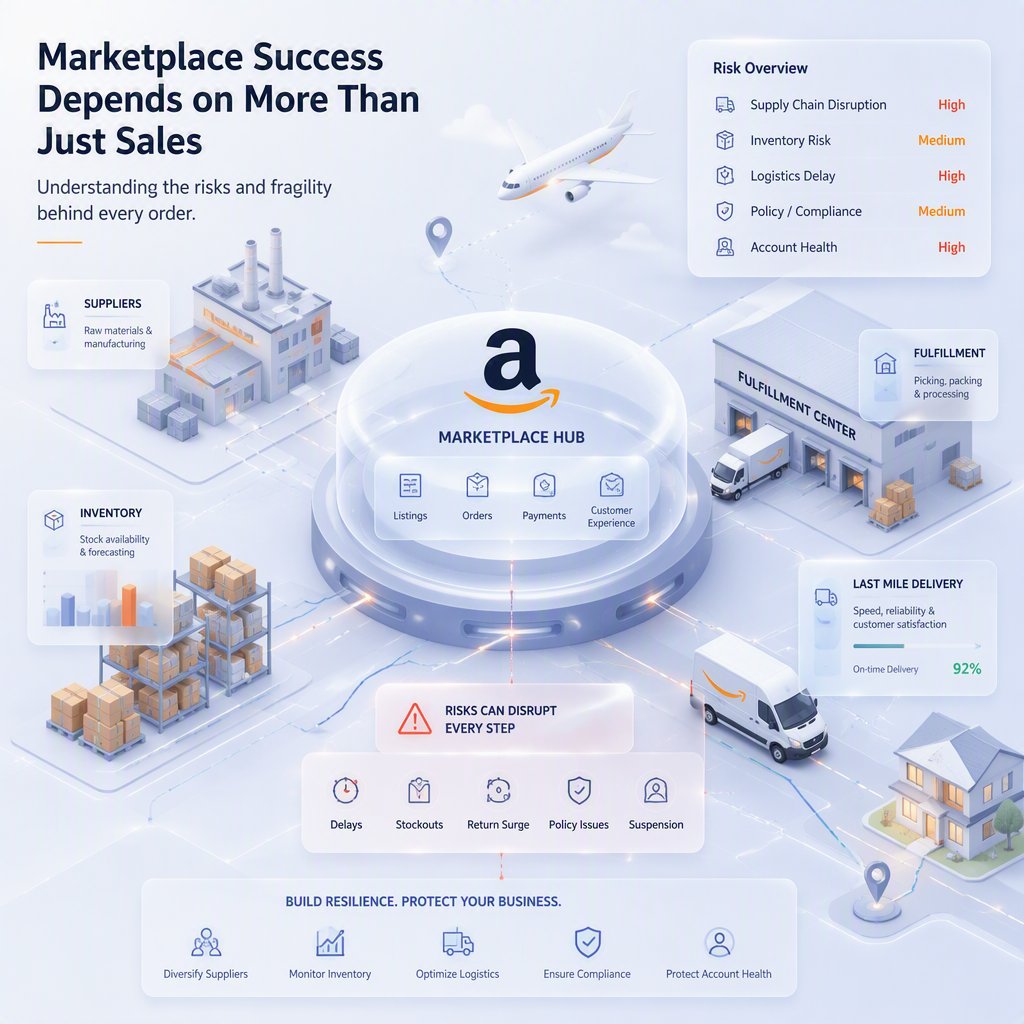
This story matters because modern marketplaces run on a layered architecture. At the top, shoppers see search, product detail pages, pricing, and delivery promises. Underneath that, platforms depend on inventory management, order orchestration, warehouse automation, carrier integrations, payments, and merchant tools.
Amazon sellers know this stack well through Seller Central. A listing might look healthy in the catalog, but if FBA inventory is delayed, Buy Box availability can wobble, suppressed offers can appear, and customer promise dates can slide. On the vendor side, Vendor Central teams deal with forecast accuracy, purchase order fill rates, ASN compliance, and chargeback exposure. The same logic applies to any large marketplace, including Wildberries.
What disruption does at the system level
When a physical node in a commerce network is hit, several things can happen at once:
-
Inventory visibility breaks down
-
Stock may still exist in the system, but not where the routing engine expects it.
-
That creates phantom availability or delayed replenishment signals.
-
Order routing becomes less efficient
-
The platform may need to reroute from a different fulfillment center or pause certain delivery lanes.
-
That increases latency and raises cost per order.
-
Promise dates become less reliable
-
Delivery estimates rely on real-time fulfillment capacity.
-
If the network is unstable, service levels suffer and conversion can drop.
-
Merchant confidence weakens
-
Third-party sellers become more cautious about sending inventory into the network.
-
Large brands may shift toward direct-to-consumer backup channels or alternative distributors.
Amazon’s systems are designed to reduce these risks through redundancy, distributed fulfillment, and deep data integration. But even Amazon isn’t immune to external shocks, whether they come from labor issues, weather, strikes, cyber incidents, or geopolitical events.
Why sellers should care about the architecture
A marketplace’s technical design shapes seller economics. If fulfillment is concentrated in a small number of nodes, disruption hits harder. If inventory placement is spread across many regions, the platform can absorb shocks better, but at the cost of higher complexity and potentially slower operational response.
That’s why tools like:
restock planninginventory placement APIsdemand forecastingsales velocity monitoringaccount health dashboards
matter so much. They’re not just operational conveniences. They’re risk controls.
On Amazon, sellers who rely heavily on FBA need to watch for:
- inbound shipment delays
- stranded inventory
- reduced regional availability
- sudden fee changes tied to storage or routing
- listing performance swings caused by fulfillment instability
Vendor Central teams face a similar issue, but with more fixed dependence on Amazon’s buying and replenishment logic. If demand signals are off, POs can shrink or become erratic, which affects margin planning and working capital.
Industry Impact
The bigger lesson here is that marketplace competition is increasingly about infrastructure resilience, not just catalog size or ad spend.
Wildberries has grown by combining marketplace mechanics with strong fulfillment coverage, and that model resembles the direction e-commerce has taken globally. Amazon has spent years building a network that can support same-day, next-day, and regional delivery at massive scale. That network is a strategic moat, but it also creates concentration risk.
For the broader Amazon ecosystem, there are three important implications.
1.
Resilience is now a competitive feature
Shoppers don’t think about warehouse topology, but they notice when delivery dates slip or items go out of stock. Sellers notice it even faster when conversion drops or ad spend becomes less efficient because traffic is landing on weak inventory.
The platforms that win are the ones that can keep promises under pressure.
2.
Multi-channel strategies keep getting more important
Brands selling on Amazon, their own site, and maybe additional marketplaces can’t afford to depend on a single fulfillment or sales channel. If one network gets disrupted, the others need to carry demand.
That’s especially relevant for brands using:
- Amazon FBA as a primary channel
Seller Fulfilled Primefor select SKUs- Vendor Central for wholesale scale
- direct fulfillment for protected or high-margin products
A balanced model reduces exposure.
3.
Data quality becomes a risk control, not just a reporting feature
When supply chain conditions change fast, clean catalog data and accurate inventory feeds matter more. Late updates create oversells, backorders, and policy issues. On Amazon, that can mean suppressed offers, poor customer metrics, or an account health headache. On the vendor side, it can mean disputes over shortages or chargebacks.
Implementation Considerations
If you’re running an Amazon business, this is a good moment to review how exposed your operations are to disruption. Not because your marketplace is under attack, but because the same network principles apply everywhere.
For sellers
-
Audit FBA dependency by ASIN
-
Identify which SKUs rely almost entirely on FBA.
-
Flag high-revenue items with no backup fulfillment path.
-
Track inventory velocity weekly
-
Use
Manage Inventory, replenishment reports, and sales trend data to spot sudden shifts. -
Don’t wait for stockouts to react.
-
Keep a fallback fulfillment plan
-
Maintain enough buffer inventory for critical SKUs.
-
Consider a hybrid model with MFN or a 3PL for resilience.
-
Watch for buy box instability
-
If delivery promises slip, pricing and conversion can fall even when demand is intact.
For Vendor Central teams
-
Stress-test forecast assumptions
-
Look at replenishment plans under delayed inbound scenarios.
-
Model what happens if lead times widen by 7 to 14 days.
-
Review chargeback exposure
-
Late ASNs, mismatched carton labels, and missed appointments become more expensive when supply chains are stressed.
-
Coordinate with Amazon retail contacts
-
Keep communication tight on promotions, availability, and substitution risks.
For developers and operations teams
-
Monitor API latency and feed failures
-
Inventory and order feeds can become a hidden point of failure.
-
Build alerts for missing acknowledgments, delayed report processing, and catalog sync errors.
-
Design for graceful degradation
-
If one routing or inventory sync path fails, another should keep critical SKUs live.
-
This is basic systems engineering, but e-commerce teams still overlook it.
-
Plan around observability
-
Log inventory changes, order status transitions, and delivery promise updates.
-
The faster you can trace a mismatch, the less revenue you lose.
The best Amazon operations teams treat fulfillment like infrastructure engineering. That mindset pays off when conditions get messy.
Future Outlook
This event signals a broader shift in how marketplaces are judged. Speed still matters, but resilience is moving up the list. Investors, sellers, and platform operators are paying closer attention to whether a marketplace can absorb shocks without losing customer trust.
For Amazon, that reinforces the value of distributed fulfillment, regional storage, better forecasting, and stronger seller tooling. Expect continued investment in:
- more granular inventory placement
- tighter real-time supply chain telemetry
- improved seller-side visibility into inbound and outbound flow
- stronger contingency planning for transportation and capacity disruptions
For sellers and brands, the message is even more direct. The winners won’t just be the companies with the best ads or the lowest prices. They’ll be the ones that can keep products available, promises accurate, and operations flexible when conditions change.
Wildberries is a reminder that an e-commerce platform is never just a storefront. It’s a network of software, warehouses, carriers, merchants, and data pipelines. If one layer is shaken, the whole machine feels it.
Conclusion
The strikes on Wildberries show how exposed large marketplaces can be when commerce depends on tightly coupled physical and digital systems. For Amazon sellers, Vendor Central users, and marketplace teams, the lesson is to treat resilience as part of strategy, not an afterthought.
If you sell on Amazon, now’s a good time to:
- review fulfillment concentration
- tighten inventory monitoring
- build backup supply paths
- watch buy box and delivery promise changes
- pressure-test your vendor or seller ops for delays
The marketplace keeps getting bigger, but it’s also getting more complex. The businesses that prepare for disruption will recover faster, protect margin better, and keep customers longer.