Amazon Marketplace Sustainability Claims Under Scrutiny: What Sellers Should Know
Salevoyant Editorial · August 3, 2026
Introduction
Amazon’s latest consumer lawsuit is about seafood, but the implications run much wider than one product category. When a marketplace giant gets challenged over sustainability labels, it puts a spotlight on how claims are sourced, displayed, and validated across Amazon’s retail and marketplace stack.
That matters now because Amazon has spent years pushing trust signals like certifications, badges, and merchandising copy to help customers buy faster. If those signals are weak, incomplete, or inconsistently audited, the risk isn’t just legal exposure. It can affect conversion, catalog integrity, and seller confidence across the platform.
Core Development
A proposed class action filed in Seattle federal court accuses Amazon of misleading shoppers with environmental claims on seafood products sold through its platform. The lawsuit says labels such as “dolphin safe,” “responsibly sourced,” “sustainable,” “wild caught,” and “MSC Certified Sustainable Seafood” led consumers to believe the seafood had minimal environmental impact.
The plaintiffs argue those claims are not properly substantiated, pointing to problems like limited public vessel tracking and the fact that some fishing boats disable transponders. They also claim a meaningful share of imported wild-caught seafood isn’t responsibly sourced. In their view, Amazon used broad sustainability messaging without enough disclosure to prevent deception.
The suit targets seafood sold under brands including Bumble Bee, Chicken of the Sea, StarKist, and Amazon’s own 365 by Whole Foods Market line. The plaintiffs are seeking compensatory damages, punitive damages, and restitution under Washington consumer protection law.
A few details make this especially notable:
- The case targets both third-party brand products and Amazon private-label inventory
- It focuses on claims displayed at the point of purchase, not just packaging
- It frames the issue as a consumer deception and disclosure problem, not only a sourcing dispute
Amazon is no stranger to product-related litigation, but this one cuts into a sensitive area. Sustainability claims are part of the trust architecture that ecommerce platforms use to reduce friction. Once those claims are challenged, the burden shifts to proof, traceability, and governance.
Technical Deep Dive
At a technical level, this case highlights a simple but uncomfortable truth: marketplace claim management is a data problem.
Amazon’s catalog doesn’t just store titles, bullets, and images. It also carries structured and semi-structured attributes, certification markers, A+ content, merchandising badges, and sometimes retailer-authored claims that appear in search results, detail pages, or filters. When a shopper sees “sustainable” or “certified,” that signal may come from a mix of:
- Brand-submitted content
- Vendor-provided item data
- Amazon-curated merchandising logic
- Third-party certification feeds
- Content moderation and catalog enrichment workflows
That creates a chain of responsibility problem. If one upstream system injects a claim and another system republishes it across multiple surfaces, the original source can get blurred. By the time a shopper sees the listing, it feels like Amazon is making the claim, even if a vendor supplied the language.
For Amazon, the challenge is scale. The company manages millions of ASINs and a huge number of content updates every day. Manual review doesn’t scale well, so platforms rely on a combination of:
- Rule-based validation
- Category-specific attribute schemas
- Automated policy enforcement
- Certification mapping
- Content suppression and remediation workflows
That works reasonably well for obvious violations, but sustainability claims are harder. They’re often qualitative, jurisdiction-specific, and hard to verify in real time. A term like “responsibly sourced” can sound objective to a consumer while hiding a messy chain of evidence behind the scenes.
There’s also a data provenance issue. Amazon’s systems may know whether a product has an MSC certification code, but that doesn’t necessarily prove every batch, supplier, or vessel in a seafood supply chain meets the same standard. In other words, a certification is only as strong as the data pipeline behind it.
The core technical risk here isn’t just inaccurate copy. It’s weak provenance across product data, certification data, and customer-facing claims.
This is where traceability tools matter. In ecommerce and grocery, platforms increasingly depend on:
- Supplier onboarding workflows
- Document verification
- Certificate expiration checks
- Lot-level or batch-level traceability
- Restricted attribute governance
- Audit logs for content changes
If those controls are thin, marketplaces can end up with a “trust by presentation” model instead of a “trust by evidence” model. That’s a dangerous place to be.
Industry Impact
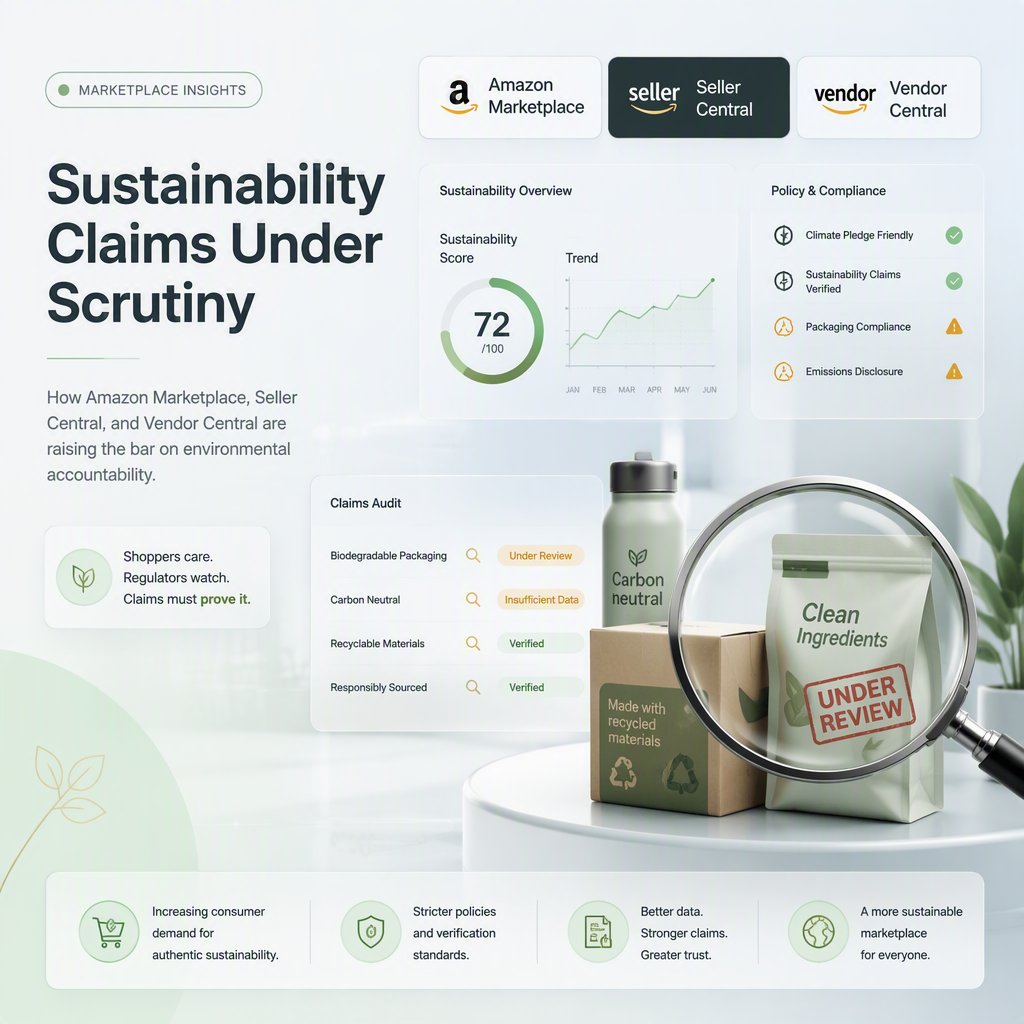
For Amazon sellers, this lawsuit is a reminder that claim hygiene is no longer optional. Even if a seller isn’t selling seafood, the logic applies to any product category where environmental, ethical, or sourcing claims influence buying decisions. Think organic, carbon neutral, cruelty free, made from recycled materials, fair trade, and similar labels.
For Seller Central users, the practical lesson is clear: every claim in your title, bullet points, images, A+ modules, and backend attributes should be backed by documentation you can actually produce. Amazon’s content moderation systems can catch obvious violations, but legal risk often comes from the gray areas. A claim that sounds harmless in marketing copy can become expensive once it’s interpreted as a factual statement.
For Vendor Central teams, this is even more operationally important. Vendors often supply the product copy, compliance documents, and certifications that shape how Amazon presents the item. If the vendor data is incomplete or stale, Amazon may still be the visible publisher of that claim. That creates tension between brand, retailer, and platform responsibility.
There’s also a broader catalog management angle. Amazon has invested heavily in making product pages more informative and easier to compare. But the more Amazon enriches those pages with trust badges and sustainability cues, the more it becomes responsible for ensuring those signals are consistent across:
- Search results
- Detail pages
- Mobile app surfaces
- Sponsored placements
- Voice and shopping assistants
- Grocery and whole foods merchandising
That’s a lot of surface area. One bad attribute can propagate fast.
From a business standpoint, this kind of case can hit Amazon in three ways:
- Legal costs and damages exposure
- Higher compliance overhead for category teams
- Reduced conversion if trust signals become harder to use
That last point is easy to miss. If Amazon tightens claim approval too much, honest sellers may lose helpful differentiation. If it’s too loose, the platform invites more lawsuits and customer backlash. It’s a balancing act with real revenue implications.
Implementation Considerations
If you sell on Amazon, especially in grocery, supplements, household goods, or sustainability-driven categories, this is the time to audit your content stack.
What sellers should check
-
Titles and bullets Remove vague claims unless you have proof. “Eco-friendly” and “responsibly sourced” can be risky if they’re not defined.
-
Images and infographics Text embedded in images is still a claim. Amazon and regulators don’t treat it as decoration.
-
A+ Content and Brand Story modules Make sure certification references match current documentation.
-
Backend attributes Review category-specific fields tied to sourcing, ingredients, materials, or certifications.
-
Documentation Keep certificates, supplier declarations, test reports, and renewal dates in one place.
What vendors should do
- Confirm which claims are vendor-authored versus Amazon-authored
- Build a review process for any sustainability language before item setup
- Track certificate expiry dates and update Amazon before listings go stale
- Align legal, compliance, and catalog operations so they’re not working in silos
What developers and catalog teams should do
If you’re building tools around Amazon catalog ops, consider:
- Claim provenance tracking with source IDs and timestamps
- Rule engines for claim validation by category and region
- Alerting for expiring certifications
- Diff logging for content edits across ASINs
- Workflow gates that block publication when evidence is missing
A lightweight internal schema can go a long way. For example:
claim_type
source_system
evidence_url
certificate_id
effective_date
expiry_date
review_status
jurisdiction
That kind of structure makes compliance audits faster and reduces the chance of a bad claim slipping into production.
If a claim can’t be tied to a current, verifiable source, it probably shouldn’t appear on the detail page.
Future Outlook
This lawsuit is part of a bigger shift in ecommerce governance. Consumers are getting more skeptical, regulators are getting more aggressive, and platforms are being pushed to prove that their trust signals mean something.
Expect Amazon to keep tightening how it handles sensitive claims, especially in categories where environmental language affects buying decisions. That could mean more automated validation, more document requests from vendors, and stricter suppression of unverified wording in catalog copy.
We may also see more emphasis on structured proof instead of marketing language. In practice, that means platforms will prefer attributes that can be machine-checked, like certification IDs, audit dates, and standardized compliance fields. Freeform claims are harder to defend.
For sellers, this is a warning shot. If your listing strategy depends on fuzzy wording, you’re carrying avoidable risk. If your catalog is clean, documented, and review-ready, you’re in a better position to keep selling without disruption.
Amazon’s scale makes this hard, but not impossible. The companies that manage catalog truth as a data discipline, not a copywriting afterthought, will be better prepared for what comes next.
Conclusion
Amazon’s seafood sustainability lawsuit isn’t just a legal story. It’s a reminder that marketplace trust depends on data quality, claim governance, and proof that can survive scrutiny.
For sellers and vendors, the practical steps are straightforward:
- Audit sustainability and sourcing claims now
- Tie every statement to current documentation
- Separate marketing language from verifiable facts
- Build internal workflows that catch risky copy before it goes live
The platform can move fast, but trust moves slower. If Amazon wants to keep using sustainability as a merchandising signal, it’ll need stronger validation behind the scenes. And if you sell on the marketplace, you should expect that bar to keep rising.