Amazon Marketplace Update: Class Action Claims Pregnancy Discrimination
Salevoyant Editorial · September 10, 2026
Introduction
Amazon is back in court, and this time the case goes straight to the mechanics of how one of the world’s largest employers manages time off, accommodations, and attendance at warehouse scale. The new class action alleging discrimination against pregnant workers isn’t just a labor dispute. It’s a reminder that Amazon’s operational systems, from warehouse staffing to compliance workflows, can have legal and reputational consequences that ripple across the entire marketplace.
For sellers, vendors, and Amazon tech partners, this matters because Amazon’s internal labor practices shape the stability of fulfillment, delivery speed, and customer service. When those systems come under pressure, the effects can show up in inventory flow, replenishment timing, and cost structures.
Core Development
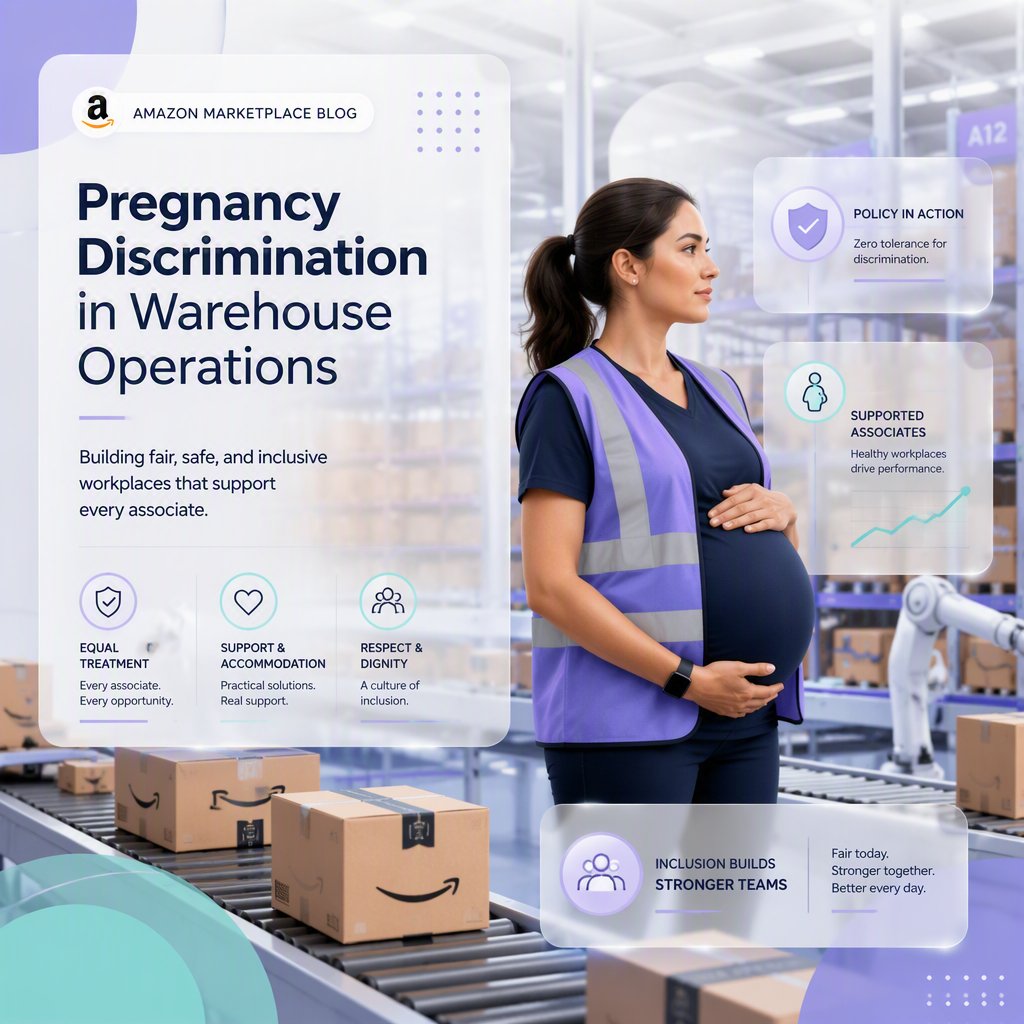
A proposed nationwide class action filed in Brooklyn federal court accuses Amazon of systematically discriminating against pregnant employees, especially warehouse workers. The complaint, brought by four former employees and filed by worker advocacy group A Better Balance, says Amazon denied basic accommodations such as chairs, bathroom breaks, water breaks, and time off for prenatal appointments. It also claims the company disciplined or fired pregnant workers who exceeded time-off limits and required medical documentation in ways the plaintiffs say violated federal and New York law.
One of the most striking allegations involves a warehouse worker in Rochester, New York, who says she was taken out in a wheelchair after a pregnancy-related emergency and later fired after Amazon counted her hospital visit against attendance limits. Amazon disputes the claims, saying its records show it approved more than 99.9% of pregnancy-related accommodation requests in the last year and provided accommodations to tens of thousands of employees annually.
That tension matters. The lawsuit isn’t just about one facility or one manager. It points to a broader question: can Amazon’s highly standardized, metrics-heavy labor model adequately handle edge cases like pregnancy, disability, or other protected medical conditions without producing compliance failures at scale?
The complaint also lands in a larger legal context. New Jersey filed a similar lawsuit last year, and New York sued Amazon in 2022 over alleged discrimination against warehouse employees who were pregnant or had disabilities. The EEOC is also preparing changes to regulations tied to the Pregnant Workers Fairness Act, which adds another layer of uncertainty for large employers already operating under evolving rules.
Technical Deep Dive
Amazon’s warehouse network runs on deeply instrumented operations. Attendance, productivity, break compliance, and time-off tracking are typically managed through software systems that translate workplace policy into enforceable rules. That’s efficient. It’s also where legal risk can hide.
A large fulfillment center usually depends on a combination of workforce management platforms, badge-based time tracking, shift scheduling tools, and exception handling workflows. In practice, these systems tend to optimize for throughput and consistency. That makes sense in a high-volume environment where tiny delays cascade into missed sort deadlines or late customer promises. But pregnancy accommodations don’t fit neatly into a rigid attendance engine.
Here’s where the architecture gets tricky:
- Policy translation layer: HR policies have to be converted into system rules. If the rules are too strict, employees with protected needs get penalized. If they’re too loose, operations teams worry about coverage gaps.
- Exception handling: Accommodation requests should route into a separate workflow, usually with medical review, HR approval, and site-level implementation. If that workflow isn’t cleanly integrated, managers may rely on default attendance logic instead.
- Audit trails: In a company Amazon’s size, documentation matters. Every denied accommodation, time-off adjustment, or termination warning needs a defensible record. That’s especially important under laws like the Pregnant Workers Fairness Act and state labor protections.
- Site-level variance: Even with centralized policy, execution differs by warehouse, shift, and manager. One facility may handle accommodations well while another applies attendance rules mechanically. That’s a classic scale problem.
From a systems perspective, this case raises a familiar e-commerce platform issue: Amazon’s biggest strength, standardization, can become a weakness when the edge cases are legally sensitive. The company is built to reduce variance in fulfillment. But worker accommodation cases demand human judgment layered on top of software controls.
The real risk isn’t just a single bad decision. It’s what happens when a standardized attendance system keeps making the same kind of mistake across dozens of sites.
There’s also a data governance angle. If Amazon is indeed approving nearly all accommodation requests, then the core issue may be less about policy and more about how those approvals are operationalized inside the warehouse. Approval on paper doesn’t help if the scheduling system, line manager, or attendance engine still flags the worker as noncompliant.
That’s the sort of breakdown that often surfaces in litigation. The company can point to policy. Plaintiffs point to execution.
Industry Impact
This case reaches beyond employment law. Amazon’s marketplace ecosystem depends on a fulfillment machine that runs close to the edge. When warehouse operations become unstable, sellers feel it quickly.
For Marketplace sellers, the concern is indirect but real:
- Slower labor deployment can affect inbound receiving, especially at peak volume.
- If staffing issues become widespread in certain regions, FC throughput can tighten.
- More legal scrutiny can push Amazon to adjust policies, training, and internal controls, which can change how fulfillment exceptions are handled.
For Vendor Central participants, the implications can be even more visible. Vendors rely on Amazon’s purchase order flow, dock scheduling, and receiving accuracy. Any strain on warehouse labor processes can ripple into:
- Delayed check-in at fulfillment centers
- Slower ASN reconciliation
- More disputes over shortages or receiving discrepancies
- Higher operational friction during seasonal surges
For e-commerce technology teams, this lawsuit is a reminder that workforce compliance is now part of platform resilience. Amazon’s warehouse systems aren’t just about picking and packing. They’re part of a broader distributed operations stack that has to absorb legal, regulatory, and human variability without breaking service levels.
There’s also a reputational cost. Amazon has spent years positioning itself as a logistics and technology leader. Cases like this challenge that narrative by showing how the same systems that enable scale can also produce harsh outcomes when they treat protected workers like ordinary capacity variables.
Implementation Considerations
If you build for the Amazon ecosystem, this story offers some practical lessons.
For sellers and vendors
- Watch fulfillment service metrics closely. If a site or region starts showing delays, don’t assume it’s purely inventory-related.
- Diversify inventory placement where possible. A single bottleneck in the network can affect replenishment speed.
- Build buffer into forecasting for peak periods and labor-sensitive windows.
- Escalate recurring receiving issues early through Seller Central or Vendor Central support channels, and document everything.
For developers and ops teams
- Design for exception handling, not just the happy path. Automated systems need a clean path for protected leave, medical accommodations, and manual review.
- Separate compliance logic from attendance enforcement. If the same workflow handles both, protected workers can get caught by default rules.
- Keep immutable logs of approval timestamps, policy acknowledgments, and manager actions. In regulated environments, traceability isn’t optional.
- Test policy updates against downstream systems. A change in HR policy can fail if scheduling, badge access, or performance dashboards aren’t updated too.
For Amazon-adjacent businesses
- Assume policy shifts can happen quickly. If the EEOC changes regulations in November, large employers may revise internal controls again.
- Plan for operational noise. Legal disputes often lead to training updates, process reviews, and short-term friction.
- Treat compliance as infrastructure. At Amazon scale, labor law isn’t a side issue. It’s part of the operating system.
Future Outlook
This lawsuit is part of a broader reset in how large employers manage protected workers inside highly automated operations. Amazon will likely keep defending itself on the basis of aggregate approval rates and existing accommodation programs. But that won’t be enough if plaintiffs can show the system still punishes workers in practice.
The next phase probably includes three shifts:
- Stricter accommodation workflows with clearer exception routing and manager controls.
- More auditability inside warehouse HR systems, especially around attendance-related terminations.
- Pressure on the broader industry to separate productivity management from protected leave enforcement more cleanly.
For Amazon, the legal exposure is only part of the story. The bigger question is whether it can keep scaling its operations without letting rigid automation undercut employee protections. That’s hard in a network this large. But it’s also where the company’s reputation, labor costs, and operational reliability intersect.
If the EEOC tightens guidance, Amazon and its peers may need to redesign some internal processes, not just rewrite policy documents. That means more granular approval logic, better manager training, and stronger system-level safeguards around protected status.
Conclusion
This class action is more than a headline about warehouse labor. It’s a stress test for Amazon’s operational architecture. The allegations suggest that when standardization meets protected worker rights, the seams can show, especially at warehouse scale.
For sellers and vendors, the practical takeaway is simple: labor compliance inside Amazon’s fulfillment network can affect speed, stability, and receiving quality. For technologists, the lesson is sharper. Systems that optimize for efficiency need robust exception handling, or they’ll eventually turn legal risk into operational risk.
Amazon’s marketplace may be built on automation, but this case shows that the human layer still matters. A lot.