Amazon Marketplace: What Alexa+ in Japan Means for Product Discovery
Salevoyant Editorial · October 29, 2026
Introduction
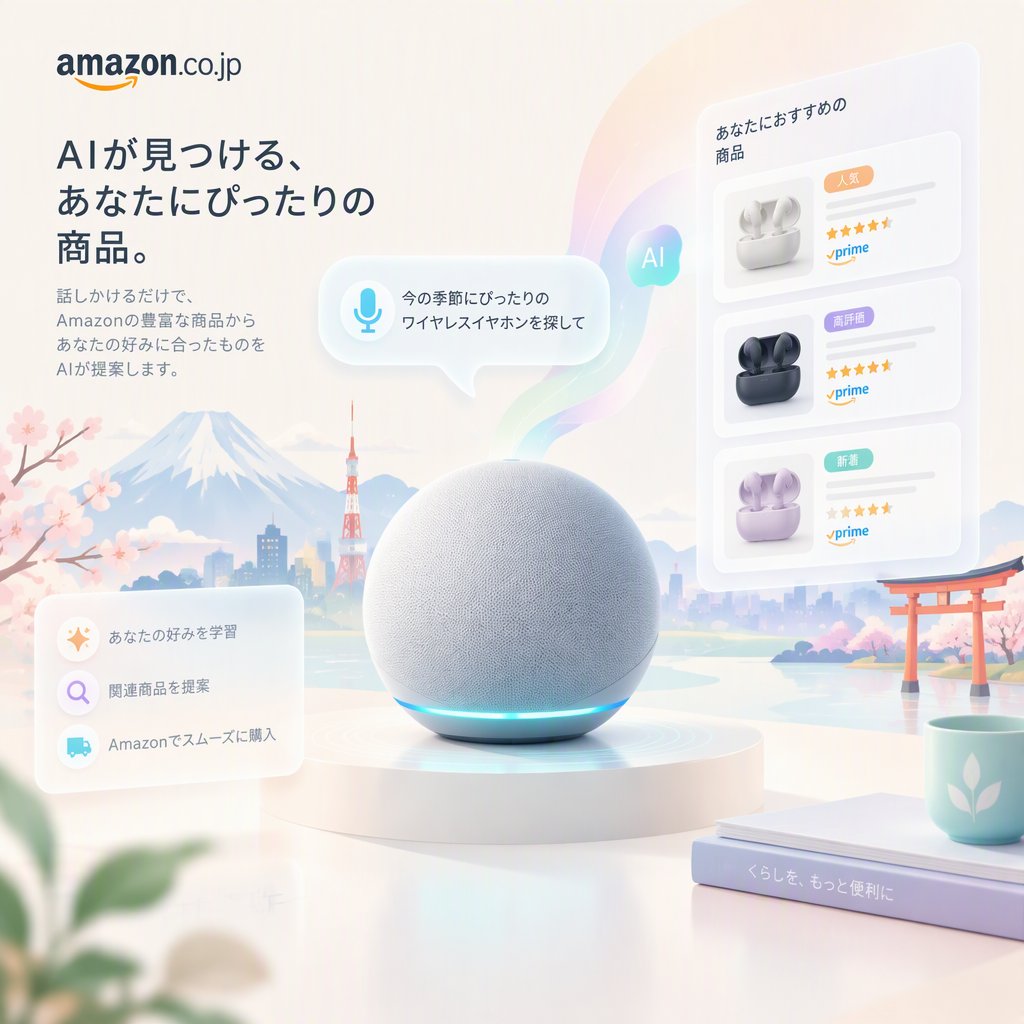
Amazon begins rolling out Alexa+ early access in Japan on October 29, 2026, bringing generative AI conversations, personalized assistance, and shopping capabilities into its consumer ecosystem. For sellers and vendors, the significant shift isn't another voice interface: it's an assistant that can compare products, summarize reviews, and help customers move from a loosely expressed need toward a purchase.
Core Development
According to Amazon's launch announcement, Alexa+ is designed around Japanese language, culture, and communication habits. It interprets conversational intent, remembers preferences, and performs tasks rather than simply answering questions.
Early access is free and rolls out progressively to customers with compatible devices, including eligible Echo products, Fire TV devices, and selected Panasonic and JVC televisions with Fire TV. Customers can also request access through Amazon's registration page.
Once enrolled, customers can use Alexa+ across supported devices, the Alexa app, and a browser at alexa.jp. After early access ends, the service will cost JPY 3,000 per month, while Prime members receive it at no additional charge.
The shopping functions are particularly relevant to marketplace businesses:
- Product comparisons and customer-review summaries.
- Recommendations informed by customer interests.
- Shopping lists that account for household food preferences.
- Delivery tracking and wish-list price-drop notifications.
- Sale notifications for a customer's usual brand, with confirmation before ordering in the replenishment example Amazon describes.
Some integrations remain planned, not available commitments for launch day. Amazon names restaurant reservations through Tabelog, deliveries through Uber Eats and Demae-can, and ticket purchases through Ticket Pia as forthcoming services.
This is a consumer-service announcement. It doesn't introduce a new Seller Central dashboard, Vendor Central workflow, or merchant advertising product.
Technical Deep Dive
Intent recognition becomes a commerce interface
Traditional voice commands work best when customers know what to ask. Alexa+ aims to handle less structured requests, including incomplete statements and language whose meaning depends on context.
That matters in commerce. A hypothetical request such as “Find something suitable for my mother's kitchen” requires more than keyword matching. A useful assistant must identify the product need, resolve missing constraints, and distinguish a recommendation request from permission to buy.
Amazon doesn't disclose the Japan service's model architecture, product-ranking logic, retrieval design, or transaction APIs. Those details shouldn't be inferred from the announcement.
The technical implication, however, is clear: conversational commerce needs a dependable connection between language interpretation, product information, customer preferences, and transaction controls. A fluent answer alone doesn't make a reliable shopping assistant.
For sellers, this strengthens the case for precise attributes. Capacity, dimensions, materials, compatibility, and pack quantity help distinguish products that might otherwise sound interchangeable in conversation.
Personalization introduces household complexity
Amazon says Alexa+ remembers preferences and recognizes household members through registered voice IDs and visual IDs. Examples include remembering dietary restrictions and tailoring music responses to the person speaking.
Shopping introduces harder questions. Does a remembered preference belong to an individual or the household? Is it still current? Does a dietary restriction apply to this purchase?
The announcement doesn't detail how Alexa+ resolves every such case. These are operational considerations, not confirmed shortcomings. They explain why personalization needs clarification and permission boundaries, especially when an assistant can act.
Amazon provides an Alexa privacy dashboard for reviewing interactions, shared attachments, and recording-retention settings. That is a consumer control, not a promise that sellers gain access to household preference data.
Cross-device continuity raises reliability demands
Amazon describes conversations continuing across devices, including a recipe discussion moving from an Echo Show to a smartphone.
Maintaining conversational state means retaining the right context without confusing an earlier suggestion with a current instruction. Purchase-related actions also need protection against duplicate requests when connectivity fails or a customer repeats themselves.
From an engineering perspective, idempotency, authorization checks, and transaction-state tracking are relevant design requirements. Amazon doesn't publish those implementation details here.
Response latency matters too. Customers may tolerate a pause while comparing products, but a confirmation must be unambiguous. The release provides no latency benchmarks, error rates, or shopping-conversion results.
Industry Impact
Prime becomes the distribution channel
Including Alexa+ in Prime gives Amazon an existing route to customers without requiring a separate subscription decision from members.
Strategic analysis: useful everyday interactions could bring more shopping activity into Amazon's ecosystem. Someone using Alexa+ for recipes, entertainment, and household routines may also use it for replenishment or product research. That possibility isn't evidence of increased sales, but it explains the commercial logic of the bundle.
Amazon reports that customers in Japan performed more than 2.6 billion smart-home actions through Alexa over the preceding 12 months. That's evidence of an established interaction channel, not a measure of shopping demand.
Product discovery may become less visible to merchants
A shopper browsing search results sees multiple listings, images, prices, and sponsored placements. An assistant may instead present a comparison or a short recommendation.
If that behavior grows, sellers could have less visibility into why their products enter consideration. Clear product differences may matter more when an assistant compresses a catalog into a few spoken options.
There are limits to what businesses can conclude today. Amazon doesn't explain how Alexa+ selects shopping recommendations, whether sponsored products appear, or whether merchants receive assistant-specific attribution.
Treat Alexa+ as a developing discovery channel, not a documented ranking system you can already optimize against.
For Vendor Central users, the announcement makes accurate catalog content and reliable availability worth reviewing. It doesn't establish new purchasing terms, forecasting requirements, or vendor reporting.
Implementation Considerations
Sellers and vendors don't need an “Alexa+ optimization” package. They need disciplined product data and a measured testing plan.
Start with the catalog:
- Check structured attributes. Verify dimensions, materials, compatibility, quantities, and intended uses.
- Resolve contradictions. Titles, bullets, images, variation details, and supporting content should describe the same product.
- Explain meaningful differences. Give customers factual reasons to choose one model over another.
- Inspect recurring review complaints. Confusion about sizing, setup, or compatibility deserves attention because Alexa+ can summarize reviews.
- Maintain dependable offers. Monitor pricing, availability, and fulfillment performance through existing seller or vendor tools.
For example, a replacement water filter needs exact compatible model information, not just “fits popular systems.” A conversational assistant cannot reliably resolve ambiguity that the listing itself leaves unanswered.
Brands selling connected appliances have a more direct technical consideration. Amazon identifies its Smart Home AI Toolkit as a way for manufacturers to integrate devices with distinctive functions into Alexa+. Engineering teams should review the published documentation before estimating effort or promising compatibility.
Smart-home functionality still requires compatible products and setup. Some non-compatible appliances need an Alexa-compatible smart remote, and certain proactive experiences require routines.
For ROI, separate preparation from speculation. Catalog corrections can improve conventional shopping experiences regardless of Alexa+ adoption. New integration work needs a business case based on supported capabilities, engineering costs, support burden, and measurable outcomes.
Don't attribute a general sales increase to Alexa+ without channel-specific evidence. The launch announcement doesn't establish that such reporting exists.
Future Outlook
Japan's rollout highlights a difficult part of international AI deployment: understanding language isn't the same as understanding intent. Amazon emphasizes contextual meaning, politeness, and local habits because misreading an ambiguous response can change what an assistant does.
For commerce, localization must extend beyond translated product descriptions. It involves purchase expectations, regional services, household preferences, and appropriate confirmation.
Planned restaurant, delivery, and ticketing integrations also suggest an assistant spanning multiple transaction categories. If customers adopt those workflows, Amazon could occupy more of the decision-making stage before an individual retailer or service enters the conversation.
That's the opportunity. Reliability, customer control, and useful recommendations will determine how far it goes.
Conclusion
Alexa+ in Japan brings conversational shopping closer to customers, but it doesn't yet provide merchants with a defined optimization playbook or new Seller Central and Vendor Central tools.
The practical response is straightforward: improve product-data accuracy, clarify compatibility and variations, maintain reliable offers, and watch for documented merchant integrations and reporting. Sellers and vendors should prepare for assistant-mediated discovery without mistaking a consumer launch for proven commercial results.