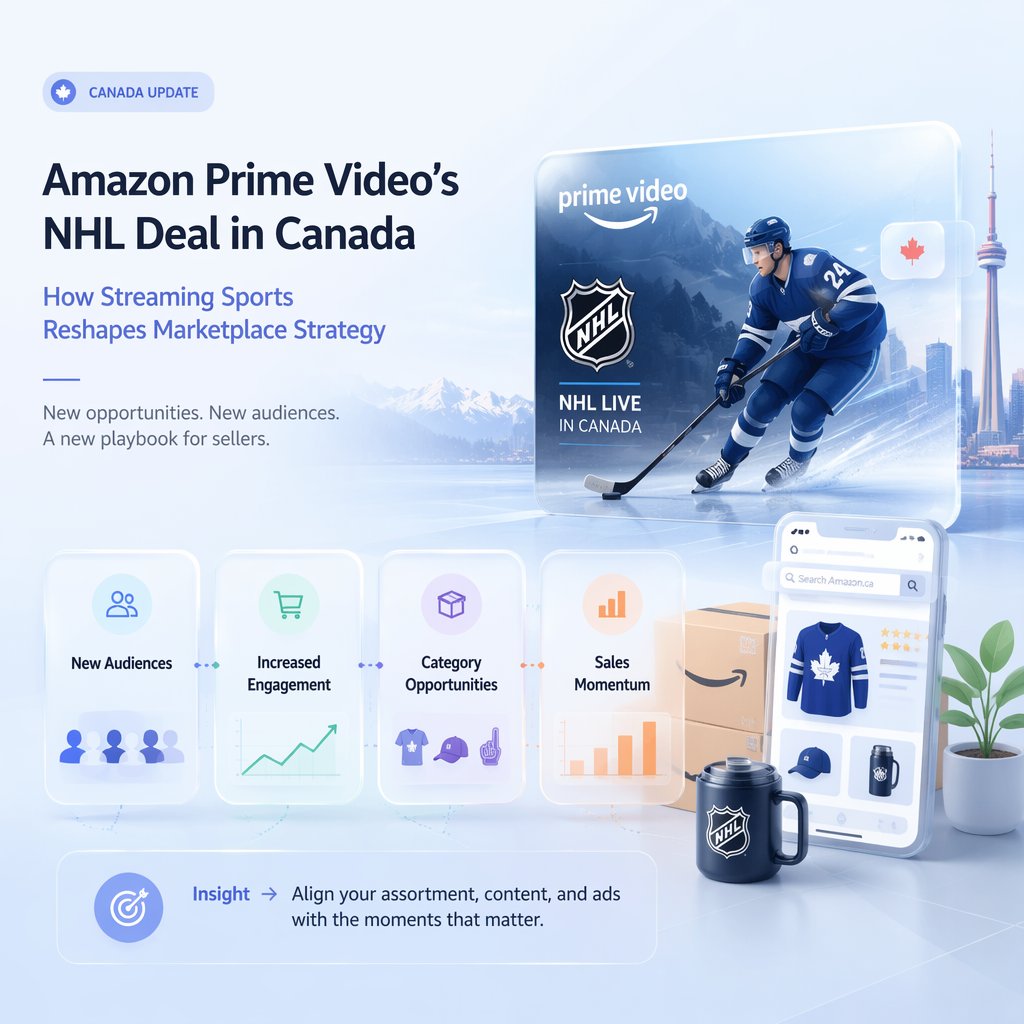
Amazon Prime Video NHL Deal in Canada: What Sellers Should Know
Salevoyant Editorial · July 30, 2026
Introduction
Amazon’s latest sports move in Canada is bigger than a content headline. Prime Video is taking exclusive Wednesday night NHL games and select playoff series under a new 12-year Rogers deal, which tells us a lot about where Amazon wants to sit in the media stack.
For Amazon sellers, vendors, and marketplace operators, this matters because sports rights are no longer just a media business story. They’re now part of Amazon’s broader customer acquisition, Prime retention, and ad-supported commerce strategy.
Core Development
Amazon Prime Video will stream Wednesday night national NHL regular-season games in Canada, in both English and French, starting next season. The deal also includes select Stanley Cup playoff series, specifically two first-round series and one second-round series each year.
The arrangement is part of a 12-year licensing agreement with Rogers Communications, tied to Rogers’ separate
1 billion national NHL media rights package in Canada. Amazon says Prime members in Canada will get at least 26 regular-season games starting September 30, with no extra subscription fee beyond Prime.
A few details make this announcement stand out:
Sportsnet keeps most national NHL games
Prime Video gets a recurring weekly package, not just one-off events
Playoff inventory is selected through a draft-like allocation process
The deal runs through the 2037-38 season
Rogers’ earlier arrangement with CBC and Citytv is ending, which means the old free-to-air model is shrinking further. That’s a big symbolic shift. Hockey, which used to be tightly associated with broadcast television in Canada, is moving deeper into the streaming era.
Amazon is already not new to this game. Prime Video has been carrying Monday night NHL games in Canada for the past two seasons. This new pact expands that footprint and gives Amazon a more durable role in one of Canada’s most culturally important sports properties.
The key takeaway here is simple: Amazon isn’t just buying content, it’s buying habits.
Technical Deep Dive
From a platform perspective, this deal is about more than showing live video. Amazon has to deliver a low-latency, high-availability, multi-language broadcast experience at scale, while keeping the playback smooth across mobile, connected TV, web, and set-top devices.
That puts pressure on several parts of the Prime Video stack.
Live streaming infrastructure
Live sports is one of the hardest workloads in consumer streaming. Amazon needs:
Redundant ingestion paths for live feeds
Adaptive bitrate streaming using protocols such as HLS and likely DASH in parts of the delivery chain
Edge caching through CDN layers to reduce buffering and regional latency
Fast failover in case of encoder, origin, or distribution issues
Device-specific playback optimization for smart TVs, Fire TV, iOS, Android, browsers, and game consoles
Unlike on-demand video, hockey can’t be delayed or buffered heavily without harming the product. Even a few seconds of latency can create problems for live odds integrations, social media sync, and real-time fan engagement.
Multilingual delivery
The fact that the broadcast will run in English and French adds another operational layer. Amazon has to manage:
Separate audio tracks or alternate language feeds
Closed captioning and accessibility compliance
Stream metadata and locale-aware discovery
Scheduling logic so the right feed appears by region and language preference
For Canada, that’s not a nice-to-have. It’s a platform requirement. French-language support helps Amazon reach Quebec and Francophone viewers more effectively, but it also adds complexity to packaging, testing, and rights management.
Rights packaging and content orchestration
The “draft” style allocation of playoff series is interesting because it shows how flexible modern rights deals have become. Instead of a fixed list of events, Amazon gets a rotating selection based on availability and priority ordering.
That means the content operations team needs:
Rights-aware scheduling systems
Metadata tagging for each series and game
Dynamic entitlement logic
Coordination with league feeds, graphics, and regional restrictions
This is where streaming platforms differ from traditional broadcasters. A linear network is built around fixed schedules. A platform like Prime Video has to treat rights like software rules. The entitlement engine decides who sees what, when, and where.
Measurement and engagement data
Live sports on Prime Video also feeds Amazon’s measurement machine. The company can connect viewing behavior to:
Subscription retention
App engagement
Device usage patterns
Ad exposure, where applicable
Cross-service interactions inside the Amazon ecosystem
That’s valuable because sports viewers are often highly engaged but selective. If Amazon can keep them in the Prime ecosystem longer, it improves the lifetime value of the subscription.
Industry Impact
This deal says a lot about Amazon’s wider strategy in media and commerce.
First, Prime membership becomes more valuable when it includes must-watch live programming. Sports is one of the few content categories that still pulls large, scheduled audiences. That matters in an era when entertainment is increasingly fragmented.
Second, Amazon keeps blurring the line between media and commerce. Prime Video isn’t just a streaming app. It’s part of the larger Prime bundle that supports shipping, shopping, and now entertainment retention. The more reasons a customer has to keep Prime active, the better Amazon’s economics look.
Third, the move reinforces a broader trend across North American sports rights: streaming is no longer the side channel. It’s becoming a primary distribution layer. The Rogers deal follows patterns already visible with the CFL, Major League Soccer, the NFL, and parts of the NBA and MLB ecosystem.
For marketplace participants, there are practical knock-on effects:
Advertising inventory around live sports becomes more attractive
Sponsored products and brand campaigns benefit from higher Prime engagement
CTV ad strategies get more important for brands that sell on Amazon
Seasonal demand spikes around sports merchandise, snacks, electronics, and home-viewing gear can be targeted more precisely
For vendors, especially those in categories like consumer electronics, home audio, beverages, apparel, and collectibles, this creates another premium attention window. Hockey broadcasts drive predictable viewing habits. That’s useful for campaign planning, inventory forecasting, and media mix modeling.
Implementation Considerations
If you’re a seller, vendor, or brand manager, this kind of rights deal may feel far removed from your day-to-day work. It isn’t.
Here’s why it matters operationally.
For Amazon sellers
Live sports content can influence shopping behavior in subtle ways. If Prime Video drives more evening engagement, you may see:
Higher traffic on connected TV surfaces
Better response to seasonal promotions
More interest in sports-adjacent products
Stronger conversion for impulse-friendly items
Sellers should watch category demand around game nights and playoff periods. Products tied to watch parties, gift bundles, team colors, and home entertainment often benefit from scheduled events.
For Vendor Central users
Brands supplying Amazon directly should think about forecast alignment. When Prime engagement rises, Amazon’s demand signals can shift faster than expected in related categories. That means:
Watching Vendor Central replenishment trends more closely
Preparing for surge demand in media-adjacent categories
Tightening lead times for high-velocity SKUs
Coordinating promotions with broader Prime engagement windows
If you’re in Vendor Central, this is a reminder that Amazon’s media business can indirectly affect retail performance. Traffic and demand don’t always move in obvious ways, but they do move.
For advertisers and developers
If your brand runs Amazon ads or builds media measurement tooling, live sports creates a different environment than standard streaming inventory. Expect:
Higher concurrency windows
More premium CTV placements
Stricter performance requirements for creative delivery
More attention to attribution windows and audience overlap
Developers working in ad tech, streaming QA, or retail analytics should care about session timing, device compatibility, and event correlation. Live sports traffic is spiky. Systems need to handle bursts without degrading playback or ad delivery.
Practical checklist
Review category demand around NHL scheduling
Stress-test campaign timing for Prime Video audience spikes
Revisit CTV creative for sports-heavy viewing windows
Monitor Seller Central and Vendor Central performance data for seasonality changes
Prepare inventory earlier for playoff-linked demand in relevant categories
Future Outlook
This deal points to a future where Amazon treats live sports as a core Prime feature, not an experiment. Canada is a useful testbed because the market is bilingual, highly sports-aware, and already familiar with streaming adoption.
Expect Amazon to keep refining three things:
Broader sports rights packages
Amazon will likely continue pursuing regional and national rights where it can pair exclusivity with Prime value.
Deeper ad integration
Live sports audiences are premium. That creates room for better targeting, stronger sponsorship models, and more sophisticated measurement.
Tighter commerce linkage
The long-term opportunity isn’t just video. It’s making sports content a trigger for retail behavior inside Amazon’s ecosystem.
There’s also a competitive signal here. As more broadcast rights move to streaming platforms, traditional TV loses its grip on appointment viewing. That weakens free-to-air discovery and increases the value of bundled subscriptions. Amazon understands that very well.
For marketplace sellers, the implication is clear. The more Amazon controls customer attention, the more influence it has over shopping behavior, search patterns, and ad performance. Media and commerce are no longer separate tracks.
Conclusion
Amazon’s new NHL deal in Canada is a sports rights announcement on the surface, but it’s also a platform strategy move with wider implications. Prime Video gets premium live content, Rogers extends its long-term media play, and Amazon strengthens the case for Prime as a multi-purpose subscription.
For sellers and vendors, the practical lesson is to pay attention to where Prime engagement is growing. Live sports can shift traffic, ad performance, and category demand in ways that aren’t always obvious at first glance.
If you work in Amazon commerce, keep an eye on these media deals. They’re not side stories anymore. They’re part of the infrastructure that shapes how customers spend time, and eventually, how they spend money.