Amazon Seller Central: 2 Vogels Predictions to Watch Before You Budget
Salevoyant Editorial · November 24, 2026
Introduction
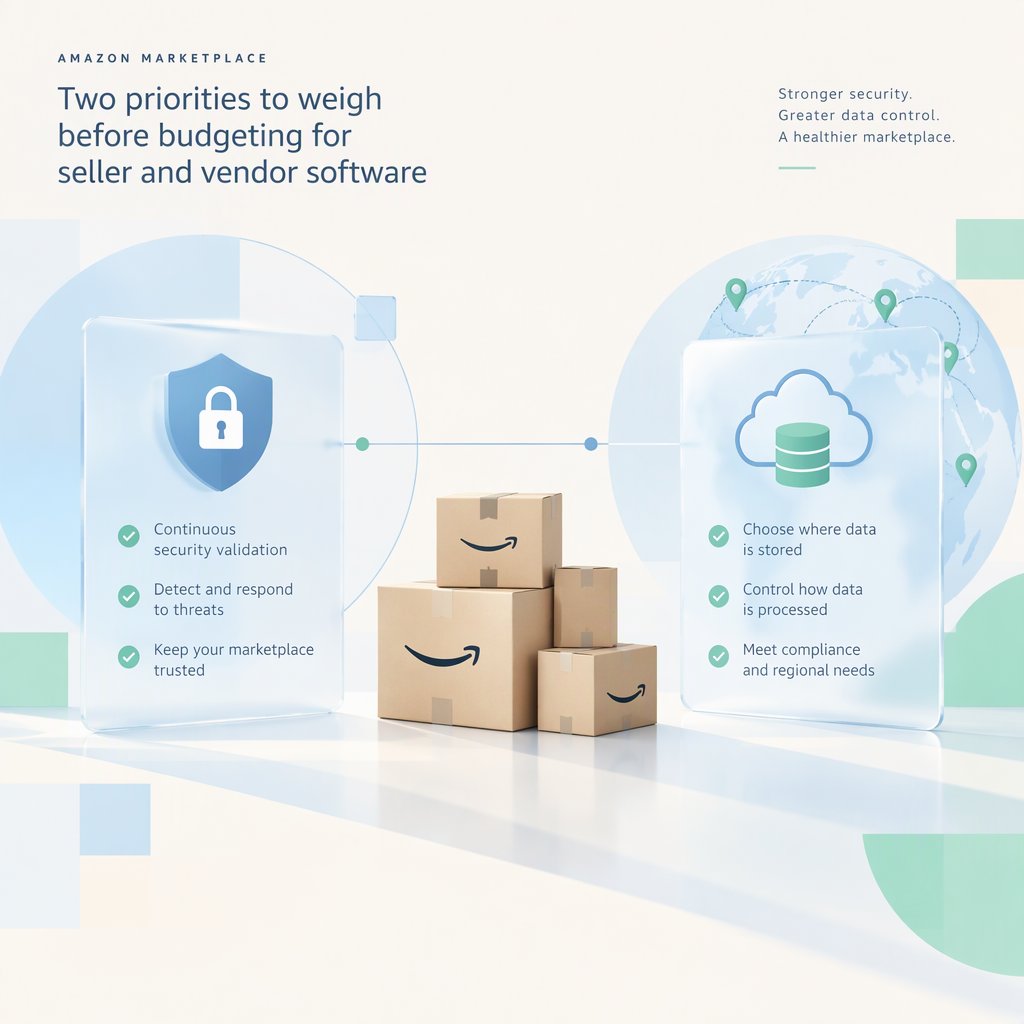
Amazon CTO Werner Vogels’ 2027 predictions aren’t a Seller Central or Vendor Central roadmap, but two of them deserve attention before marketplace teams lock in next year’s software budgets. If a connector can touch listings, inventory, or purchase orders, the immediate questions aren’t about which AI model it uses. They’re about what it can change, where it sends data, and who finds out when something goes wrong.
Core Development
In his November 24 forecast, Vogels lays out five bets for 2027 and beyond: computing will borrow more from neuroscience, software security testing will run continuously, data sovereignty will become a design requirement, scientists will work with AI agents to discover treatments, and non-invasive brain interfaces will start to find everyday uses by the end of the decade.
It’s a forecast, not a product announcement. The article doesn’t announce a change to Seller Central, Vendor Central, or Amazon’s Selling Partner API (SP-API). But Amazon’s decision to frame continuous security validation and data sovereignty as engineering problems is worth noting. Vogels points to AWS Continuum as an early example of ongoing risk detection in code and to AWS European Sovereign Cloud as one option for organizations that need a dedicated environment.
The marketplace connection is an analytical one: sellers and vendors increasingly depend on software that operates outside Amazon’s portals. A workflow might begin with an Amazon report or API call, then pass through a connector, an ERP, a support platform, and an AI service. Each handoff brings a decision about access, storage, and accountability that the seller or vendor may not see in the portal.
Technical Deep Dive
Continuous validation changes what counts as a finished release. An integration can pass review when it ships and become riskier later when an admin broadens a permission, a connector adds a feature, or a new automation starts writing to a production account. For commerce teams, useful defensive checks don’t need to be exotic. Verify that a reporting service can’t publish listing changes, that revoked credentials no longer work, and that a failed inventory sync generates an alert rather than quietly leaving a stale quantity in place.
The distinction between read and write access also changes the business case for automation. An AI assistant that summarizes inventory exceptions has a different risk profile from one that pushes quantity changes across every SKU. Start with recommendations and keep high-impact actions behind approval. If the automation eventually earns write access, cap the size of a batch and keep a record of the previous values so an operator can correct a bad update without reconstructing it from spreadsheets.
Sovereignty is about more than the region on a database. Vogels argues that teams will need to prove where data lives, who controls the encryption keys, and which model processes it. Take a vendor tool that summarizes purchase order discrepancies. Its main database might reside in Europe, while diagnostic logs, backups, or model requests cross a boundary the procurement team thought it had set. Customer-held keys can help control access to stored data, but they don’t establish where a separate service processes a request. Useful controls cover both storage and processing.
The computing forecast is a longer-term performance story. Moving data between memory and processors costs energy and adds latency. Vogels sees promise in neuromorphic designs that bring storage and computation closer together. For commerce, a plausible fit is local inspection at a packing station where a round trip to a cloud service adds delay or makes the workflow dependent on a stable connection. That’s not a reason to replace warehouse hardware today. It’s a reason to measure latency and exception rates before assuming a larger cloud model is the only answer.
Industry Impact
The near-term competitive advantage may go to software providers that can explain their controls without making a merchant open a support ticket. A seller comparing two repricers should be able to see which tool can update offers, what happens if a rule proposes an outlier price, and how quickly an operator can pause changes. The cheapest subscription can turn expensive if one bad batch creates hours of cleanup or exposes a large share of the catalog to incorrect pricing.
Vendor Central users have a different exposure. Where suppliers connect purchase order acknowledgments, shipping notices, and invoices through EDI or an integration partner, automated exception handling can cut manual work. It can also send a discrepancy downstream before anyone checks the underlying records. A tool that flags a case-pack mismatch for review is easier to justify than one that changes a shipping notice without checking what the warehouse actually packed.
The useful question isn’t whether a connector has AI. It’s whether you can see what it changed, stop the next batch, and correct the last one.
There’s a trade-off for the people buying these tools. More controls can mean higher costs or slower rollouts, particularly if a provider runs separate regional deployments. But not every workload needs that expense. Aggregate SKU-level sales analysis and a workflow that handles order records need different reviews. Applying the strictest setup to both can raise costs without reducing the risk that actually matters.
Implementation Considerations
Start with one workflow that writes back to Amazon or feeds a downstream transaction. Inventory availability, bulk pricing, and purchase order acknowledgments are better candidates for a first review than a dashboard that only reads data.
- Map the handoffs. Record the Amazon account, connector, destination, and owner. Ask where production data, logs, and backups are stored. If a model is involved, ask where
model inferenceruns and whether inputs are retained. - Set limits before increasing volume. Use
read-onlyaccess where the workflow permits it. For write-enabled tools, set batch limits and approval thresholds, and test the pause control before expanding to more SKUs or accounts. - Check recovery, not just throughput. Ask how the connector handles duplicate messages and
idempotency, meaning a retry shouldn’t apply the same change twice. Verify that an operator can distinguish a delayed update from one that failed or was only partly applied. - Measure the whole cost. Track review time, manual corrections, support tickets, and time to detect a bad update alongside subscription fees. If a tool clears routine exceptions faster but makes unusual cases harder to investigate, the time savings may not survive peak season.
Future Outlook
The other predictions sit farther from a marketplace operator’s planning cycle. Vogels expects researchers and AI agents to work together on drug discovery, with scientists verifying results and clinical trials still determining safety and efficacy. He also expects non-invasive brain interfaces to improve access for people who can’t speak or move. That’s a reason to follow assistive technology, not a reason to budget for a new shopping interface. Accessible product pages and clear interaction patterns have a more immediate payoff.
The nearer-term signal is in how technology buyers evaluate automation. If Vogels is right, expect more questions about update controls, data processing locations, and how vendors verify those settings after a release. A one-time questionnaire is a weak substitute for evidence the controls still work when a connector ships a new version.
Conclusion
Vogels’ forecast doesn’t change what sellers or vendors need to do in Amazon’s portals today. It does offer a test for the software they buy in 2027. Pick the integration with the most consequential write access, trace its data beyond the main database, and verify who can stop or correct a change. Do that before adding another marketplace, account, or batch of SKUs. It’s cheaper to learn where the controls fall short when the workflow is still small.