Amazon Seller Central and AWS AI Chip Deal with Qualcomm Explained
Salevoyant Editorial · September 9, 2026
Introduction
Amazon’s latest infrastructure move isn’t about retail, and that’s exactly why it matters. Qualcomm’s new partnership with Amazon gives us a clearer view of how AWS is building the next generation of AI compute, and how fast the market for custom chips is changing.
For Amazon sellers and Vendor Central teams, this may sound far removed from Buy Box pricing or catalog management. It isn’t. The same AWS infrastructure that powers Amazon’s cloud services is now becoming a bigger part of how AI workloads, forecasting tools, content systems, and marketplace automation get built and scaled.
Core Development
Qualcomm announced a long-term agreement that could allow Amazon to buy up to $60 billion worth of Qualcomm AI data-center chips and related products. On top of that, Qualcomm granted Amazon warrants worth about $4 billion, which vest as product purchases happen and give Amazon the right to buy Qualcomm shares at a fixed price of
61.26 each.
That structure is important. This isn’t just a supplier contract. It’s a commercial partnership with financial alignment baked in. Qualcomm gets the chance to deepen its role in AI infrastructure, while Amazon gets preferred access to a chip roadmap that may help diversify its compute stack beyond the usual hyperscaler playbook.
The deal matters for three reasons:
It gives Qualcomm a credible path into AI inference, the faster-growing part of AI infrastructure
It adds another big customer to Qualcomm’s cloud strategy, alongside Microsoft and Meta
It reinforces Amazon’s habit of using long-term infrastructure partnerships to secure capacity and influence product direction
Qualcomm said the partnership also includes work on high-speed optical connectivity, including designs that reach 1.6 terabits per second. That’s not a marketing detail. It points to the reality that AI data centers are becoming network-bound as much as compute-bound.
Technical Deep Dive
To understand why this deal matters, you have to look at where the AI market is heading. Training giant models still grabs headlines, but most day-to-day AI usage is now about inference, meaning the execution of already trained models. That includes everything from recommendation engines and search ranking to document summarization, customer service assistants, and product listing tools.
In Amazon’s ecosystem, inference is everywhere.
Think about:
Search relevance in the Amazon store
Advertising auction models in Amazon Ads
Demand forecasting in Vendor Central planning tools
Listing optimization and automated content generation
Fraud detection and account risk scoring
Alexa and voice services
Internal copilots and agent workflows used by Amazon teams
Inference workloads reward different chip traits than training workloads. They need lower latency, predictable throughput, power efficiency, and cost control at scale. That’s where custom silicon becomes attractive.
Qualcomm is positioning its chips for that exact use case. Instead of trying to beat Nvidia head-on in every category, it’s targeting specialized workloads where performance per watt and integration with networking matter just as much as raw GPU muscle. That strategy makes sense for Amazon, which runs massive distributed systems and cares deeply about unit economics.
The optical side of the deal is just as interesting. As models get larger and inference clusters get denser, data centers run into communication bottlenecks. You can’t just keep adding compute and expect performance to scale linearly. At some point, the network becomes the limiter.
That’s why the mention of 1.6T optical interconnects stands out. Faster interconnects can reduce the time it takes for chips to exchange data across racks and pods. In practical terms, that can improve:
Distributed inference throughput
Model serving latency
Cluster efficiency
Energy usage per request
Amazon has been investing in this kind of infrastructure for years through AWS networking, Nitro-based offload systems, and its own chip designs. The Qualcomm deal suggests Amazon wants more optionality in the silicon layer, not just more of the same hardware from the same vendors.
The real story isn’t just that Amazon might buy chips from Qualcomm. It’s that AWS continues to build a multi-vendor AI stack where silicon, networking, storage, and cloud services are all being optimized together.
There’s also a financial angle. The warrant structure ties Amazon’s purchasing volume to potential equity upside. That kind of arrangement has become more common in the AI sector because it lowers the friction of adoption while signaling long-term commitment. It’s part procurement strategy, part ecosystem control.
Industry Impact
For the broader Amazon ecosystem, this deal has practical consequences beyond the data center.
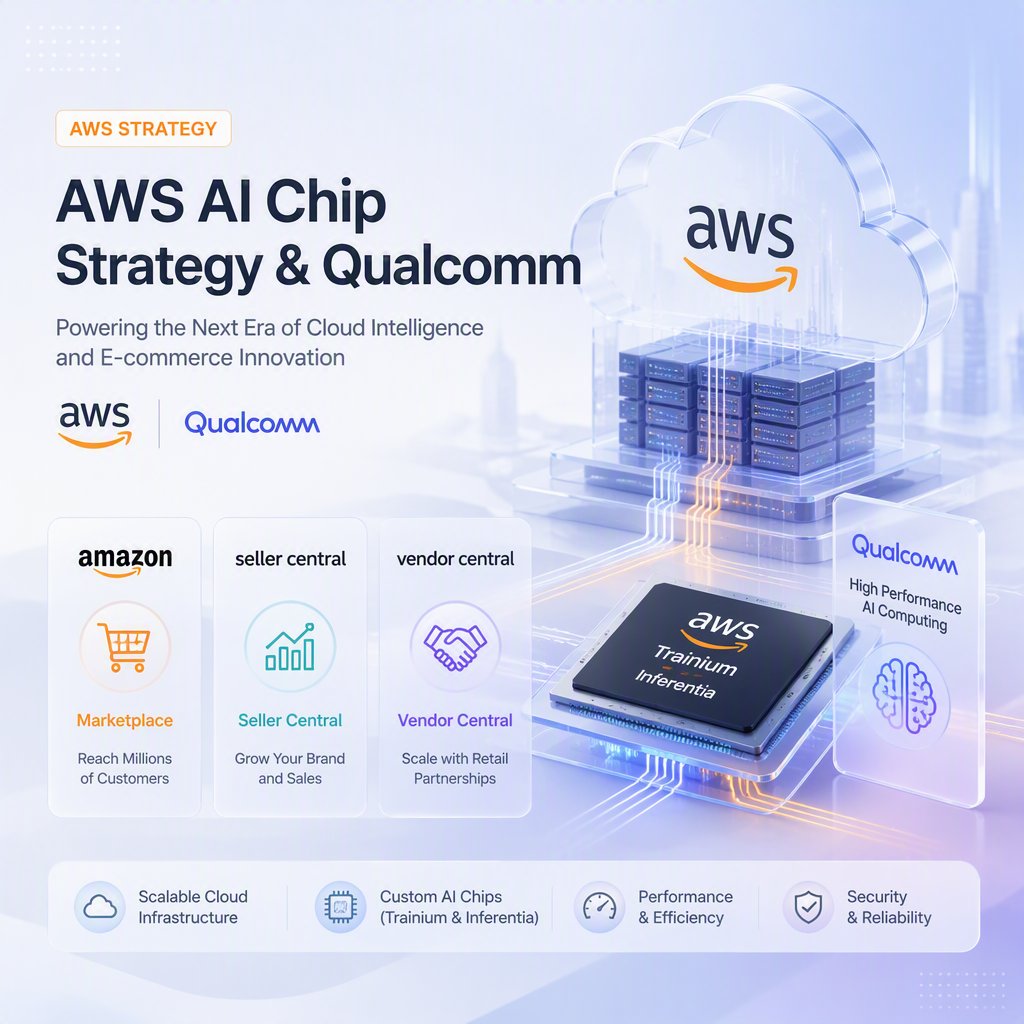
First, it strengthens AWS’s ability to offer more differentiated AI infrastructure. Amazon already has its own chip family, including Trainium and Inferentia, which support model training and inference workloads. Qualcomm now adds another option. That matters because cloud customers don’t all want the same thing. Some want the cheapest inference stack. Others want lower latency or better compatibility with their software pipeline. More hardware choices usually mean better pricing pressure and more deployment flexibility.
Second, it reinforces Amazon’s long-term strategy of controlling more layers of the stack. Amazon has always liked owning infrastructure where it can. From logistics to cloud to custom silicon, the company tends to invest in systems that improve margin over time and reduce dependence on outside vendors.
For sellers and vendors, the indirect impact is real:
Better AI infrastructure can improve forecasting accuracy
Faster inference can support smarter ad targeting
More efficient model serving can reduce latency in search and recommendation systems
Internal automation may accelerate improvements in catalog quality, supply chain visibility, and support tooling
If you’ve noticed Amazon rolling out more automated seller experiences, better content tools, or tighter operational workflows, deals like this are part of the foundation. They’re not visible in Seller Central, but they shape what’s possible inside it.
This also keeps pressure on Nvidia and other semiconductor vendors. AWS has no interest in being locked into a single chip roadmap. A more diverse supplier base gives Amazon negotiating power and resilience if shortages, pricing swings, or performance trade-offs hit one segment of the market.
For vendors using Vendor Central, the outcome could be subtle but meaningful. Better AI infrastructure can improve purchase order forecasting, replenishment recommendations, and retail analytics systems. That doesn’t solve every planning issue, but it can reduce noise in the data.
Implementation Considerations
If you work in the Amazon ecosystem, this isn’t a stock story to file away and forget. It has execution implications.
For developers and technical teams
Expect AWS to keep expanding support for specialized AI instance types
Watch for more tooling around model serving, low-latency inference, and distributed workloads
Plan for architecture choices that assume heterogeneous compute, not one-size-fits-all GPU infrastructure
Keep an eye on pricing and performance benchmarks across AWS chip families, especially for inference-heavy applications
For sellers
AI-driven catalog optimization tools may get faster and cheaper to run
Product content generation tools could become more responsive and more available at scale
Search and ad systems may continue getting smarter, which means your data quality matters even more
Clean titles, correct attributes, and strong image assets will matter in a more automated ranking environment
For Vendor Central users
Forecasting and replenishment systems may gradually improve if Amazon can run more inference at lower cost
More compute efficiency could support richer analytics in retail operations
If Amazon’s internal tooling gets faster, vendor-facing recommendations may become more frequent and more granular
Practical takeaway
Don’t think of AI infrastructure as something only cloud architects care about. In Amazon’s world, better compute often shows up later as better tools, faster automation, and tighter operational control.
That said, there are trade-offs. Custom chips don’t always win on compatibility. If a workload depends on a very specific framework, library, or optimization path, moving it to a new hardware stack can take time. Enterprises will still compare:
Performance
Power efficiency
Developer effort
Migration risk
Total cost of ownership
If the economics are better but the software port is painful, adoption slows. Amazon knows this, which is why these partnerships usually arrive with tooling, networking, and cloud integration attached.
Future Outlook
This deal signals a market that’s moving past the “one chip fits all” phase of AI. Hyperscalers want choices. Chipmakers want anchor customers. And everyone wants lower inference costs because that’s where the volume is heading.
For Amazon, the next step is likely a broader mix of custom silicon and partner silicon across AWS regions and service tiers. That gives the company more room to tune workloads by price, performance, and energy profile. It also helps Amazon respond to the rapid growth in AI features across its own services without becoming overly dependent on any single hardware supplier.
For the marketplace side, expect more AI-native features to appear in the tools sellers and vendors already use. Those features may not be flashy. They’ll probably show up as faster recommendations, better anomaly detection, smarter search, and more automation in the background. But that’s where the real value often lands.
If Qualcomm’s chips prove efficient for inference, and if the optical networking piece holds up in real deployments, this partnership could push other cloud providers to lock in similar supply arrangements. That’s how infrastructure markets evolve. One deal leads to another, then the benchmarks shift, and suddenly the ecosystem has new assumptions about cost and scale.
Conclusion
Qualcomm’s partnership with Amazon is bigger than a chip order. It’s a sign that AI infrastructure is becoming more specialized, more financially intertwined, and more central to how Amazon builds everything from AWS services to seller tools.
For Amazon sellers, vendors, and technical teams, the lesson is straightforward:
AI features inside Amazon’s ecosystem will keep expanding
Infrastructure efficiency will shape product speed and service quality
Custom silicon and optical networking are now core parts of the competitive battle
Better cloud economics can ripple into better marketplace tools over time
This isn’t the kind of announcement that changes your Seller Central dashboard overnight. But it does shape the engine under the hood. And in Amazon’s world, that engine determines a lot of what comes next.