Amazon Seller Central and AWS Leadership Change: What to Know
Salevoyant Editorial · July 16, 2026
Introduction
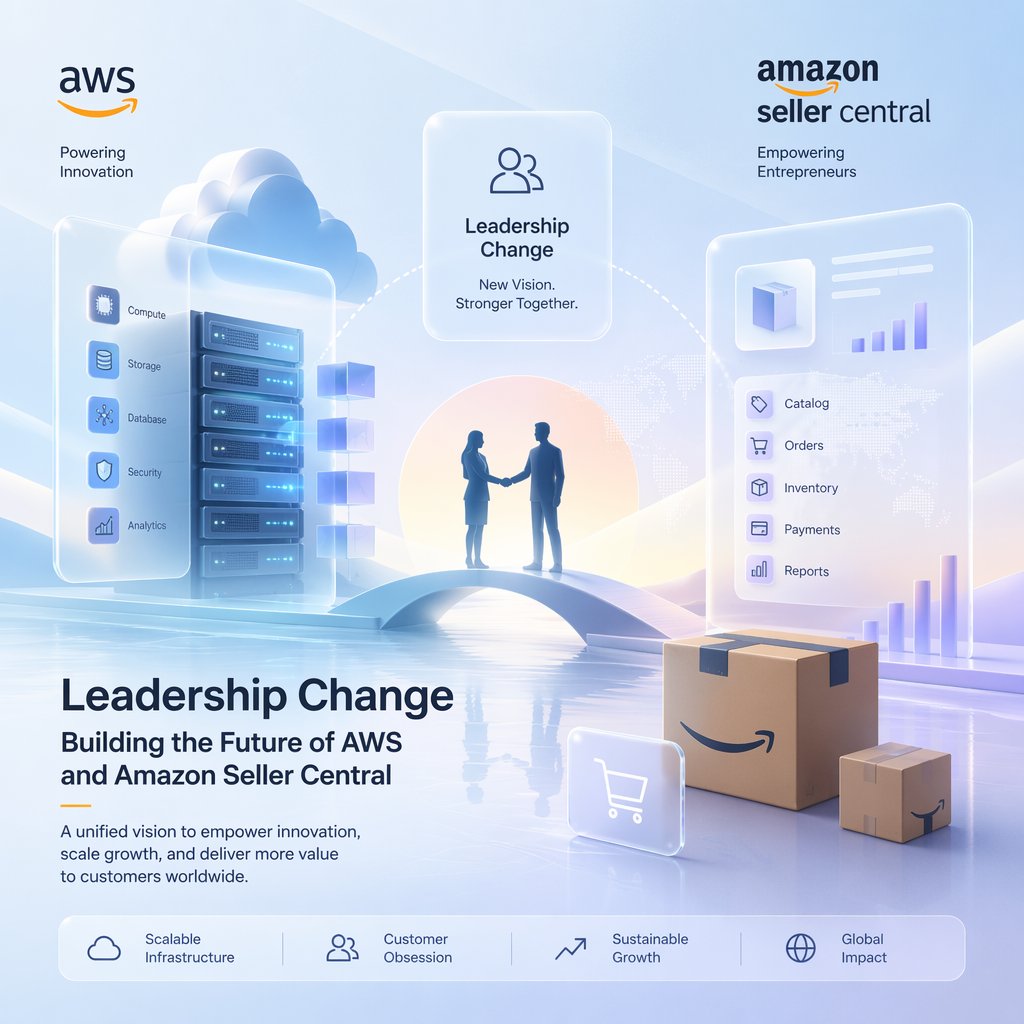
Amazon doesn’t usually make a lot of noise about internal leadership changes, but this one matters. Dave Brown, a long-time AWS executive and one of the people close to Andy Jassy’s inner advisory circle, is leaving after 19 years. The timing is notable because Amazon is still tightening the connection between cloud infrastructure, AI services, and the systems that power its retail and marketplace operations.
For sellers, vendors, and marketplace tech teams, this isn’t just a personnel story. It’s a signal about where Amazon is placing strategic weight, especially around compute, machine learning, and the shared foundation that supports both AWS and Amazon’s retail engine.
Core Development
According to the memo from AWS CEO Matt Garman, Dave Brown is departing for another job after nearly two decades at Amazon. Brown was most recently responsible for compute and machine learning services, two of the most important pillars in AWS today. Those services sit at the core of how Amazon runs modern workloads, from model training and inference to high-scale application hosting.
Brown’s replacement is Dave Treadwell, currently senior vice president of ecommerce foundation, starting August 1. That detail is easy to miss, but it’s important. Treadwell isn’t just another AWS leader. He’s deeply tied to Amazon’s retail infrastructure, which suggests Amazon wants continuity between cloud systems and the underlying commerce stack that powers its marketplaces.
There’s also the S-team angle. Both Brown and Treadwell are members of Amazon’s senior leadership team, the group that directly advises Jassy. That means this isn’t a routine org chart shuffle. It’s a transfer of responsibility inside Amazon’s highest decision-making layer.
When Amazon moves an S-team executive between cloud and ecommerce infrastructure, it usually reflects a broader architectural priority, not just a management change.
Technical Deep Dive
At a technical level, Brown’s old role sits in one of the most important parts of AWS. Compute services are the foundation for EC2, containers, autoscaling, and managed runtime environments. Machine learning services cover the tools that let customers train models, run inference, manage data pipelines, and deploy AI features at scale.
These systems matter because Amazon’s internal and external workloads both depend on them. AWS customers use the same broad compute layers that Amazon teams rely on for everything from retail search to forecasting and logistics optimization. That creates a unique feedback loop. Amazon builds infrastructure for its own business needs, then hardens it into commercial cloud services.
A leadership change in this area can affect several technical priorities:
- Capacity planning and chip strategy: AWS is still balancing demand across CPU, GPU, and custom silicon like
TrainiumandInferentia. - Inference economics: AI workloads are shifting from training-heavy spending to persistent production inference, which changes how AWS prices and optimizes services.
- Service reliability: Compute and ML services have to stay stable under extreme customer load, especially as generative AI use grows.
- Platform consistency: AWS customers expect predictable APIs, low-latency orchestration, and backward compatibility across regions and instance families.
Treadwell’s background in ecommerce foundation suggests Amazon may want someone who understands large-scale platform plumbing, not just cloud product strategy. Ecommerce foundation is where Amazon handles the less visible but absolutely critical parts of its retail system, things like catalog infrastructure, transaction workflows, inventory coordination, and the services that keep Seller Central and Vendor Central functioning at scale.
That crossover matters. Amazon’s retail stack and AWS aren’t isolated businesses. They share architectural DNA. Both depend on distributed systems, resilient data pipelines, and careful service decomposition. A leader who understands retail infrastructure may be better positioned to align AWS platform work with Amazon’s internal operating model.
One practical implication is the growing overlap between commerce data and AI systems. Amazon sellers already use AI-assisted tools in areas like product listing optimization, ad targeting, and demand forecasting. Vendors increasingly depend on integrated systems for purchase order visibility, supply chain planning, and forecasting. Those workflows rely on reliable compute, fast model inference, and well-governed data movement. If AWS shifts its internal priorities toward ecommerce-grade reliability and cost efficiency, that can ripple outward into the tools sellers use every day.
Industry Impact
This leadership move lands in a period when Amazon is under pressure from multiple directions. Cloud competitors are pushing harder on AI infrastructure. Enterprise customers want lower-cost inference. Sellers want better marketplace tools. Vendors want cleaner forecasting and fewer operational surprises. Amazon has to support all of that without letting complexity pile up.
For the broader ecosystem, there are a few likely implications.
1.
More alignment between AWS and retail operations
Amazon has always benefited from the fact that its cloud business and retail business inform each other. But in practice, those groups can still operate with different priorities. Brown’s replacement coming from ecommerce foundation hints that Amazon may be emphasizing tighter coordination between infrastructure teams and commerce systems.
That could show up in:
- Better internal APIs for commerce services
- More robust observability across marketplace workflows
- Improved latency and reliability for seller-facing tools
- Cleaner integration between forecasting, fulfillment, and AI services
2.
More pressure on AI cost efficiency
Compute and machine learning are where AWS margins and customer economics intersect. As AI adoption grows, customers are becoming much more sensitive to cost per request, throughput, and model efficiency. Amazon needs to show that its stack can support production-scale AI without forcing customers into runaway bills.
For sellers and vendors, this matters because Amazon’s own AI tools are only as good as the infrastructure underneath them. If AWS can lower inference costs and improve service reliability, Amazon has more room to expand AI-powered features inside Seller Central, advertising tools, catalog management, and supply chain systems.
3.
Signs of continuity, not disruption
This doesn’t look like a breakup in strategy. It looks more like a controlled handoff. AWS is keeping an S-team-caliber executive in the role, and that usually means Amazon wants stability while it evolves the platform.
That stability is important for third-party developers and service providers. Amazon’s ecosystem is tightly coupled to backend changes, even when sellers never see the underlying code. A steady infrastructure roadmap reduces the risk of sudden API shifts, performance regressions, or feature fragmentation.
Implementation Considerations
If you build on Amazon’s ecosystem, whether through seller tools, vendor tech, ads automation, or marketplace software, this is a good moment to review your own dependency stack.
For developers and SaaS providers
- Audit your use of
AWS computeservices such as EC2, ECS, EKS, Lambda, and managed ML endpoints. - Watch for pricing or architecture changes tied to
Trainium,Inferentia, and GPU capacity. - Recheck scaling policies, especially for workloads that spike during Prime Day, holiday peaks, or major promo events.
- Strengthen monitoring around API latency, queue backlogs, and model inference times.
If your product depends on Amazon marketplace data, assume that backend changes can affect availability and response timing even if the public APIs stay the same. Build for retries, idempotency, and graceful degradation.
For Amazon sellers
You won’t feel this change directly in Seller Central tomorrow, but the knock-on effects still matter.
- Better infrastructure can mean more stable listing tools, ad interfaces, and analytics dashboards.
- Faster ML systems can improve recommendation engines, demand signals, and catalog enrichment.
- More efficient cloud operations can support new AI features without adding friction for sellers.
If you run automated repricing, inventory forecasting, or ad optimization tools, pay close attention to service reliability. Amazon’s ecosystem often rewards teams that are ready for subtle platform changes before they become visible to everyone else.
For Vendor Central users
Vendor workflows are especially sensitive to backend consistency because so many operations depend on predictable data exchange.
- PO routing, ASN handling, and forecast visibility all benefit from stronger infrastructure.
- If Amazon expands AI-driven planning tools, vendors may see more automation in replenishment and exception management.
- Integration partners should test EDI and API workflows for robustness during high-volume periods.
That’s not just operational hygiene. It’s ROI protection. A few minutes of downtime in a high-volume replenishment cycle can create stockouts, lost buy box opportunities, and avoidable chargebacks.
The sellers and vendors who win are usually the ones who treat Amazon’s platform changes as infrastructure events, not just product updates.
Future Outlook
This leadership shift points to a few likely trends over the next 12 to 18 months.
First, Amazon will probably keep pushing hard on AI-native infrastructure. That means more emphasis on custom silicon, lower-latency inference, and services tuned for production AI rather than experimental demos. AWS has to compete on both raw capability and cost control.
Second, expect more convergence between retail systems and cloud engineering. Amazon’s own commerce business is too large and too data-heavy to stay separate from its infrastructure roadmap. The company has an incentive to turn internal operational lessons into reusable platform features.
Third, marketplace participants should expect Amazon to keep investing in automation. Seller tooling, vendor planning, search relevance, and ad targeting all benefit from stronger compute and ML layers. That doesn’t mean every workflow gets easier, but it does mean Amazon will keep trying to remove manual steps where machine decisions can improve speed or scale.
Finally, leadership continuity at the S-team level suggests Amazon isn’t about to slow down. It’s reorganizing for the next stage of cloud and commerce growth, and the overlap between those two businesses is only getting tighter.
Conclusion
Dave Brown’s departure is a big internal change, but the real story is what Amazon does next. By moving Dave Treadwell from ecommerce foundation into a senior AWS role tied to compute and machine learning, Amazon is reinforcing the link between cloud infrastructure and commerce systems.
For Amazon sellers, Vendor Central users, and marketplace tech teams, the takeaway is straightforward:
- Infrastructure decisions at AWS still shape seller-facing tools.
- AI and compute economics will keep influencing Amazon’s product roadmap.
- Backend leadership changes can affect reliability, scale, and feature velocity across the ecosystem.
If you build on Amazon, keep an eye on these moves. They often tell you where the platform is heading long before the changelog does.