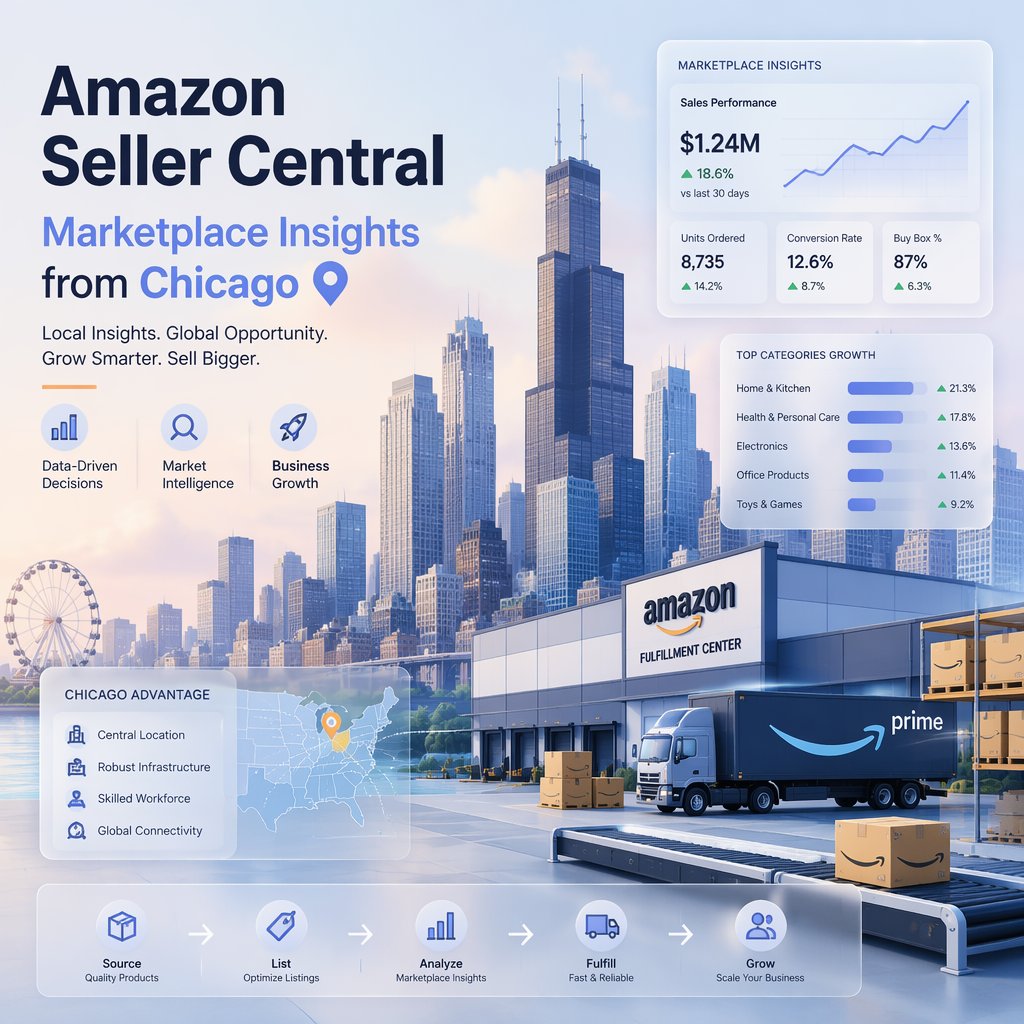
Amazon Seller Central and Marketplace Insights from Chicago
Salevoyant Editorial · July 20, 2026
Introduction
Amazon’s latest Chicago update is more than a feel-good local story. It’s a useful signal for anyone watching how the company scales its marketplace, logistics network, and workforce strategy at the same time. In one city, Amazon is showing how seller growth, delivery infrastructure, employee training, and community investment are becoming tightly connected.
For sellers, vendors, and e-commerce operators, that matters now because Amazon’s competitive edge isn’t just built on warehouse capacity anymore. It’s built on city-by-city execution, local trust, and a labor and logistics model that keeps the marketplace moving.
Core Development
Amazon says it has been part of Chicago for more than 15 years, with facilities across the city and more than 5,000 employees. Since 2021, the company has donated more than $24.4 million to over 120 Chicago-based organizations, funding education, health, arts, and food access programs.
That headline figure is important, but the more interesting part is how Amazon is tying those investments to its core business. The company is using Chicago as a case study for three things at once:
Building a stronger local labor and delivery network
Expanding access to technical education and career pathways
Supporting the small business ecosystem that depends on Amazon’s marketplace and logistics services
Chicago is also a meaningful test market because it combines dense urban delivery challenges, a broad consumer base, and a deep pool of education and nonprofit partners. If Amazon can align its infrastructure and community programs here, the model can be repeated in other major metros.
The company highlighted several specific programs:
.2 million in philanthropic and in-kind support for students and schools since 2021
$450,000 in grants for summer programs at the Discovery Partners Institute
More than 90,000 students and 1,100 teachers supported through computer science programs in 2025
68 Chicago students receiving Amazon Future Engineer scholarships since 2019
More than 300,000 meals delivered in Chicago in 2025 through the company’s delivery network
More than 13,000 indirect jobs supported in the city, including drivers and DSP staff
That’s a broad footprint. But it also reflects a very specific Amazon strategy, keep the physical network close to the customer while building a workforce and seller base that can scale with demand.
Technical Deep Dive
The Chicago announcement makes more sense when you look at Amazon as a systems company, not just a retailer. The company runs a layered stack that includes fulfillment centers, delivery stations, Delivery Service Partners (DSPs), seller infrastructure, employee training systems, and community partnerships. Each layer feeds the others.
1.
Local logistics as a network optimization problem
Chicago is a hard city to serve efficiently. You’ve got dense neighborhoods, traffic constraints, weather swings, and a mix of residential and commercial delivery patterns. Amazon’s answer is to distribute fulfillment and last-mile delivery capacity close to demand centers.
That reduces last-mile latency, improves route density, and helps the company keep shipping promises consistent. For sellers, the practical result is better access to faster shipping options, including Prime-eligible delivery performance that depends heavily on local network health.
DSPs are a key part of that model. Amazon says more than 10 DSPs in Chicago employ over 1,000 drivers and support staff. These are independent small businesses, but they operate inside Amazon’s routing, dispatch, and delivery standards.
From a technical perspective, that means Amazon can scale delivery capacity without owning every vehicle or directly employing every driver. It’s a distributed operations model with centralized control over performance metrics. That helps Amazon absorb demand spikes, but it also means DSPs need to maintain strict execution quality to stay competitive.
2.
Workforce development as infrastructure, not charity
Programs like Career Choice, the Mechatronics and Robotics Apprenticeship, and Future Engineer aren’t just goodwill initiatives. They’re pipeline-building tools.
Amazon’s fulfillment and transportation operations rely on a steady flow of trained workers who can operate in high-throughput environments. Robotics systems, warehouse automation, and data-driven logistics all require people who can maintain equipment, interpret workflows, and adapt to operational software. Career programs help reduce training friction and turnover risk.
That matters for throughput. When labor quality is unstable, fulfillment performance gets noisy. When workers understand the systems around them, the network performs better.
Amazon says more than 25,000 hourly workers across Illinois are eligible for Career Choice, with 30 participating schools in the state. That creates a local training ecosystem that can support Amazon’s own operations while also feeding the broader labor market.
3.
Marketplace growth depends on ecosystem stability
The company also points to independent sellers as the majority of sales in its store, with more than 60% of sales coming from third-party sellers. In Illinois, those sellers moved more than 152 million items in 2025, averaging over $415,000 in sales per seller.
Those numbers matter because marketplace success doesn’t live only in Seller Central dashboards. It depends on inventory flow, delivery speed, customer service consistency, and regional infrastructure. A Chicago seller that benefits from faster inbound freight or improved local delivery options can convert that into higher Buy Box competitiveness and lower defect risk.
The same applies in Vendor Central. For brands selling wholesale to Amazon, better local fulfillment efficiency can reduce stockouts, improve replenishment cadence, and support more reliable availability in high-demand metro areas.
Amazon’s community work in Chicago isn’t separate from operations. It sits alongside the logistics stack and helps keep that stack resilient.
Industry Impact
This Chicago push reflects a broader shift in how Amazon competes. The company isn’t just trying to ship faster. It’s trying to make its local presence harder to displace.
For sellers, that has a few real implications.
Stronger delivery infrastructure can improve conversion
When Amazon’s regional network performs well, sellers benefit from faster shipping promises, better customer satisfaction, and fewer delivery exceptions. That can influence conversion rates, especially for items where speed matters more than brand loyalty.
Local economic ties help stabilize demand
Amazon is investing in education, food access, and arts programs, but there’s also a business logic here. Cities that see Amazon as a net contributor are less likely to treat the company as a purely extractive platform. That doesn’t eliminate regulatory pressure, of course, but it can soften the environment around expansion, labor access, and facility operations.
Seller competition may get tougher, not easier
A healthier logistics network tends to favor sellers who already manage inventory well and maintain strong metrics. If Amazon’s local delivery system improves, those sellers may see more consistent performance. But weaker operators could fall behind faster because the marketplace bar keeps rising.
Vendor
Central teams should pay attention to regional availability
For vendor managers, the Chicago example is a reminder that Amazon’s wholesale engine is increasingly tied to regional execution quality. Better local fulfillment can improve in-stock rates and reduce friction in replenishment planning. That said, it also increases Amazon’s ability to enforce service expectations. If your supply chain is sloppy, the system will expose it quickly.
Implementation Considerations
If you sell on Amazon, or manage vendor relationships, there are a few practical lessons hidden in this announcement.
For sellers
Review your regional inventory placement if you use FBA.
Watch suppression, stockout, and restock lead times in Seller Central.
Pay attention to delivery speed in metro markets where Amazon is investing in logistics density.
If you sell on Amazon Ads, check whether improved local fulfillment correlates with better conversion on high-intent keywords.
For vendor teams
Revisit your replenishment logic and forecast assumptions for the Midwest.
Monitor availability, fill rate, and chargeback exposure closely.
If you supply products that move well in urban markets, align production cycles with Amazon’s delivery and demand patterns.
Be ready for tighter performance expectations as Amazon strengthens local execution.
For operations and engineering teams
Treat marketplace performance as a systems problem, not a channel-only problem.
Measure how fulfillment proximity affects cancellation rates, late shipment rates, and customer feedback.
Connect inventory planning with last-mile realities, not just ASIN-level demand signals.
Use local market data to decide where better stock placement can produce ROI.
For brand and marketplace strategists
Chicago shows why Amazon keeps investing in city-specific programs. The company wants durable operational advantage, not just transactional volume.
If your brand depends on Amazon, track the health of nearby logistics nodes as closely as you track keyword rank.
Community sentiment can matter more than it used to, especially as Amazon expands its physical and social footprint in major metros.
Future Outlook
Amazon’s Chicago strategy hints at where the company is headed next. Expect more of these local narratives, where logistics, education, workforce development, and community spending are presented as one integrated operating model.
That approach serves several goals:
It helps Amazon recruit and retain workers.
It strengthens relationships with local governments and institutions.
It supports faster, more reliable marketplace execution.
It gives sellers and vendors a more stable operating environment, at least in markets where the model scales cleanly.
The bigger signal is that Amazon’s growth strategy is becoming more geographically aware. Instead of treating the marketplace as a single national layer, Amazon is increasingly managing it as a network of city-level systems. That means local infrastructure, training programs, and civic partnerships now influence the e-commerce experience just as much as algorithms and ad spend.
For marketplace participants, that’s a meaningful shift. The winners will be the businesses that understand how local execution shapes national performance.
Conclusion
Amazon’s Chicago update isn’t just about donations or community outreach. It shows how the company now ties together logistics, workforce development, seller success, and local investment into one operating model.
For Amazon sellers, the takeaway is simple. Better regional infrastructure can improve performance, but it also raises the bar. For Vendor Central users, the message is similar, supply chain discipline matters more when Amazon’s local network gets tighter. And for everyone building on Amazon’s ecosystem, Chicago is a reminder that the platform’s future depends on more than software. It depends on the physical, human, and civic systems underneath it.
If you’re watching Amazon closely, keep an eye on these city-by-city moves. They tell you where the company is strengthening its moat, one market at a time.