Amazon Seller Central and Quick Commerce: What Same Pin Code Battles Mean
Salevoyant Editorial · July 19, 2026
Introduction
India’s quick commerce market is no longer about who can reach the most new places. It’s about who can own the fastest repeat order in the same few pin codes, and that shift matters a lot for Amazon sellers, vendors, and marketplace operators. Between April and July, the big players added nearly 900 dark stores, but the number of unique pin codes served barely moved. That tells us the fight is getting denser, more expensive, and more strategic.
Core Development
According to Bernstein’s estimates, the five largest quick commerce operators in India added roughly 900 dark stores over a three-month stretch. The biggest expansion came from Blinkit, which added 289 stores to reach 2,511, and Flipkart Minutes, which added 262 stores to cross 1,000 locations. Amazon Now nearly doubled its footprint, adding about 250 stores to reach an estimated 600 to 700 locations.
That’s the headline. The deeper point is more interesting.
The number of unique pin codes served rose by only 152, reaching 2,722. So instead of pushing into fresh territory, the platforms are stacking supply inside the same service areas. In metro markets, overlap is rising fast. Bernstein says all five companies were present in 44% of metro pin codes by July, up from 26% in April.
In plain English, the same customer in a dense city may now see multiple apps promising delivery in 10 to 20 minutes from nearby inventory nodes. That changes everything from customer acquisition economics to inventory planning.
For Amazon, this isn’t just a quick commerce experiment. It’s a defensive play for the broader retail flywheel. Satish Meena of Datum Intelligence put it well when he said the real prize is habit, especially among the top 50 to 60 million wallets. That’s the user base that drives repeat consumption, and whichever app wins that daily reflex gets a powerful advantage.
Technical Deep Dive
Quick commerce depends on a very specific operating model. It’s built on micro-fulfillment, not traditional warehouse economics. A dark store is essentially a compact inventory node, usually stocked with fast-moving SKUs and optimized for picking speed, not browsing.
The system only works if several layers are tightly integrated:
- Demand forecasting at the SKU and pin code level
- Inventory placement based on velocity and local preferences
- Routing optimization for rider dispatch
- Promise accuracy in the app, including delivery ETA and stock availability
- Substitution logic when preferred items run out
When Amazon Now adds stores in already-served pin codes, it’s not merely opening more real estate. It’s trying to reduce delivery radius, cut rider travel time, and increase order density per square kilometer. That helps unit economics, but only if the store can sustain enough order volume.
Here’s the trade-off. A denser network improves speed and can lower fulfillment cost per order. But it also raises fixed costs. Rent, staffing, refrigeration, shrink, and last-mile coordination all scale quickly. If a store sits in a low-demand pocket, it becomes a drag on margin.
This is why the report’s metro analysis matters. Bernstein estimates metros can support about 3,600 dark stores, while the market already has around 4,300. That suggests some of this buildout is happening ahead of demand, which usually means the platforms are competing on coverage overlap rather than pure expansion.
For Amazon, that strategy fits its broader technical DNA. The company has always treated infrastructure as a competitive layer. In marketplace terms, the same principle applies to:
- Fulfillment center density
- Prime promise accuracy
- Seller-side inventory placement
- Regional demand clustering
- Buy box responsiveness
Quick commerce is just a faster, denser version of the same playbook.
The real battleground isn’t store count. It’s order frequency per pin code and whether the app becomes the first place a customer opens for everyday buying.
Industry Impact
This shift has direct implications for the Amazon ecosystem.
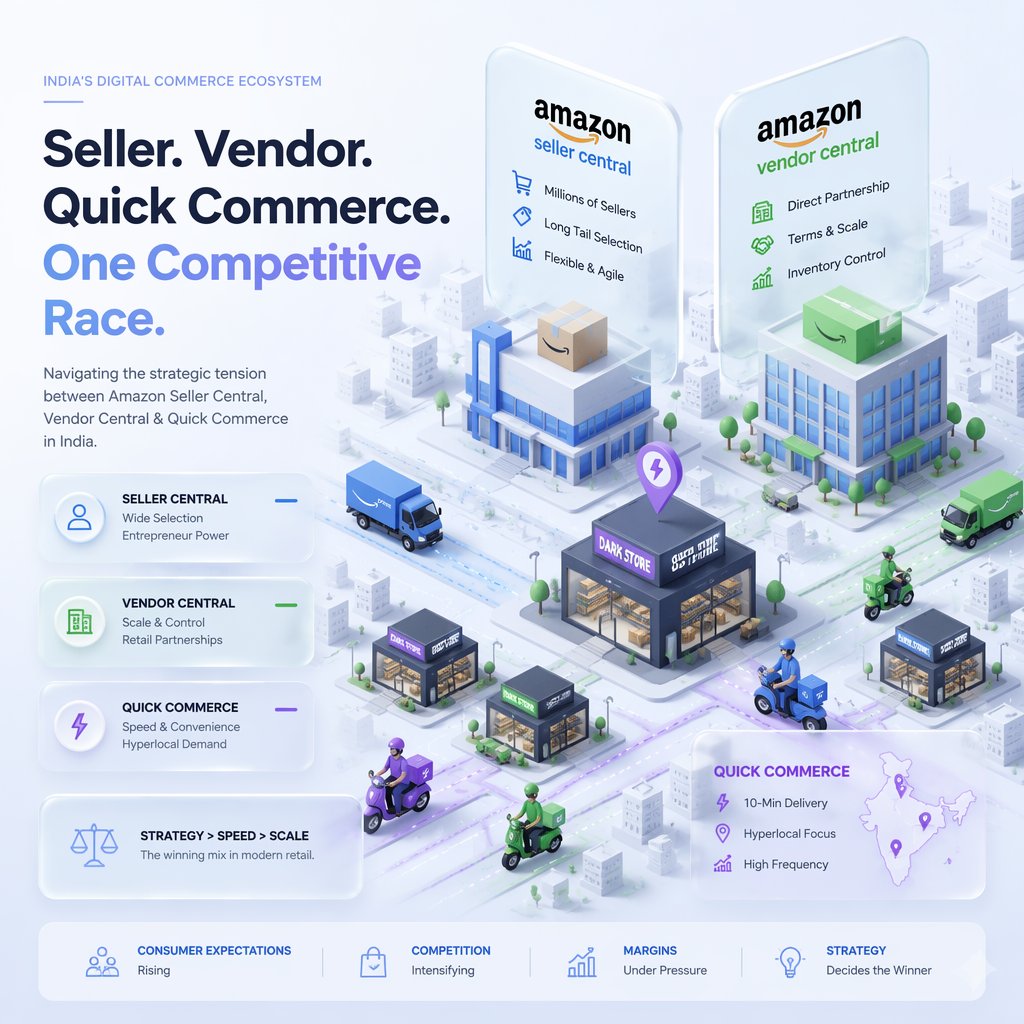
For Amazon sellers, more quick commerce density means faster replenishment cycles and a stronger bias toward fast-moving, lightweight, high-frequency items. Think packaged snacks, household basics, personal care, baby essentials, small electronics accessories, and impulse-buy products. If a product moves well in quick commerce, it may start behaving differently across Amazon’s broader retail channels too.
For Vendor Central users, the implications are even more operational. Brands that supply Amazon through vendor programs may need to rethink pack sizes, case configurations, and replenishment cadence. A product that sells well in a 1,000-unit case through conventional retail may need a very different allocation model if local fulfillment nodes are handling smaller, more frequent demand bursts.
The market also creates pressure on Amazon’s catalog and merchandising systems. Quick commerce depends on:
- Accurate local availability
- Tight catalog normalization
- Fast catalog updates
- Better substitution mapping
- Higher-quality search relevance for short intent queries
That means sellers with weak data hygiene may get filtered out of high-intent visibility. If the product title, attributes, and GTIN mapping are messy, the system can’t place or surface the item reliably in dense local fulfillment.
There’s also a broader strategic angle. Amazon Now sits in a market where Blinkit, Zepto, Swiggy Instamart, and Flipkart Minutes are all racing to define consumer habit. That matters because the daily essentials category is sticky. Once a customer defaults to one app for milk, snacks, batteries, and toiletries, the app becomes a behavior pattern, not just a storefront.
For Amazon, that’s valuable beyond grocery. It can pull traffic into:
- Core marketplace orders
- Prime membership usage
- Add-on purchases
- Brand discovery
- Repeat replenishment
In other words, quick commerce can act as a retention layer for the wider Amazon ecosystem.
Implementation Considerations
If you’re a seller, vendor, or marketplace operator, this isn’t just industry noise. There are practical steps to consider now.
For Amazon sellers
- Review your catalog for quick-commerce-friendly SKUs
- Prioritize items with high velocity, low breakage, and predictable demand
- Tighten product detail pages, especially titles, images, and attributes
- Watch for changes in regional conversion rates and delivery promise performance
- Keep pricing tight. In dense urban markets, price sensitivity is high and comparison is instant
For Vendor Central teams
- Revisit your assortment segmentation
- Track which SKUs fit small-basket, high-frequency behavior
- Align supply chain planning with shorter reorder cycles
- Monitor fill rates, out-of-stock rates, and service-level penalties
- Work with Amazon on packaging that suits micro-fulfillment and fast picking
For developers and operations teams
- Expect more dependence on real-time inventory sync
- Improve data pipelines for SKU-level availability
- Strengthen exception handling for substitutions and stockout logic
- Audit latency in pricing, catalog feeds, and order routing
- Prepare for higher traffic bursts in metro clusters where overlap is densest
For brand owners
- Identify products with strong habit formation
- Test whether quick commerce order patterns differ from standard marketplace orders
- Measure whether dense city availability lifts broader Amazon sales
- Be careful with margin erosion. Speed sells, but fulfillment costs can eat the gain quickly
Future Outlook
The next phase of quick commerce in India probably won’t be defined by who opens the most stores. It’ll be defined by who runs the tightest network and extracts the most orders per node.
Expect three things to happen next:
- More store overlap in top metros, especially where customer density supports frequent repeat orders
- Sharper assortment pruning, with platforms cutting slow-moving SKUs and favoring items that turn fast
- Higher pressure on unit economics, especially for newer entrants trying to scale without burning through capital
For Amazon, the near-term question is whether Amazon Now becomes a meaningful daily habit product or just a tactical extension of the marketplace. If it can tie quick commerce into Prime behavior, grocery replenishment, and high-frequency household purchasing, it becomes much more than a side bet.
If it can’t, then the network may end up looking impressive on paper but expensive in practice.
The interesting part is that the market is now testing a familiar Amazon lesson at a new speed: distribution density matters, but only if demand density keeps up. A store every few kilometers doesn’t automatically create profitability. It creates opportunity, yes, but also complexity.
Conclusion
Quick commerce in India is entering a phase of crowded overlap, not open expansion. The biggest platforms, including Amazon Now, are packing into the same pin codes to win repeat orders, reduce delivery time, and claim user habit.
For Amazon sellers and vendors, the signal is clear:
- Dense urban demand is becoming more important
- Fast-turn SKUs will matter more
- Catalog quality and inventory accuracy are getting tougher to ignore
- Margin discipline is essential, because speed comes with a cost
If you sell into Amazon’s ecosystem, now’s the time to study which products fit quick commerce behavior and which don’t. The next advantage may not come from wider reach. It may come from being the right product, in the right pin code, at the right moment.