Amazon Seller Central and Retail Media: What Slowing Sales Means
Salevoyant Editorial · August 19, 2026
Introduction
Walmart’s latest earnings story is getting more interesting by the quarter. Same-store sales are slowing, price cuts are piling up, and the company is leaning harder on retail media to protect profit. That matters far beyond Walmart itself, because it’s another signal that commerce and advertising are now fused together across the biggest retail platforms.
For Amazon sellers, vendors, and marketplace operators, this isn’t just a Walmart story. It’s part of the same shift that made Amazon Ads one of the most important profit engines in e-commerce. The details here point to where retail media is headed next, and what sellers need to prepare for.
Core Development
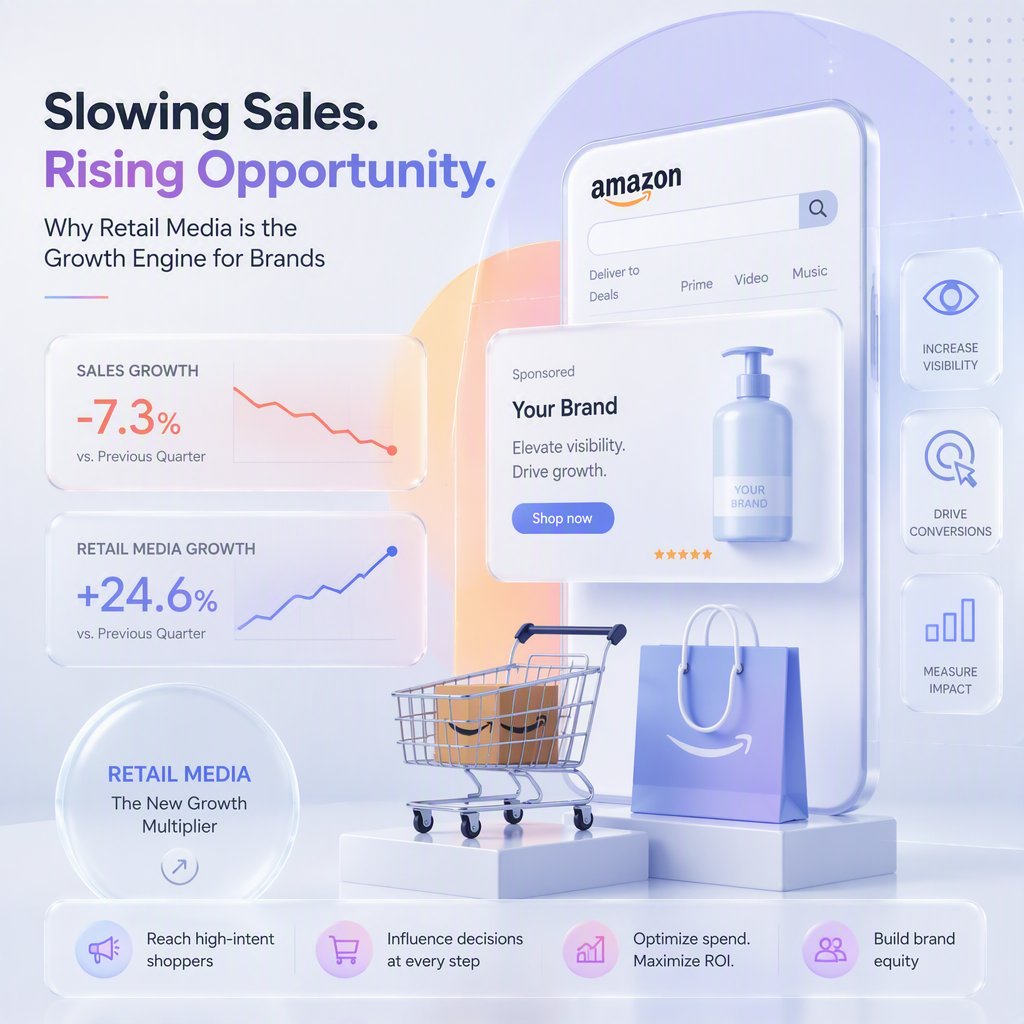
Walmart Connect, the company’s advertising business, grew 44% in the quarter ended April 30, its fastest reported pace since Walmart started disclosing the metric in 2023. At the same time, US same-store sales slowed to 4.1%, down from roughly 4.5% in each of the previous five quarters.
That combination tells you a lot. Retail traffic is still healthy, but growth is less explosive than before. So Walmart is using its ad stack to defend margins while it keeps prices low on about 7,000 items and pushes fast delivery. In other words, it’s doing what Amazon has done for years, using media revenue to support a low-margin commerce business.
Walmart Connect is still much smaller than Amazon Ads, but it’s becoming more important to the company’s earnings profile. Analysts estimate it carries gross margins around 70% and contributes about a third of operating income. That’s a big number for something that represents a small slice of total sales.
The company’s strategy now extends beyond the website and app. Walmart is testing ads inside its AI shopping assistant Sparky, rolling out AI tools for advertisers, and expanding into streaming after buying Vizio in 2024. This widens the addressable ad surface in the same way Amazon has expanded from search ads into display, video, and off-site inventory.
Technical Deep Dive
Retail media works because it sits close to the transaction. Unlike standard digital ads, which often rely on indirect attribution, retail media can connect a click, impression, or video view to a purchase event using shopper and order data.
At a technical level, Walmart Connect uses:
- First-party shopper data, including browsing and purchase behavior
- Closed-loop attribution, which links ad exposure to actual sales
- Audience segmentation, so brands can target based on category interest, basket behavior, or intent
- Multi-surface inventory, spanning search, product pages, app placements, store-linked surfaces, and now streaming TV
That same architecture is what makes Amazon Ads so sticky. Amazon has had years to refine sponsored products, sponsored brands, display, video, and DSP-style targeting based on marketplace behavior. Walmart is following the same blueprint, but with a more recent data foundation and a smaller media footprint.
The AI angle is worth watching closely. Walmart says active users of Sparky more than doubled in the quarter ended April 30, and it’s testing ads inside the assistant. That’s not just a new placement. It’s a new query layer. If more shopping starts inside conversational interfaces, then ad relevance won’t depend only on keywords. It’ll depend on intent extraction, ranking models, and contextual matching inside a dialogue flow.
The next retail media battleground may not be search boxes. It may be chat interfaces that decide which products get recommended before a shopper ever lands on a product page.
This is where technical execution gets hard. Chat ads need low-latency responses, strong policy controls, and careful relevance tuning. If the ad load is too heavy, the experience feels pushy. If targeting is too loose, conversion drops. That balance will matter just as much for Walmart as it does for Amazon’s own shopping assistant efforts.
There’s also a measurement problem. Retail media works best when ad exposure can be tied to downstream sales, but AI-driven discovery introduces more “assist” behavior and fewer direct clicks. That means new attribution models, better event logging, and tighter identity resolution across devices and surfaces.
Industry Impact
For Amazon’s ecosystem, Walmart’s move reinforces a big structural trend, retail media is becoming a core profit center, not a side business.
That has several implications:
1.
Advertising is now part of retail infrastructure
Sellers used to think of ads as an optional traffic source. On Amazon, that’s no longer true for most categories. Visibility is increasingly pay-to-play, especially in competitive verticals where organic ranking alone doesn’t hold enough shelf space. Walmart’s growth suggests the same logic is spreading across major retailers.
2.
Ad data is becoming a strategic asset
Walmart’s membership program and Vizio acquisition expand the data pool it can use for targeting and attribution. Amazon has already built a deep moat here through marketplace activity, Prime behavior, media consumption, and device usage. The lesson is simple, the more signals a platform collects, the stronger its ad product becomes.
3. Retail media is moving off-site
Streaming TV, connected TV, and AI chat surfaces are no longer experimental side projects. They’re becoming part of the commerce funnel. Amazon has long understood this with Fire TV, Twitch, Prime Video, and off-site DSP campaigns. Walmart is now pushing in the same direction, which means sellers may soon face a more fragmented but more powerful set of ad opportunities across retail platforms.
4.
Margins are shifting upward through media
Low prices and fast delivery squeeze retail margins. Ads help offset that pressure. Amazon built a multi-billion-dollar ad engine by turning shopper intent into monetizable inventory. Walmart is trying to do the same, and investors clearly like the direction. If Walmart Connect keeps growing, it could become a more meaningful buffer against retail volatility.
Implementation Considerations
If you sell on Amazon, run Vendor Central programs, or manage retail media across multiple platforms, this matters operationally, not just strategically.
For Amazon sellers
- Expect higher competition for sponsored placements as other retailers copy Amazon’s ad model.
- Use Amazon search term reports, placement data, and TACoS trends to refine bids more tightly. Retail media inflation usually shows up first in crowded categories.
- Watch for spillover into Walmart and other marketplaces. If your category is margin-sensitive, you may need separate bidding assumptions for each channel.
For Vendor Central teams
- Treat media as part of the vendor negotiation stack. Retailers increasingly use ad spend to offset pricing pressure, trade terms, and promotional support.
- Look at closed-loop ROAS, not just impressions or CTR. If a retail media network can prove basket lift, it has more use in vendor conversations.
- Build retail-specific creative variants. What works on Amazon Sponsored Brands won’t always map cleanly to Walmart Connect or CTV placements.
For developers and media ops teams
- Expect more demand for API-driven campaign management, creative automation, and bulk optimization tools.
- AI-generated campaign setup can reduce manual work, but it also raises governance issues. You’ll need guardrails for budget pacing, keyword expansion, and brand safety.
- Attribution will get messier as shopping moves across search, chat, video, and store visits. Your reporting stack should handle multi-touch signals, not just last-click conversion.
For all marketplace participants
- Start thinking in terms of retail media mix, not single-platform optimization.
- Compare CPC, conversion rate, and incrementality across Amazon, Walmart, and other retail networks on the same category set.
- Don’t assume the biggest retailer always offers the best return. Sometimes the smaller network has cheaper inventory and less bidding pressure.
Future Outlook
Walmart’s ad growth is a warning shot and an opportunity. It shows that retail media is still early enough for rapid expansion, but mature enough to materially affect earnings. If Walmart keeps building out AI search, connected TV, and better measurement, it could narrow the gap with Amazon in parts of the ad stack.
Amazon still has the deeper moat. It owns more shopping intent, more fulfillment touchpoints, and a richer ad history. But Walmart’s approach proves the model is portable. Any retailer with enough traffic, transactions, and identity data can build a meaningful media business.
The next phase will likely center on three things:
- AI-assisted shopping discovery
- Cross-surface attribution
- More aggressive monetization of retail attention
That means sellers should expect more ad inventory, more format diversity, and more pressure to manage spend with precision. It also means retail media reporting will matter even more than it already does.
Conclusion
Walmart’s ad growth isn’t just a line item in an earnings report. It’s another sign that retail platforms are evolving into media networks with commerce attached. For Amazon sellers and vendors, the message is pretty clear: the rules of discovery are getting more expensive, more data-driven, and more platform-specific.
If you’re already optimizing Amazon campaigns, now’s the time to apply that discipline across channels. Watch incremental return, not vanity metrics. Build creative for multiple surfaces. And keep an eye on AI shopping interfaces, because that’s where a lot of the next ad inventory will emerge.
The platforms are changing fast. The sellers who adapt their media strategy early will have the edge.