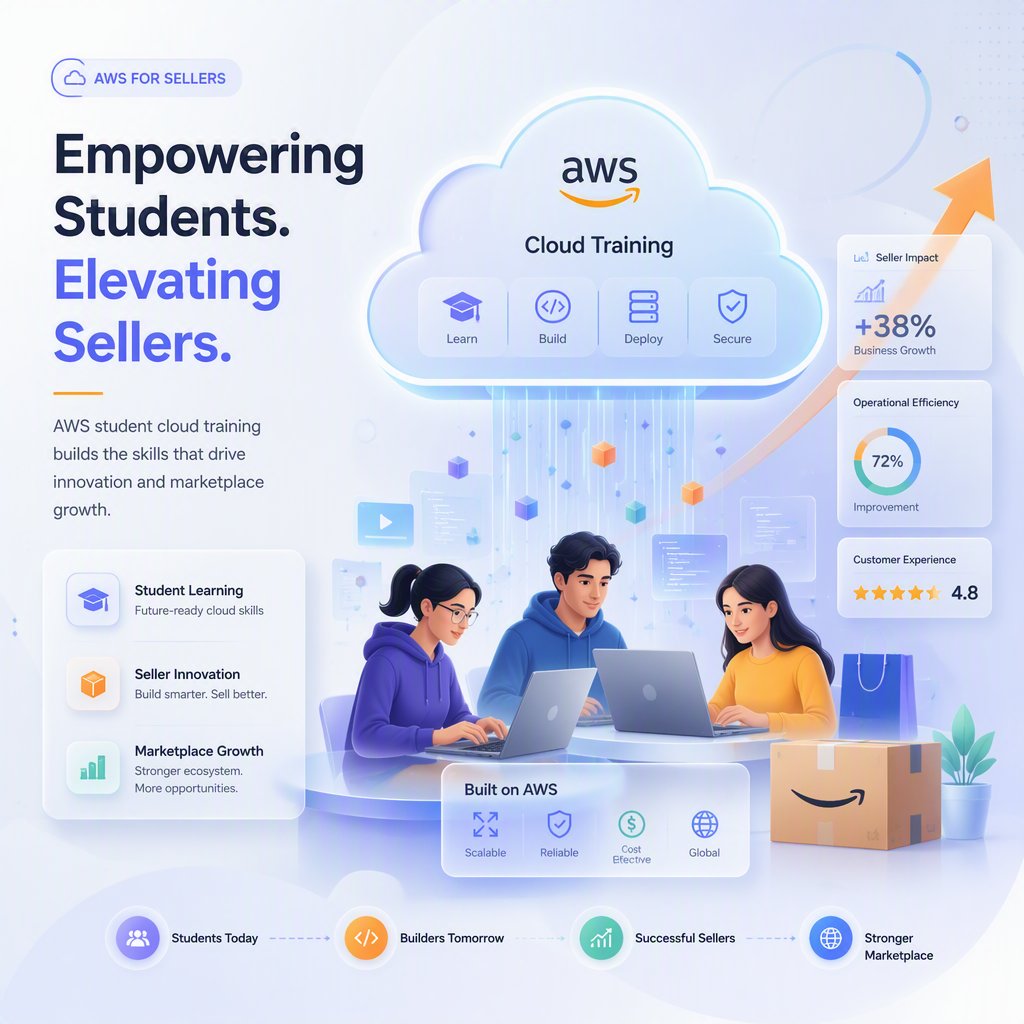
Amazon Seller Central and Vendor Central: AWS Student Cloud Training Explained
Salevoyant Editorial · August 20, 2026
Introduction
AWS just made a very large bet on the next generation of cloud builders. Its new Student Rewards program gives verified university students access to cloud credits, certification vouchers, and premium training, with a total potential value of $579 per student.
That might sound like a university-only announcement, but it matters to Amazon sellers, Vendor Central teams, and marketplace operators too. AWS talent shapes the tools, automation, analytics, and AI systems that increasingly sit behind Amazon commerce.
Core Development
AWS is launching Student Rewards inside AWS Builder Center, a community platform open to builders at every level. The program is aimed at verified university students age 18 and older, and AWS says it represents a commitment of more than $500 million in cloud and AI training resources globally.
Here’s what students receive after verifying enrollment and completing their Builder Center profile:
12 months of premium Skill Builder access
Access to 900-plus courses
Hands-on labs and certification prep
Game-based learning content
$30 in AWS credits
A
00 AWS Certification Foundational exam voucher
AWS says students can also earn badges through Builder Center activity like publishing articles, commenting, and staying engaged in the community. Those actions help enable the full reward set.
The timing is telling. Amazon is not just funding education, it’s building a pipeline of cloud-native talent that already knows AWS services before entering the workforce. That has obvious value for AWS adoption, but it also reinforces Amazon’s broader ecosystem strategy. The company wants its platform to be where people learn, build, certify, deploy, and eventually run production systems.
This is less like a student discount and more like infrastructure for future AWS fluency.
Technical Deep Dive
At first glance, this looks like a training offer. Under the hood, it’s a talent acquisition mechanism disguised as community enablement.
AWS Builder Center acts as the front door. It combines identity, community activity, learning access, and rewards distribution into one system. That matters because the entire experience is tied to measurable engagement. Students do not just sign up and collect benefits. They complete profile verification, consume content, participate in community activity, and earn incremental rewards.
From a systems perspective, that creates a few important technical characteristics:
1.
Identity verification is part of the funnel
Student Rewards depends on verified enrollment. That means AWS is likely using a combination of institutional email validation, enrollment verification services, or document-based checks. The goal is to reduce abuse and keep reward allocation tied to eligible users.
For AWS, verification isn’t only about fraud control. It also improves segmentation. A verified student cohort is far more valuable than anonymous traffic because AWS can measure:
course completion rates
certification intent
content engagement
regional participation
conversion from training to paid usage
That data helps AWS tune future training offerings and predict adoption patterns across cloud services.
2.
Builder Center is doing community orchestration, not just content hosting
AWS says users can read and publish articles, share projects, build profiles, and join community spaces organized by topic and region. That’s a classic platform flywheel.
The more people post and interact, the more useful the community becomes. The more useful it becomes, the more likely students are to stay inside AWS instead of using third-party learning platforms. From a technical standpoint, this requires solid content moderation, profile management, recommendation logic, and event tracking.
3.
The reward stack is intentionally layered
The program separates immediate and earned value:
immediate access to premium Skill Builder
credits for hands-on experimentation
a certification voucher
badges tied to ongoing activity
That structure encourages sustained usage. It’s not just a one-time signup incentive. AWS is designing repeated touchpoints so the student keeps returning to the platform over months, not days.
4.
Training is tied to product adoption
The 900-plus courses, labs, and certification prep resources almost certainly map to AWS service families, architecture patterns, and exam domains. That means students aren’t learning cloud generically. They’re learning AWS-specific implementation models, terminology, and workflows.
For example, a student who trains on:
IAM
S3
Lambda
EC2
CloudWatch
Bedrock
isn’t just learning concepts. They’re building familiarity with the exact services many startups, agencies, and commerce teams already use in production.
That creates future switching costs. Not in a bad way, but in the simple sense that people tend to use what they know best.
Industry Impact
For Amazon’s ecosystem, this program has several ripple effects.
For AWS partners and developers
AWS is feeding the talent pipeline that supports its partner network, consulting ecosystem, and startup base. The company needs more certified engineers, solution architects, and technical operators who can deploy on AWS without a long ramp-up period.
That’s especially important now that AI workloads are becoming more practical for smaller teams. A student who learns AWS cloud basics today may later build:
commerce analytics dashboards
forecasting tools
catalog enrichment workflows
support automation systems
AI-assisted content generation pipelines
Those are the kinds of tools agencies and Amazon sellers increasingly buy or build.
For Amazon sellers
This matters even if you never touch the AWS console yourself.
A growing share of seller tooling depends on AWS-backed infrastructure. Inventory forecasting, ad reporting, repricing systems, product research dashboards, and AI listing tools often sit on top of cloud services. As more developers learn AWS deeply, the marketplace gets more software built natively for Amazon commerce workflows.
That can mean better tools for sellers, but it can also intensify competition. Sellers with sophisticated tech stacks tend to move faster on:
catalog optimization
ad bid automation
multi-marketplace expansion
demand prediction
operational reporting
If AWS-trained builders create more software for commerce teams, the baseline expectation for seller technology rises.
For Vendor Central users
Vendor teams often deal with larger catalogs, supply chain complexity, and reporting overhead. More AWS talent in the market could improve the quality of vendor-side analytics, especially around:
shortage detection
replenishment planning
chargeback analysis
retail readiness workflows
retail media measurement
Amazon’s own vendor ecosystem already rewards data-driven decision-making. Better cloud talent means more capable internal dashboards and more automation around those workflows.
For Amazon itself
This is also a defensive move. AWS is competing for mindshare against other cloud platforms that are increasingly investing in AI education and certification pathways. If AWS can become the default learning environment for students, it gains a long-term distribution advantage.
The company is training not just users, but future decision-makers. That’s the point.
Implementation Considerations
If you’re a developer, engineer, seller operator, or marketplace tech lead, there are a few practical lessons here.
If you build tools for Amazon sellers
Think about how AWS-trained talent will shape your hiring pipeline. Junior engineers may arrive with stronger comfort around:
cloud storage patterns
serverless workflows
identity and access controls
monitoring and logging
ML and AI service basics
That can shorten onboarding, but it also means candidates may expect more modern infrastructure from employers.
If you run seller ops or BI teams
Watch for more AWS-based internal tooling from agencies, consultants, and software vendors. When evaluating platforms, ask:
Does it support scalable data pipelines?
Can it handle near-real-time reporting?
How does it manage permissions and audit logs?
Is it built for multi-account or multi-brand access?
What’s the cost profile as data volume grows?
Cloud-native architecture can lower friction, but it also shifts cost management onto you. Without guardrails, storage, compute, and API usage can creep up fast.
If you’re a seller relying on third-party software
More AWS talent usually means more innovation, but it doesn’t guarantee reliability. Ask vendors about:
uptime targets
backup and recovery plans
data residency
encryption at rest and in transit
throttling behavior during peak marketplace events
A slick dashboard isn’t enough. You want operational maturity.
If you’re hiring
This program may increase the number of early-career candidates with AWS certifications and hands-on labs under their belt. That’s useful, but don’t overrate certifications alone. Practical checks still matter:
ask candidates to explain how they’d design a queue-based workflow
review how they’d monitor a serverless app
test their understanding of cost controls
discuss data handling for marketplace reporting
Certification is a signal. It’s not the whole story.
Future Outlook
AWS is likely using Student Rewards as a long-term funnel into cloud adoption, AI training, and community retention. I’d expect the program to expand in a few directions.
First, we may see deeper ties between education and certification paths, especially in applied AI, data engineering, and cloud security. Those are the skills that map most directly to enterprise demand.
Second, Amazon could connect learning more tightly to builder outcomes. Think job matching, partner recruitment, startup incubators, or regional hackathons. The Builder Center model is naturally extensible.
Third, this kind of initiative could spill into commerce-focused tooling. If AWS wants more builders in retail tech, it can seed training around data pipelines, personalization, forecasting, and AI-assisted operations. That would be especially relevant for Amazon sellers and vendors who want to automate more of the tedious parts of marketplace management.
The larger signal is simple. Amazon keeps investing in the infrastructure around the infrastructure. It doesn’t just want to sell cloud services. It wants to shape the skills, habits, and software patterns that determine how those services get used.
Conclusion
AWS’s new Student Rewards program is more than a training giveaway. It’s a calculated investment in future cloud engineers, AI builders, and platform-native developers who will shape the next wave of commerce technology.
For Amazon sellers and Vendor Central users, the practical takeaway is clear: the tools you rely on are increasingly built by people trained inside AWS’s ecosystem. That can mean better software, faster innovation, and more automation. It can also mean tighter competition, since your rivals will have access to the same cloud-first talent pool.
If you build for Amazon commerce, keep an eye on this. The people learning AWS today may be designing the seller tools, vendor analytics, and AI workflows you’re using a year from now.