Amazon Seller Central and Vendor Central Guide to India’s New FDI Export Rules
Salevoyant Editorial · July 26, 2026
Introduction
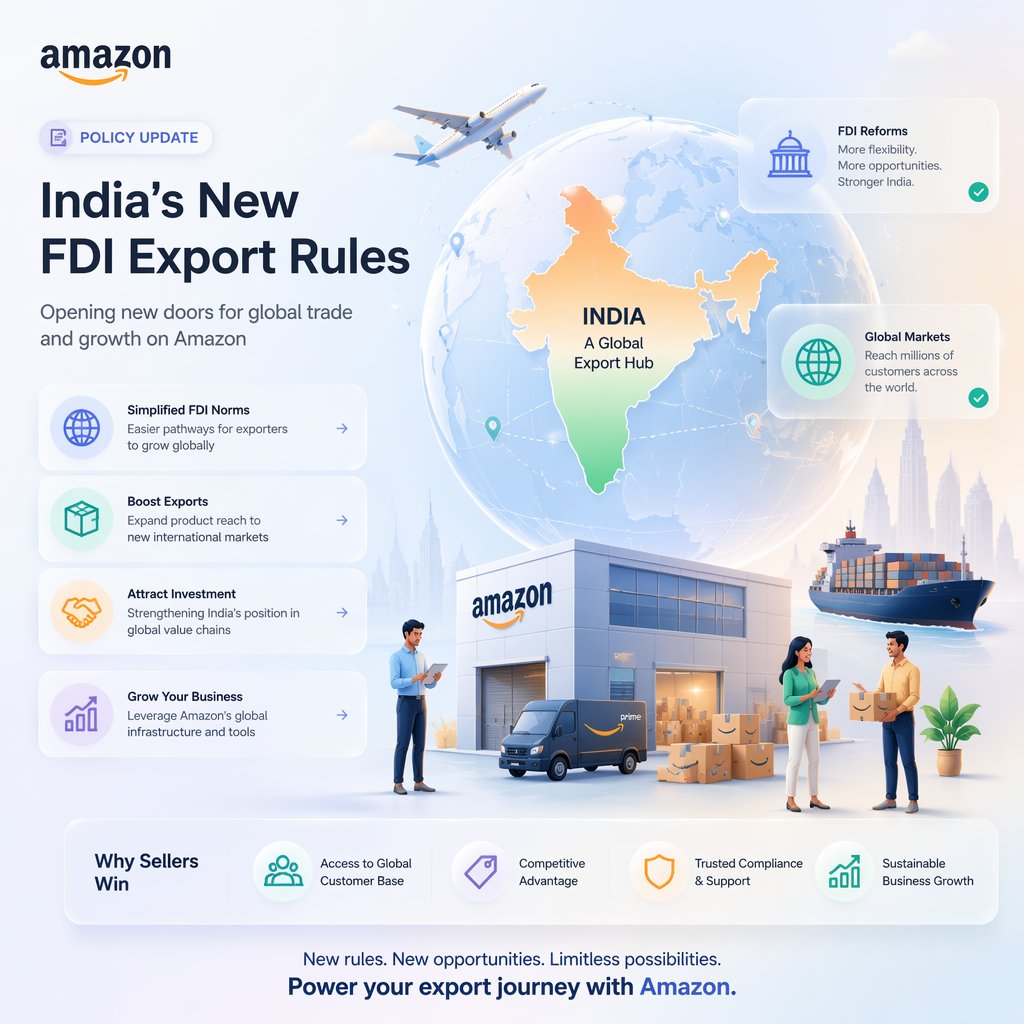
India’s latest move on FDI in inventory-based ecommerce for exports is a policy shift with a narrow legal scope, but broader operational consequences. On the surface, it doesn’t rewrite how Amazon, Flipkart, or Meesho run their domestic marketplaces. In practice, though, it may open a cleaner path for smaller sellers and MSMEs to reach international buyers without forcing them into the usual maze of fragmented export intermediaries.
Core Development
The Centre has relaxed its stance and now allows foreign direct investment in inventory-based ecommerce models for exports. That’s the key distinction here. The change is aimed at export activity, not domestic retail, so industry executives don’t expect it to materially alter how India’s biggest ecommerce players operate inside the country.
That matters because India’s ecommerce FDI rules have long drawn a sharp line between marketplace models and inventory models. Marketplace operators can connect buyers and sellers, but they can’t own inventory and sell directly in the domestic market in the same way an inventory-led retailer can. This policy adjustment creates a narrower export-focused exception.
The intended upside is straightforward. Smaller sellers, manufacturers, and MSMEs may now find it easier to use structured ecommerce infrastructure to sell beyond India’s borders. For a seller in Surat, Tiruppur, or Moradabad, that could mean a more formal route to cross-border demand instead of stitching together courier partnerships, customs paperwork, and overseas fulfillment arrangements on their own.
The big story isn’t domestic disruption. It’s whether export-oriented ecommerce can finally get a more workable compliance framework.
For Amazon-focused businesses, that’s worth paying attention to because Amazon already sits at the intersection of catalog management, cross-border logistics, tax documentation, and fulfillment orchestration. Even when the policy doesn’t target Amazon directly, it can change how sellers think about scaling through Amazon Global Selling, international Vendor Central programs, and export-specific marketplace flows.
Technical Deep Dive
The policy shift sounds legal, but the technical implications are very operational.
At a systems level, export ecommerce needs four things to work smoothly:
- Seller identity and KYC
- Product compliance and classification
- Cross-border fulfillment
- Customs and tax documentation
If the policy makes inventory-based export models more viable, platforms will need to support a more controlled order lifecycle. That includes tighter linkage between seller onboarding, inventory ownership, and shipment routing. In Amazon terms, this is similar to the level of control required when a seller uses Fulfillment by Amazon (FBA) for export-enabled listings, where inventory is placed in a managed node and dispatched according to destination-specific rules.
Why inventory-based exports are different
In a normal marketplace setup, the platform mostly acts as an intermediary. In an inventory-based export model, the platform or its export arm may take on a more direct role in managing stock intended for overseas buyers. That creates stronger requirements around:
- Traceability of inventory lot movement
- HS code accuracy for customs classification
- Destination country restrictions
- Invoice consistency
- Return handling across borders
That last point is often underestimated. Cross-border returns are expensive and operationally messy. Once a shipment leaves India, reverse logistics can eat into margins fast. So any inventory-led export system has to be built with return disposition logic, refund rules, and exception handling from day one.
Amazon’s likely relevance
Amazon sellers already see fragments of this through tools such as:
- Amazon Global Selling
- FBA Export
- Pan-EU or cross-border marketplaces in other regions
- Compliance workflows inside Seller Central
- Tax and invoice document generation
If India’s policy environment becomes more export-friendly, Amazon could see more Indian sellers entering structured export programs with better volume confidence. That would likely increase demand for:
- Listing localization
- Currency conversion handling
- International ASIN mapping
- Country-specific compliance documentation
- Fulfillment SLA monitoring
For developers and integrators, that means more pressure on backend systems that sync catalog metadata, track inventory by region, and prevent mismatches between the seller’s internal ERP and marketplace records.
Compliance becomes the real bottleneck
Lawyers are right to be cautious. In export ecommerce, policy permission doesn’t eliminate compliance risk. It just shifts where the burden sits. Any company operating an inventory-led export model still has to manage:
- FEMA and FDI compliance
- Export control rules
- GST treatment for exports
- IEC and seller registration requirements
- Destination-specific product laws
- Data retention for audit trails
This is especially relevant if the operating model uses a single legal entity across multiple workflows. A platform may be allowed to hold export inventory, but it still needs to separate domestic retail logic from export order processing. That separation is not just a legal concern, it’s a systems design problem.
You need clean segmentation in:
order_idand shipment identifiers- warehouse location tags
- export-only SKU flags
- jurisdiction-based tax logic
- customer classification for B2B versus B2C exports
Without that, businesses risk reporting errors, tax mismatches, and customs delays.
Industry Impact
For the Amazon ecosystem, the immediate effect is probably indirect, but still meaningful.
1. More export-ready sellers
India already has a deep base of manufacturers that can compete on price and quality, but many of them lack export process maturity. If policy friction drops, Amazon sellers may find it easier to treat international demand as a natural extension of their business rather than a separate channel.
That could increase activity in categories like:
- Home goods
- Textiles and apparel
- Beauty accessories
- Handicrafts
- Kitchenware
- Light consumer electronics accessories
These are categories where small Indian businesses often have strong unit economics if they can keep shipping and compliance costs under control.
2. Better economics for MSMEs
Export models often fail not because demand is weak, but because the overhead is painful. Documentation, packaging standards, shipment consolidation, foreign buyer support, and refund handling can wipe out margin. If ecommerce infrastructure absorbs more of that complexity, sellers can spend less time acting like customs brokers and more time improving product quality.
That matters for ROI. A seller who can increase average order value, reduce manual export admin, and improve shipment predictability will usually see a stronger contribution margin, even if gross sales stay flat in the short term.
3.
Amazon’s domestic model stays intact
Executives are probably right that Amazon’s domestic India operations won’t be materially affected. The marketplace rules for local retail are still the same, and Amazon’s domestic business logic doesn’t suddenly change because export FDI becomes more permissive.
But strategically, this still helps Amazon in two ways:
- It strengthens the case for Amazon as an export enabler, not just a domestic marketplace.
- It creates a cleaner policy narrative around seller empowerment and MSME reach.
That’s useful in a market where platform policy, regulator scrutiny, and seller expectations are always shifting.
4.
Vendor Central could see secondary effects
Vendor relationships may also feel a ripple effect. If brands and manufacturers can move export inventory through ecommerce-linked systems more easily, they may revisit how they allocate stock between domestic wholesale, retail distribution, and overseas fulfillment.
For Vendor Central users, the questions become more operational:
- Which SKUs should be earmarked for export?
- How should replenishment forecasts change?
- Can inventory be segmented by channel without creating excess dead stock?
- What happens when export demand outpaces local supply?
These aren’t abstract issues. They affect working capital, forecasting accuracy, and warehouse planning.
Implementation Considerations
If you’re a seller, operator, or systems integrator, this policy change is less about headlines and more about readiness.
What sellers should check
- Confirm whether your business is set up for export billing and documentation
- Review your HS code mapping for each SKU
- Make sure your product content supports international compliance
- Audit packaging labels, barcodes, and carton specs
- Validate whether your current fulfillment partner can handle export SLAs
- Check refund and return policies for cross-border orders
What engineers and platform teams should prepare
- Separate domestic and export inventory pools in the data model
- Add jurisdiction-aware tax and invoice logic
- Build audit logs for document generation and order state changes
- Support country-level restrictions at catalog and checkout layers
- Monitor fulfillment latency, customs hold rates, and delivery exceptions
What
Amazon sellers should watch in Seller Central
Sellers already using Amazon’s export tools should pay attention to:
- Inventory placement
- Marketplace expansion settings
- Product compliance warnings
- Account health impacts from late dispatch or document errors
- Fee structures that vary by region and fulfillment path
If this policy leads to more export volume, the sellers who win won’t just be the ones with the lowest cost product. They’ll be the ones with clean operations, accurate catalog data, and predictable fulfillment.
Future Outlook
The real test is whether this policy becomes a usable operating model or just another well-intended exception that gets bogged down in approvals and interpretation.
If India keeps refining the rules, we could see a more structured export marketplace layer emerge, one that sits between domestic ecommerce and traditional trade. That would be good news for smaller manufacturers who’ve been excluded from export growth because the process was simply too cumbersome.
For Amazon, this could reinforce a broader strategy that’s already visible across multiple markets, turning the platform into a cross-border commerce engine rather than just a domestic marketplace. The company has the infrastructure, the seller base, and the fulfillment know-how. What’s been missing in some regions is policy clarity.
If the regulatory environment becomes more predictable, expect more sellers to test international demand through Amazon-linked channels instead of building their own export stacks from scratch.
Policy changes like this rarely move revenue overnight. They change which businesses can scale without breaking their operations.
Conclusion
India’s relaxed FDI stance for inventory-based ecommerce exports doesn’t rewrite domestic ecommerce rules, and it probably won’t shake up Amazon’s local retail playbook. But it does matter for sellers who want a simpler route into export commerce.
The practical upside is clear:
- More opportunities for MSMEs and smaller sellers
- Better alignment between ecommerce infrastructure and export workflows
- Potential growth in Amazon export activity
- Higher compliance demands for platforms and sellers alike
If you sell on Amazon, manage Vendor Central operations, or build tools for marketplace commerce, this is the kind of policy change worth tracking closely. Not because it’s flashy. Because it changes the plumbing. And in ecommerce, plumbing is where the real business happens.