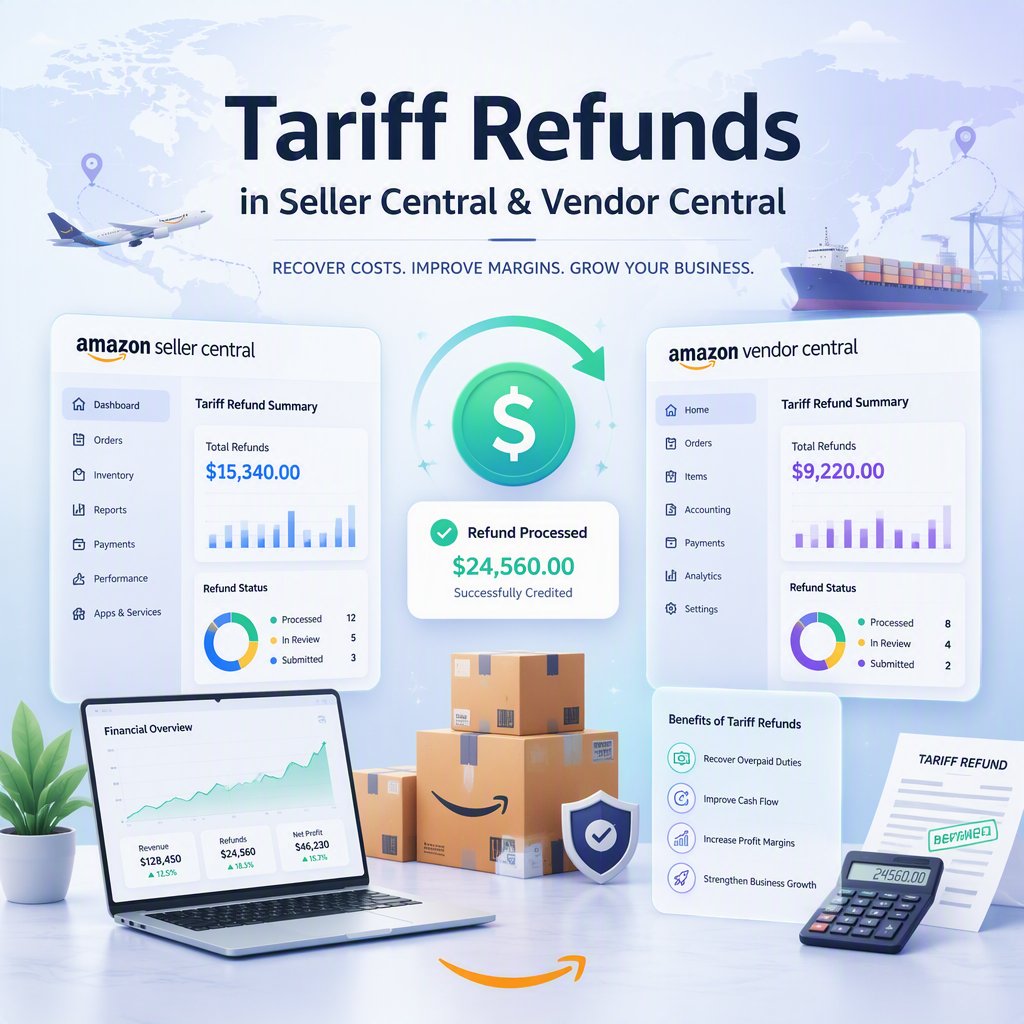
Amazon Seller Central and Vendor Central Tariff Refunds: What to Know
Salevoyant Editorial · August 14, 2026
Introduction
If you bought imported goods last year, there’s a decent chance some of the tariff money tied to that purchase is making its way back to you. That sounds like a consumer headline, but for Amazon sellers, Vendor Central teams, and marketplace operators, it’s really a pricing, reimbursement, and compliance story.
The interesting part isn’t just that refunds are happening. It’s how Amazon, shippers, and retailers are deciding who actually gets paid back, how that data is traced, and what happens when tariff costs are buried inside product pricing instead of billed directly.
Core Development
U.S. shippers such as FedEx, UPS, and DHL have started returning tariff refunds to customers after the Supreme Court struck down sweeping tariffs that had been imposed under the International Emergency Economic Powers Act. The tariffs, rolled out in 2025, hit goods from almost every country and were later ordered returned by the government.
So far, roughly
00 billion has been refunded to companies that originally paid those tariffs through U.S. Customs and Border Protection’s claims process. Some of that money is now flowing back to consumers, but only in cases where the shipping company or customs broker can trace the charge back to a specific shipment and a specific payer.
For Amazon, the key detail is that the company said it received $600 million in tariff refunds in the second quarter. CFO Brian Olsavsky also said Amazon isn’t the importer of record on most items it sells, which matters a lot. In plain terms, if Amazon didn’t officially import the goods, it often didn’t pay the tariff in the first place, and that makes direct customer refunds harder.
Still, Amazon said it has identified a limited set of cases where it can clearly connect import charges to customers. In those cases, it will automatically issue refunds. In other cases, the company says the money will be used to lower prices.
That split is important. It shows how messy tariff pass-through becomes in a marketplace with third-party sellers, direct imports, Fulfillment by Amazon, Vendor Central replenishment, and hybrid sourcing models.
The real story here isn’t just refunds. It’s traceability. If a platform can’t map import charges cleanly to a buyer, a refund turns into a pricing decision instead.
Technical Deep Dive
The refund process depends on how the shipment was structured in the first place.
When a shipper acts as a customs broker and the importer of record, it usually has the documentation needed to file with CBP, receive the tariff refund, and match that refund back to customer transactions. That’s why FedEx and UPS can push refunds to customers through portals, credit cards, or bank accounts. They’ve got the logistics records, the duty entries, and the payment trail.
In Amazon’s world, the chain is often more fragmented.
Why importer-of-record status matters
If Amazon is the importer of record, the company controls the customs entry data and tariff payment trail. If a third-party seller, a vendor, or an overseas logistics provider is the importer, the duty may sit outside Amazon’s core transaction ledger. That creates a reconciliation problem.
For engineering teams, this is basically a data matching issue across several systems:
order_id
shipment_id
customs_entry_number
importer_of_record
duty_amount
payment_method
refund_eligibility_status
If any of those links are weak or missing, the refund logic can’t safely auto-disburse money. At scale, that matters. Amazon processes millions of transactions across retail, marketplace, and logistics layers. A small error rate becomes a huge operational and financial risk.
Why refunds are phased
Shippers are returning refunds in waves because the government itself is processing claims in batches. UPS said it filed an initial $500 million refund request and told customers to expect their money one to three months after Treasury reimbursement. DHL said it has filed claims for almost all eligible shipments where it was the importer of record and is passing refunds along as they arrive.
That phased approach is a standard settlement pattern. It reduces cash flow strain, but it also means timing differences between when a platform gets the refund and when the end customer sees it. For sellers and vendors, that creates a short-term working capital question.
Amazon’s tracing challenge
Amazon’s statement about a “limited set of circumstances” is telling. It suggests the company has enough internal telemetry to connect some import charges directly to customers, probably on shipments with clearer landed-cost attribution. But most Amazon sales don’t work that neatly.
Here’s why:
Marketplace sellers may import independently and price items into Amazon listings.
Vendor Central transactions often involve purchase orders, inbound freight, and negotiated terms, which can obscure the end-customer pass-through.
Multi-channel fulfillment can mix inventory sources.
Dynamic pricing makes it hard to isolate how much of a shelf price came from tariffs versus demand, competition, or margin changes.
In other words, even if Amazon has the refund, it may not have a reliable, legally defensible way to say, “this customer paid this exact tariff amount.”
That’s also why the class-action lawsuits mentioned in the source face an uphill climb. To win, plaintiffs would need to prove a direct causal link between tariff policy and the price they paid. That’s hard when pricing is driven by dozens of variables.
Industry Impact
For Amazon sellers, this is less about receiving a check and more about understanding how import costs ripple through pricing systems.
For Seller Central users
Many sellers absorb tariffs inside landed cost calculations and then use repricing tools or manual margin updates to stay profitable. If a tariff is later refunded, the seller has to decide whether to:
keep the margin improvement,
lower price to gain rank,
or pass savings back to customers.
That’s a strategic decision, not just an accounting one.
If you’re selling in a competitive ASIN category, even a small price drop can improve conversion, buy box share, and ad efficiency. But if your catalog is broad and inventory turns slowly, it may make more sense to retain the refund as margin recovery.
For Vendor Central users
Vendor Central is where this gets especially complicated. Vendors often operate on purchase order terms, chargebacks, allowances, and negotiated pricing. If tariff costs were built into wholesale pricing, then any refund may be reflected indirectly through future price negotiations rather than direct consumer payouts.
That means vendors should be asking:
Were tariff charges embedded in cost of goods sold?
Did Amazon absorb any import exposure, or was it fully passed through?
Are there open terms or retroactive price protection clauses?
Can the vendor finance team map refunds back to specific POs or inbound shipments?
If not, the refund may never appear as a line item. It may just influence the next negotiation round.
For marketplace and retail tech teams
This story also highlights a bigger platform lesson. If Amazon wants to support cleaner customer reimbursement in the future, it needs stronger cost attribution across logistics, customs, and checkout records. That means better metadata, tighter mapping between shipment and order systems, and more transparent landed-cost models.
That’s not easy, but it’s where the market is heading. Customers are becoming more price-sensitive, regulators are watching surcharge behavior more closely, and marketplaces need a defensible audit trail.
Implementation Considerations
If you’re a seller, vendor, or systems integrator working around Amazon’s ecosystem, there are a few practical steps worth taking now.
1.
Reconcile landed cost by shipment
Don’t just track unit cost. Track:
product cost
freight
duty
brokerage fees
Amazon referral and fulfillment fees
storage and prep costs
That full landed-cost view tells you whether a refund should affect price, margin, or both.
2. Preserve import documentation
Keep customs entries, broker invoices, commercial invoices, and proof of payment in a searchable archive. If a refund or dispute shows up later, you’ll need those records. In a marketplace with thin margins, paperwork is a profit tool.
3.
Separate tariff recovery from pricing logic
If you use repricing software, make sure tariff refunds don’t automatically trigger a price cut unless that’s intentional. Otherwise, you may hand back margin faster than necessary.
4.
Review customer communication workflows
Amazon said it will proactively contact affected customers in certain cases. If you’re a brand or seller handling customer service outside Amazon, build a response template now. Refund questions can create confusion fast, especially when the buyer never saw a tariff line item in the first place.
5.
Watch for accounting and tax treatment
Refunds can affect revenue recognition, margin reporting, and in some cases tax treatment. Finance teams should confirm whether the money is recorded as a tariff recovery, a contra-expense, or a pricing adjustment. The treatment matters for reporting accuracy.
Future Outlook
This refund wave signals something bigger than a one-time correction. It shows how vulnerable cross-border commerce is to policy shocks, especially in marketplaces that rely on imported inventory and distributed fulfillment.
Amazon is likely to keep pushing toward more precise cost attribution. The company has every incentive to know exactly where a tariff lands, who paid it, and whether it can be recovered or offset. That’s useful for compliance, but it also feeds better pricing models, more accurate profitability analysis, and tighter seller tooling.
Expect a few broader shifts:
More landed-cost automation in Seller Central and vendor analytics
Stronger customs data integration inside retail and logistics systems
More disputes over tariff pass-through in consumer litigation
Greater pricing transparency pressure on major retailers and marketplaces
The bigger the marketplace, the more important the back-end accounting becomes. Amazon can’t optimize fulfillment, pricing, or margin without cleaner cost data. This tariff refund cycle is a reminder that the systems underneath the storefront matter just as much as the product page.
Conclusion
Tariff refunds are starting to reach consumers, but the path is uneven and highly dependent on who paid the duty, who imported the goods, and how cleanly the transaction can be traced. For Amazon, the reported $600 million refund windfall is less a windfall than a test of operational precision.
If you’re a seller or vendor, the takeaway is simple:
tighten your landed-cost tracking,
preserve import records,
review how tariff costs are baked into pricing,
and don’t assume a refund will automatically show up as cash in hand.
In Amazon’s ecosystem, cost recovery is rarely just a finance issue. It’s a systems issue, a pricing issue, and sometimes a competitive advantage.