Amazon Seller Central and Vendor Central: What Quick Commerce Growth Means
Salevoyant Editorial · September 1, 2026
Introduction
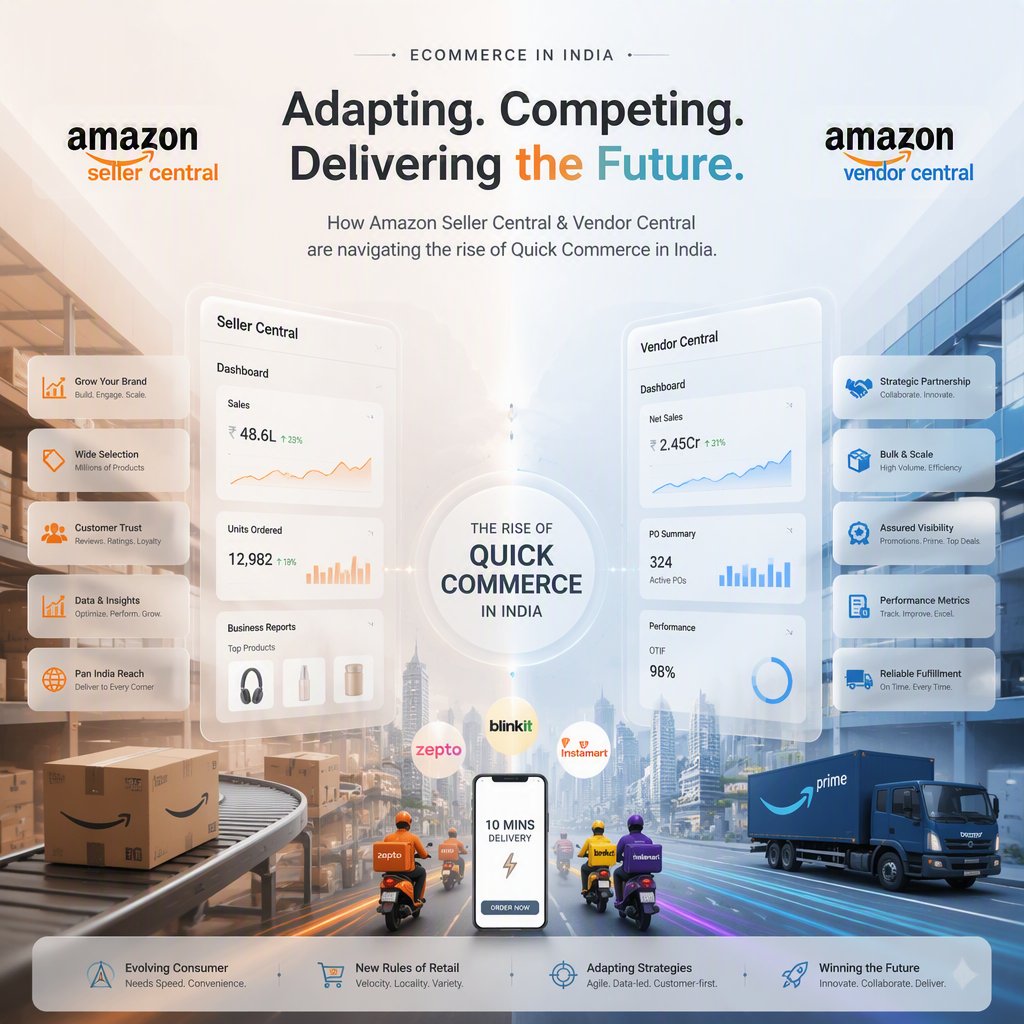
Quick commerce in India isn’t a side story anymore. A new Goldman Sachs report shows the channel’s share of ecommerce GMV rising from 3% in 2019 to 11% in 2025, while Amazon and Flipkart together slipped from 73% to 62% over the same period.
That matters because this isn’t just a shift in consumer preference. It’s a structural change in how ecommerce demand is routed, fulfilled, and monetized, and Amazon sellers, vendors, and marketplace operators need to think about it now, not later.
Core Development
The headline is simple: quick commerce is gaining ground fast, and the big generalist marketplaces are losing some of theirs. According to the report cited by The Economic Times, quick commerce apps now account for 11% of India’s ecommerce GMV in 2025, up from 3% in 2019. Over the same period, Amazon and Flipkart’s combined share fell from 73% to 62%.
That’s a meaningful swing in a market as large and competitive as India. GMV, or gross merchandise value, is the total value of goods sold through a platform over a given period. When one channel’s share of GMV grows by eight percentage points in six years, it usually means the buying habit behind it is changing, not just the marketing spend.
Quick commerce wins on speed, convenience, and frequency. It’s built for smaller baskets and immediate needs. Think snacks, household items, personal care, chargers, fresh goods, and last-minute replenishment. By contrast, Amazon and Flipkart still dominate broader ecommerce use cases, but they’re now competing in a market where “good enough tomorrow” is often losing to “right now.”
For Amazon, the challenge is more nuanced than raw share loss. It’s not just losing to another marketplace. It’s losing certain demand categories to a different fulfillment model.
Technical Deep Dive
The operational difference between quick commerce and traditional ecommerce is where the real story sits.
Amazon’s core model, especially in India, has historically been built around inventory depth, catalog breadth, and distributed fulfillment. Orders are routed through fulfillment centers, sortation layers, line-haul networks, and last-mile delivery partners. The system is optimized for selection and scale, with delivery speed improving through regional placement, promise engines, and service-level tuning.
Quick commerce runs on a different architecture. It depends on micro-fulfillment centers, often placed close to dense demand clusters. These dark stores or compact fulfillment nodes hold a smaller but faster-moving assortment. Inventory is tightly curated, replenishment cycles are frequent, and delivery promises are measured in minutes, not days.
That has several technical consequences:
-
Inventory planning gets narrower and faster
-
SKU counts are lower, but stock turns are higher.
-
Demand forecasting is more volatile because orders spike around routines, weather, local events, and time-of-day patterns.
-
Routing logic becomes hyperlocal
-
Instead of optimizing for interstate or intercity shipping, the system prioritizes proximity, rider availability, and real-time order batching.
-
Latency matters everywhere, from order confirmation to picker assignment to dispatch.
-
Assortment strategy shifts from breadth to velocity
-
Fast-moving SKUs dominate.
-
Long-tail catalog items are less important unless they support repeat purchase behavior.
-
Promising engines get stricter
-
A platform can’t advertise ultra-fast delivery unless the inventory record is accurate and replenishment is reliable.
-
Stockouts hit harder because the customer expects immediate fulfillment, not a delayed shipment substitution.
Amazon has invested heavily in logistics infrastructure, but the quick commerce model requires a different tuning of the stack. It’s less about long-haul efficiency and more about last-mile density. The economics only work when order frequency, basket composition, and delivery radius align tightly enough to support the fulfillment cost.
The important shift here is that speed is no longer just a premium feature. In some categories, it’s becoming the default expectation.
For Amazon’s marketplace systems, this also affects how demand is measured and allocated. Search ranking, buy box decisions, inventory placement, and replenishment signals all become more sensitive when the competition is not a comparable ecommerce cart, but an instant-delivery app with a smaller assortment and tighter SLA.
Industry Impact
For Amazon sellers and vendors, this trend changes category strategy.
First, high-frequency essentials are under more pressure. If a consumer can order detergent, chips, toothpaste, or pantry items in 10 to 20 minutes from a quick commerce app, the value proposition of waiting one or two days weakens. That doesn’t kill Amazon’s demand in those categories, but it does compress pricing power and raise expectations on delivery reliability.
Second, repeat purchase behavior becomes more fragmented. A household might use Amazon for stock-up purchases, Flipkart for deal-driven buying, and quick commerce for replenishment. That means fewer categories can be defended with a one-size-fits-all offer. Sellers need channel-specific strategy, not just marketplace presence.
Third, ad spend efficiency gets more complicated. On Amazon, sponsored product economics rely on search intent, conversion rate, and margin after fulfillment. If quick commerce steals the urgent, low-consideration purchase, Amazon ads may become more valuable for planned purchases and less effective for reactive ones. That changes keyword strategy, product mix, and ACOS targets.
For vendors in Vendor Central, the implications are operational too. Retail partners often want cleaner replenishment planning, lower stockout risk, and more predictable fulfillment windows. If quick commerce grows, retailers may ask suppliers to support smaller, more frequent replenishment patterns. That affects:
- Forecasting models
- Case pack sizing
- Reorder point logic
- Regional distribution planning
- Promotion calendars
Sellers using Seller Central should also pay close attention to catalog velocity. Products that fit quick commerce behavior often have:
- High repeat rates
- Compact packaging
- Low return risk
- Stable shelf-life
- Lightweight fulfillment economics
If your products fit that profile, you may need to reconsider whether your assortment and pricing are tuned for Amazon’s broader fulfillment model or whether local, fast-turn channels deserve a bigger role.
Implementation Considerations
If you’re an Amazon seller, vendor, or marketplace operator, this isn’t just something to observe. It’s something to adjust for.
What sellers should review
-
SKU segmentation
-
Separate your assortment into stock-up, replenishment, and impulse items.
-
Don’t treat all products as if they compete in the same demand bucket.
-
Price pack architecture
-
Smaller pack sizes may perform better in quick commerce channels.
-
Amazon often rewards multipacks or larger baskets, but local instant-delivery apps favor convenience sizing.
-
Fulfillment economics
-
Recalculate landed cost, return rate, and contribution margin by channel.
-
A product that works on FBA may not work if the same category faces faster, denser competition nearby.
-
Content strategy
-
Make product pages clearer and more conversion-friendly.
-
In fast decision categories, shoppers don’t want a research project. They want confidence.
What vendors should revisit
-
Forecasting cadence
-
Monthly planning may not be enough for fast-moving categories.
-
Consider shorter replenishment windows and regional demand splits.
-
Assortment rationalization
-
Not every SKU deserves equal shelf space.
-
Prioritize high-velocity items that can support frequent replenishment.
-
Retail media alignment
-
If demand is fragmenting across channels, promotion timing needs to be more precise.
-
National campaigns won’t always map cleanly to local fulfillment realities.
What developers and ops teams should keep in mind
-
Inventory synchronization matters more
-
Real-time stock accuracy is critical when competitors promise near-instant delivery.
-
Laggy feeds create oversells, canceled orders, and wasted ad spend.
-
API and feed hygiene
-
Product availability, price updates, and regional offers need tighter control.
-
Even small sync delays can hurt conversion.
-
Operational observability
-
Track stockout rates, substitution rates, and promise accuracy by region and category.
-
If you can’t see the gap, you can’t close it.
Future Outlook
This shift is likely to accelerate, not slow down. Quick commerce still has limits. It works best in dense cities, for routine purchases, and for categories with predictable replenishment. It’s not replacing Amazon’s entire model. But it is pulling away some of the most profitable, most frequent purchase occasions.
That means the market may split more clearly into three layers:
- Instant fulfillment for urgent, repeat, low-basket needs
- General ecommerce for broad selection and planned purchases
- Value-led marketplaces for price-sensitive discovery and deal hunting
Amazon’s response will probably continue to mix logistics investment, local inventory placement, and category-specific promise tuning. The company already knows that delivery speed influences conversion, but this next phase is about matching the right service level to the right shopping mission. Not every order needs same-day. Not every category can survive on slower shipping either.
For sellers, the smartest move is to stop thinking in terms of a single ecommerce channel. The winning play is increasingly about basket type, urgency, and replenishment frequency. If a product is bought because it’s needed now, speed wins. If it’s bought after comparison shopping, selection and trust still matter. Amazon remains strong in both, but the margin for error is getting smaller.
Conclusion
Quick commerce’s rise in India is a warning signal for the broader ecommerce stack. The jump from 3% to 11% GMV share since 2019 shows that consumer behavior is shifting toward speed and convenience, while Amazon and Flipkart’s combined share slipping to 62% shows that even the largest platforms aren’t immune.
For Amazon sellers and vendors, the takeaway is clear:
- Reassess which of your products compete on urgency
- Tighten inventory and feed accuracy
- Build category strategies around fulfillment speed, not just reach
- Watch how quick commerce reshapes repeat purchase behavior in your core markets
This isn’t a temporary trend. It’s a change in how commerce gets fulfilled, priced, and consumed. The companies that adapt their catalog, logistics, and ad strategy fastest will keep the strongest position.