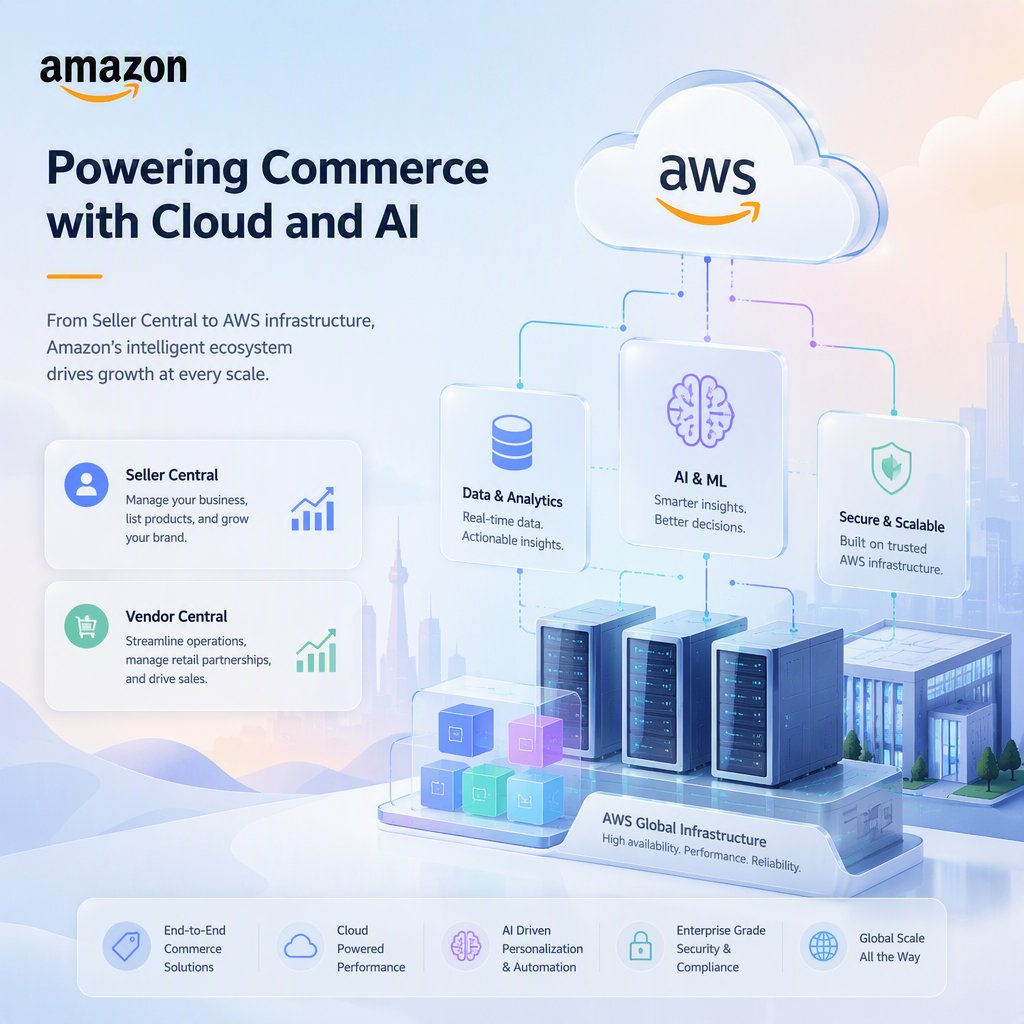
Amazon Seller Central and Vendor Central: What the AI data center race means
Salevoyant Editorial · August 27, 2026
Introduction
Amazon isn’t just a marketplace company anymore. It’s also one of the most aggressive infrastructure builders in cloud computing, and that matters because the AI boom is starting to expose a very real bottleneck: power, land, and data-center capacity. Jefferies’ latest data point makes that clear, and it helps explain why Amazon Web Services is spending so heavily to keep pace with hyperscaler demand.
For Amazon sellers, Vendor Central teams, and marketplace operators, this isn’t abstract Wall Street noise. The same infrastructure pressure that shapes AWS growth also affects retail automation, product search, forecasting, advertising systems, and the AI tools Amazon keeps rolling into its commerce stack.
Core Development
Jefferies says North American non-commenced leased data-center capacity reached 25.5 gigawatts in Q2 2026, up 32% quarter over quarter and a staggering 346% year over year. In plain English, hyperscalers are signing up for future capacity at a pace that’s outstripping the industry’s ability to build new facilities quickly enough.
The key takeaway is simple: third-party data-center operators are becoming more important. They’re no longer just backup capacity providers. They’re increasingly central to how Amazon, Microsoft, Google, Meta, and Oracle get infrastructure online fast enough to support AI workloads.
Jefferies also points out that roughly 47% of future hyperscaler capacity plans are now leased, compared with about 25% historically. That’s a meaningful shift. It suggests the old model, where big cloud providers built almost everything themselves, is giving way to a hybrid model that mixes owned sites with leased facilities.
Amazon stands out in the report. Jefferies says Amazon leads on every measure, with 20.6 GW built or building and 28.1 GW announced. That pipeline is larger than any competitor’s full self-build portfolio. In other words, Amazon’s footprint isn’t just large, it’s expanding at a scale that rivals the whole market.
The core story here isn’t just demand growth. It’s that capacity itself is now the constraint.
Technical Deep Dive
The technical bottleneck behind this story is easy to miss if you only look at cloud revenue numbers. AI training and inference need three things at scale, power, cooling, and networked compute density. Data centers can’t be treated like generic office space with servers in racks anymore. They’re closer to industrial energy assets.
Why leased capacity matters
A leased data center lets a hyperscaler move faster because the operator has usually already handled parts of the hardest work:
land acquisition
zoning and permitting
utility interconnection
shell construction
basic mechanical and electrical infrastructure
That matters because speed-to-power has become the real competitive metric. If Amazon can get GPUs and networking gear into a facility six months earlier than a rival, it can serve more AWS customers, train larger models, and monetize demand sooner.
The Jefferies data also shows why this is happening now. Combined capex for the “Big 3” clouds plus Meta and Oracle is estimated at $811 billion in calendar 2026 and
.1 trillion in 2027. That level of spending isn’t just about buying chips. It’s about building the physical substrate underneath AI.
Capacity math and Amazon’s position
Jefferies says North American committed future leased capacity sits at 25.5 GW, while hyperscaler self-build capacity under construction is about 29.0 GW. Taken together, future North American hyperscaler capacity is roughly 1.6 times the estimated in-place capacity of 33.4 GW.
That’s a huge pipeline. It also tells us something important about Amazon’s strategy. AWS has long balanced owned infrastructure with colocation and leased facilities, but the balance is tilting further toward fast deployment where needed. That’s especially true for AI clusters, where the value of a site depends on:
available megawatts, not just square footage
fiber connectivity and network redundancy
liquid cooling readiness
proximity to high-voltage transmission
the ability to absorb bursty GPU demand
Why timing is still messy
Jefferies is careful to note that lease commitments don’t mean everything goes live on schedule. Projects can slip because of:
utility delays
transformer shortages
supply-chain constraints
local opposition
permitting friction
labor bottlenecks
That uncertainty matters. A hyperscaler can announce capacity years ahead, but the actual value only shows up when the site is energized and ready for production workloads. For AWS, that means future growth still depends on execution at the utility and construction layers, not just on cloud demand.
Industry Impact
This data-center race has direct implications for Amazon’s broader ecosystem.
1. AWS economics get more capital intensive
AWS is still one of Amazon’s most important profit engines, but the AI era changes the economics. GPU clusters cost far more to deploy than traditional compute. That means depreciation rises, build cycles shorten, and the pressure on return on invested capital gets sharper.
For Amazon, the upside is clear. More capacity means more AWS revenue, more enterprise lock-in, and more room to sell AI services like model hosting, inference, analytics, and developer tooling. But the trade-off is real. The company has to keep funding infrastructure ahead of revenue recognition.
2.
Marketplace systems depend on cloud scale
Amazon’s retail stack runs on the same broader infrastructure mentality, even if the workloads differ. Search relevance, pricing engines, ad auctions, inventory forecasting, fraud detection, and seller analytics all depend on massive compute availability.
When AWS expands data-center capacity, Amazon isn’t only supporting external customers. It’s also reinforcing the internal systems that power:
Seller Central reporting and forecasting
Vendor Central replenishment and compliance workflows
Sponsored ads delivery
image and catalog processing
recommendation engines
AI-assisted content generation
That’s a big deal for sellers. Better infrastructure often translates into faster dashboards, more capable automation, and richer AI features, even if those benefits don’t show up as a single headline product launch.
3.
Third-party infrastructure players gain influence
Jefferies’ thesis points to a larger trend: operators that control power, land, and near-term delivery capacity are in a stronger position than ever. That means colocation firms, landowners near substations, and developers with permitted sites are becoming strategic partners.
For Amazon’s ecosystem, this could mean more partnerships, more regional diversification, and more competition for high-quality sites. The company won’t always want to own every asset outright if leasing can bring capacity online faster.
4.
Sellers should expect more AI-driven tooling
The infrastructure race isn’t just a cloud story. It’s a product story. Amazon needs enormous compute to keep rolling out AI tools that help sellers with:
listing optimization
catalog cleanup
demand forecasting
ad campaign generation
customer insight summarization
support automation
If AWS capacity expands quickly enough, these features can roll out at scale. If not, Amazon has to ration access, limit regions, or prioritize enterprise workloads over smaller accounts.
Implementation Considerations
For Amazon sellers, Vendor Central users, and technical teams, the practical question is how this infrastructure shift affects day-to-day operations.
What sellers should watch
AI feature rollout speed: New Seller Central tools will depend on backend compute availability. If Amazon expands capacity, expect faster feature releases and broader access.
Catalog and content automation: Tools for title generation, image processing, and attribute completion are likely to get better as Amazon’s model infrastructure grows.
Forecasting accuracy: Better compute can improve demand planning, but only if Amazon’s internal data pipelines remain clean and timely.
Ad performance systems: Sponsored ads already depend on real-time auctions and targeting. More infrastructure helps Amazon support higher query volume and more complex bidding logic.
What
Vendor Central teams should consider
Data latency expectations: If Amazon is investing more in infrastructure, vendors should still plan for reporting delays during peak periods or major system changes.
AI-assisted replenishment: Forecasting and replenishment tools may become more predictive, but they’ll also depend on vendor data quality.
Operational resilience: Vendors that sync ERP, EDI, and inventory feeds with Amazon should keep monitoring for schema changes and API updates as Amazon modernizes its stack.
What developers and engineers should note
Design for multi-region resilience where possible.
Expect more demand for low-latency inference and GPU-aware scheduling.
Keep an eye on cooling and power density constraints, especially for AI workloads.
Optimize data pipelines, because infrastructure doesn’t fix bad inputs.
If you’re building on Amazon APIs or AWS services tied to commerce workflows, the real opportunity is to treat infrastructure expansion as a signal that Amazon will keep pushing more automation into the seller and vendor experience.
Future Outlook
The next phase of cloud competition won’t be defined by who has the cleverest AI demo. It’ll be defined by who can actually deliver enough compute, fast enough, in enough places.
Amazon is well positioned, but the bar keeps rising. The company has scale, deep capital access, and a massive installed cloud base. It also faces hard constraints that money alone can’t solve quickly, especially power availability and permitting timelines.
A few trends look likely:
More leased capacity as a share of hyperscaler expansion
More regional buildouts near available power and fiber
Higher capex volatility as AI demand swings
Tighter integration between AWS infrastructure and Amazon’s retail tech stack
More pressure on third-party data-center operators to deliver “ready-to-energize” sites
For Amazon’s marketplace ecosystem, that means AI features should keep expanding, but not always evenly. Some sellers will get access earlier than others. Some regions will see faster rollouts. And some tools may remain limited until the underlying capacity is ready.
Conclusion
Jefferies’ report is really a reminder that the AI economy still runs on physical infrastructure. Amazon’s scale in this race is enormous, and its growing data-center footprint will shape everything from AWS economics to seller tools and marketplace automation.
For sellers and vendors, the takeaway is practical:
expect more AI-driven features in Amazon’s ecosystem
watch for faster automation in catalog, ads, and forecasting
don’t ignore infrastructure constraints, because they shape product rollout timing
build your own systems with resilience and clean data in mind
Amazon’s next advantage may not come from a single software release. It may come from having enough power, enough sites, and enough capacity to keep shipping AI at scale.