Amazon Seller Central and Vendor Central: What the Latest Results Mean
Salevoyant Editorial · August 2, 2026
Introduction
Amazon’s latest quarterly results didn’t just calm investors, they helped steady a market that had started to question whether AI spending was outrunning real returns. That matters for Amazon sellers, Vendor Central teams, and marketplace operators because Amazon’s cloud, ad, and logistics investments often set the pace for the rest of its ecosystem.
The stock reaction is a financial headline on the surface. Underneath it, there’s a much more practical story about infrastructure spending, demand forecasting, and how Amazon keeps scaling the systems that power Seller Central, Vendor Central, AWS, and retail fulfillment.
Core Development
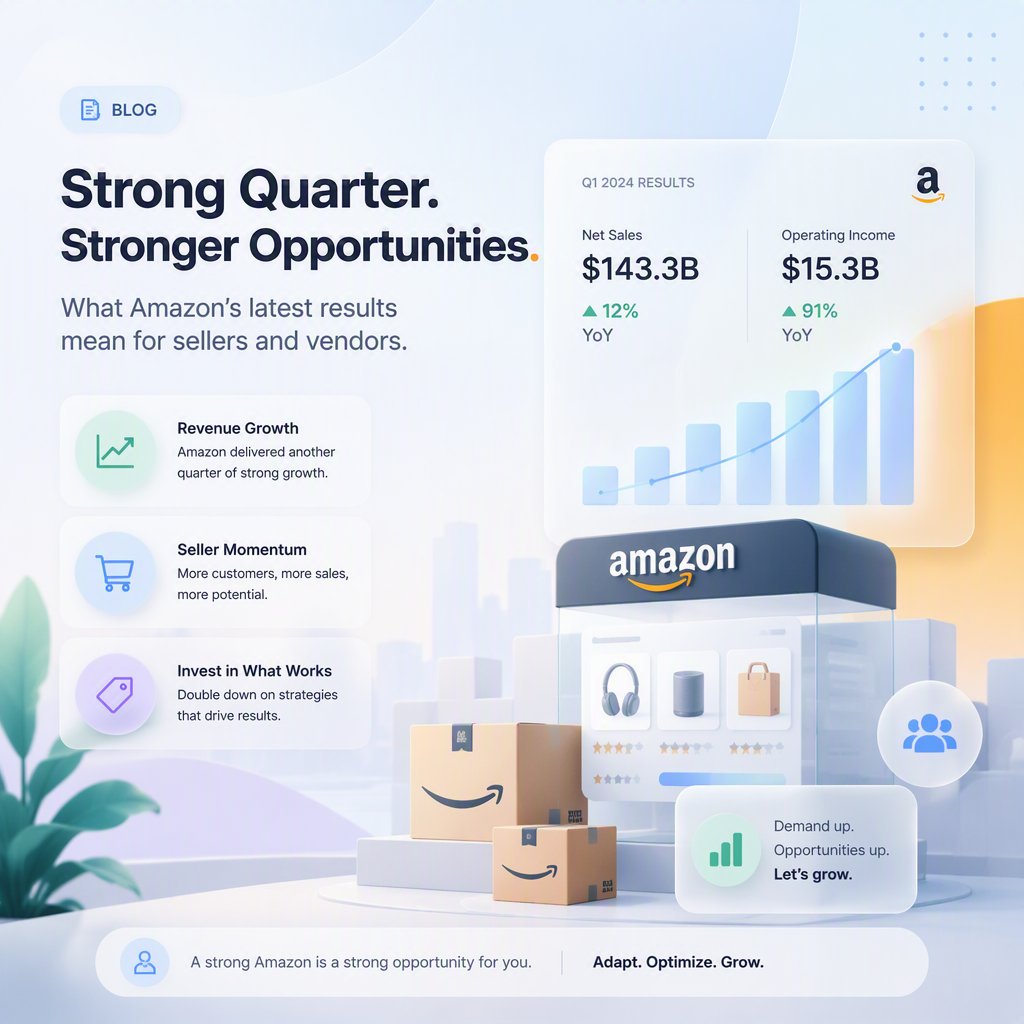
Wall Street ended the week higher after Amazon reported its strongest quarterly revenue growth in more than four years. The stock jumped sharply, and the market response was immediate: investors who had been worried that big tech was pouring too much money into AI data centers suddenly had a reason to relax.
That matters because Amazon is one of the companies most closely tied to the AI spending cycle. Its AWS business builds and rents the infrastructure that powers AI training and inference, while Amazon’s retail and advertising businesses depend on the same broader cloud and data backbone. When Amazon posts stronger growth, it suggests the spending is finding its way into revenue, not just capital expenditure.
The reaction came at a useful moment. Earlier in the month, markets had been jittery about whether heavy AI infrastructure investment would pay off fast enough. Amazon’s report, paired with Microsoft’s strong cloud update earlier in the week, helped reset expectations.
Apple’s weaker results pulled in the opposite direction, reminding investors that not every tech giant is benefiting equally from the current cycle. But for Amazon, the message was simple: the company still knows how to turn scale into growth.
For marketplace participants, the headline isn’t just that Amazon beat expectations. It’s that Amazon’s core platform economics still look durable enough to support aggressive infrastructure spending.
Technical Deep Dive
To understand why this matters to Amazon’s ecosystem, it helps to separate three layers of the business: AWS infrastructure, Amazon’s retail platform, and the merchant tools built on top of both.
1. AWS is the engine behind the AI narrative
A lot of investor anxiety has centered on whether cloud providers are overspending on GPUs, networking, storage, and data center capacity. In practical terms, these are the components that make large-scale AI possible:
- GPU clusters for training and inference
- High-bandwidth networking to move model data quickly
- Distributed storage systems to handle massive datasets
- Power and cooling infrastructure that keeps all of it running at scale
Amazon’s results suggest customers are still buying that capacity. For AWS, that means the spending curve is closer to a revenue-backed buildout than to speculative capex. If Amazon can fill that capacity with enterprise demand, the economics improve quickly.
That’s important for sellers too, even if they never touch an AWS console. Amazon’s internal systems rely on the same cloud and data infrastructure patterns. Better compute efficiency, more mature AI tooling, and faster data pipelines can improve search ranking models, fraud detection, inventory planning, and ad targeting.
2.
Amazon’s retail operations benefit from the same stack
Amazon’s marketplace is really a giant real-time logistics and matching system. Every ASIN listing, Buy Box decision, replenishment signal, and ad impression depends on data processing at scale. Strong cloud and AI investment can improve:
- Demand forecasting
- Inventory placement
- Search relevance
- Sponsored Products and Sponsored Brands targeting
- Fraud detection and review filtering
- Delivery promise accuracy
If the company is scaling these capabilities efficiently, sellers eventually feel it in the form of better conversion quality, fewer stockouts, and more precise ad delivery. When the system works well, it’s not flashy. Orders just flow more predictably.
3. AI spending only makes sense if unit economics hold up
This is where the market’s concern has been centered. AI infrastructure is expensive. Very expensive. The risk is that companies build capacity faster than customers can monetize it.
Amazon’s report helped ease that fear because strong revenue growth implies that the infrastructure is feeding real business demand. In cloud terms, that usually means better utilization. Better utilization improves gross margin. Better gross margin creates room for continued investment without making the balance sheet look reckless.
For Amazon, that’s the key technical and financial loop:
capex -> capacity -> customer usage -> revenue -> utilization -> margin
When that loop is healthy, Amazon can keep funding the systems that support sellers, vendors, and shoppers without choking near-term profitability.
Industry Impact
Amazon’s earnings report sends signals far beyond Wall Street traders.
For sellers
If AWS and Amazon’s core retail systems are healthy, sellers usually benefit from a more stable marketplace environment. That can show up in a few ways:
- Faster iteration in Seller Central features
- Better ad placement and conversion modeling
- More accurate inventory recommendations
- Improved performance of automation tools and APIs
- Stronger fulfillment reliability during peak periods
It doesn’t mean every seller sees immediate upside. In fact, more advanced AI systems can make the marketplace more competitive. Listings that are poorly optimized, underfunded, or slow to replenish tend to fall behind faster when ranking and advertising systems get smarter.
For Vendor Central users
Vendors should read this as a signal that Amazon is still willing to invest in sophisticated forecasting, procurement, and operational tooling. That matters for:
- Demand planning
- PO generation
- Retail analytics
- Supply chain visibility
- Cost-to-serve management
If Amazon’s internal systems get better at matching supply with demand, vendors may face tighter expectations around fill rates, delivery performance, and pricing discipline. The upside is cleaner operations. The downside is less room for sloppy execution.
For the broader marketplace
Amazon’s strength also pressures competitors. When Amazon shows that its AI and cloud spending is producing growth, it sets a higher bar for everyone else, including Walmart, Target, Shopify merchants, and other marketplace operators. The message is that AI isn’t just a buzzword layer sitting on top of commerce. It’s becoming part of the operating system.
That affects ad tech, fulfillment software, repricing tools, and third-party analytics vendors too. Anyone selling software into the Amazon ecosystem will feel more demand for automation, prediction, and margin control.
Implementation Considerations
If you’re building, selling, or managing a brand on Amazon, this market reaction shouldn’t stay abstract. It should change how you think about your own systems.
For Amazon sellers
Focus on operational resilience. Amazon’s platform is getting more data-driven, which means weak inputs get punished faster.
- Keep inventory buffers tight but realistic
- Monitor suppressed listings and search term performance weekly
- Review ad campaigns for waste, not just spend volume
- Use Brand Analytics and Search Query Performance data where available
- Watch return rates and conversion dips by variation, not just by ASIN family
If Amazon’s machine learning gets more effective, it’ll reward clean catalog data and consistent availability. Messy catalogs will stand out more.
For Vendor Central teams
Vendor managers should pay close attention to forecasting and replenishment discipline.
- Reconcile Amazon’s demand signals with your own planning models
- Stress test lead times against Q4 and promo spikes
- Audit chargebacks, shortages, and ASN accuracy
- Align retail media spend with actual in-stock rates
- Push for better visibility into assortment performance by channel and region
A smarter Amazon means less tolerance for poor supply chain hygiene. That’s not a theory. It’s usually how these systems evolve.
For developers and software vendors
If your tools integrate with Amazon APIs, this is a good time to think about scale and latency.
- Design for rate-limit volatility in SP-API workflows
- Cache non-critical reads where possible
- Build retry logic for inventory and order endpoints
- Validate data pipelines against delayed or partial updates
- Keep an eye on permission changes and feature rollout cadence
As Amazon expands AI-driven workflows, the surrounding tooling stack needs to become more resilient. The winners will be the systems that handle noisy data gracefully.
The practical lesson is simple: Amazon’s internal investment cycle only helps you if your own operations can keep up.
Future Outlook
This quarter suggests Amazon still has room to invest aggressively without scaring the market, at least for now. That could mean more capacity for AI services, more pressure on competitors, and more platform enhancements across Amazon’s commerce stack.
Here’s what I’d watch over the next few quarters:
- AWS growth and margin trends
- Capital expenditure guidance
- Ad pricing and retail media growth
- Fulfillment network efficiency
- Seller performance tools and automation updates
- Vendor forecasting and replenishment changes
If AI demand stays strong, Amazon will likely keep expanding the infrastructure behind it. That helps AWS, but it also reinforces Amazon’s advantage in retail operations. The company gets to apply the same compute, data, and automation layer across cloud, advertising, logistics, and marketplace services.
That’s a big deal. It means Amazon isn’t just selling products and cloud services. It’s building a platform where every part of the commerce stack feeds the others.
Conclusion
Amazon’s strong quarter did more than calm nervous investors. It showed that the company’s heavy AI and infrastructure spending still has a path to revenue, which is exactly what markets wanted to see.
For sellers and vendors, the takeaway is practical:
- Expect a more data-driven marketplace
- Tighten catalog, inventory, and forecasting discipline
- Treat automation and API reliability as core business issues
- Watch how Amazon’s cloud and AI investments shape retail tools over time
Amazon’s earnings are a Wall Street story, sure. But they’re also a roadmap for how the marketplace will run next. If you sell on Amazon, you’re not just participating in that system. You’re operating inside it.