Amazon Seller Central and Vendor Central: What This Dust Story Shows
Salevoyant Editorial · August 17, 2026
Introduction
Every so often, a science story comes along that feels oddly familiar to anyone who works with Amazon. A massive system depends on a long, fragile chain of events, and a small change anywhere in that chain can ripple far downstream. That’s exactly what’s happening with dust from Chad’s Bodélé Depression, which crosses the Atlantic each year and helps feed the Amazon rainforest with phosphorus.
For Amazon sellers, vendors, and marketplace operators, the lesson isn’t about ecology alone. It’s about dependency, variability, and systems thinking. The same logic applies to fulfillment networks, catalog data flows, ad delivery, and supply planning. If you understand how the rainforest depends on distant dust, you understand why Amazon businesses need to think beyond the immediate surface of their own operations.
Core Development
The key development is simple to state but remarkable in scale. Roughly 27.7 million tonnes of dust rise each year from a dry lakebed in northern Chad, cross about 5,000 kilometers of Atlantic Ocean, and some of that material eventually settles over the Amazon Basin. Inside that dust is phosphorus, a nutrient the rainforest needs to keep its ecosystem functioning.
A major satellite-based study led by atmospheric scientist Hongbin Yu estimated that the Amazon receives an average of about 28 million tonnes of African dust annually, with a wide year-to-year range from roughly 8 million to 48 million tonnes. The same research estimated that the dust carries about 22,000 tonnes of phosphorus each year into the basin.
That matters because the Amazon’s soils are old, weathered, and often poor in available phosphorus. The forest looks lush, but the nutrient cycle underneath it is tight and delicate. African dust doesn’t replace that cycle. It helps top it up.
The striking part isn’t just that dust travels across an ocean. It’s that a remote desert basin contributes to the nutrient budget of one of Earth’s largest rainforest systems.
The source of this dust is the Bodélé Depression, a former lakebed left behind by ancient Mega-Chad. As the lake dried out, it exposed fine sediments, including diatomite, which are unusually easy for wind to lift. Seasonal winds, especially the Bodélé Low Level Jet and the Harmattan flow, pick up those particles and send them westward, mostly between December and March.
Technical Deep Dive
The science here is a good reminder that environmental systems are measured, not guessed. Researchers used the CALIOP lidar instrument on the CALIPSO satellite to observe dust in three dimensions over seven years. That’s a big deal technically, because standard imagery only gives you a surface view. Lidar shows vertical structure, plume thickness, and altitude, which are essential for estimating whether particles stay airborne long enough to reach South America.
Why the measurement method matters
Dust transport isn’t a straight line from point A to point B. Particles:
- rise to different altitudes depending on wind strength
- mix with other aerosols
- fall out at different points over the Atlantic
- react chemically while airborne
- arrive in different sizes, which changes how much is biologically useful
That means the phosphorus reaching the Amazon isn’t simply the same as the phosphorus leaving Chad. Some of it is lost en route. Some arrives in chemical forms plants can’t immediately use. Some gets washed out by rainfall before it ever touches the forest floor.
This is why remote sensing and atmospheric chemistry need to work together. A dust plume can be visible in satellite data, but its ecological impact depends on particle size distribution, mineral composition, wet and dry deposition, and local soil chemistry.
Why phosphorus is the key nutrient
Amazon soils are often phosphorus-limited. In practical terms, that means the system can’t always grow as fast as its carbon-rich vegetation suggests it should. Plants need phosphorus for:
- ATP and energy transfer
- DNA and RNA
- cell membrane structure
- root development and reproduction
The rainforest recycles a lot of its nutrients internally through leaves, roots, microbes, and decomposition. But recycling isn’t perfect. Rainfall, leaching, and erosion gradually remove phosphorus from the system. Imported dust helps offset that loss.
From an engineering perspective, this is a classic input-output balance problem. The rainforest is a high-throughput system with a narrow margin. If one nutrient input drops too far, the whole system can slow down.
The chemistry inside the dust
Bodélé dust contains more than just phosphorus. It also carries iron and other minerals. Earlier field studies found that dust from the depression may export significant amounts of phosphorus and iron annually from the source region, though not all of that ends up in the Amazon.
The chemical form matters a lot. Phosphorus can be bound in minerals such as apatite, attached to iron oxides, or locked in mixed mineral phases. Plants can’t use all forms equally well. Atmospheric processing may alter those compounds before they arrive, and once deposited, soil microbes and moisture conditions affect how much becomes bioavailable.
So when people say the desert “fertilizes” the Amazon, that’s shorthand. The real process is messier. Dust acts more like a distributed nutrient delivery network than a simple fertilizer dump.
Industry Impact
At first glance, this sounds far removed from Amazon’s commerce stack. It isn’t. The ecosystem logic maps surprisingly well to how Amazon businesses actually work.
1.
Resilience depends on external inputs
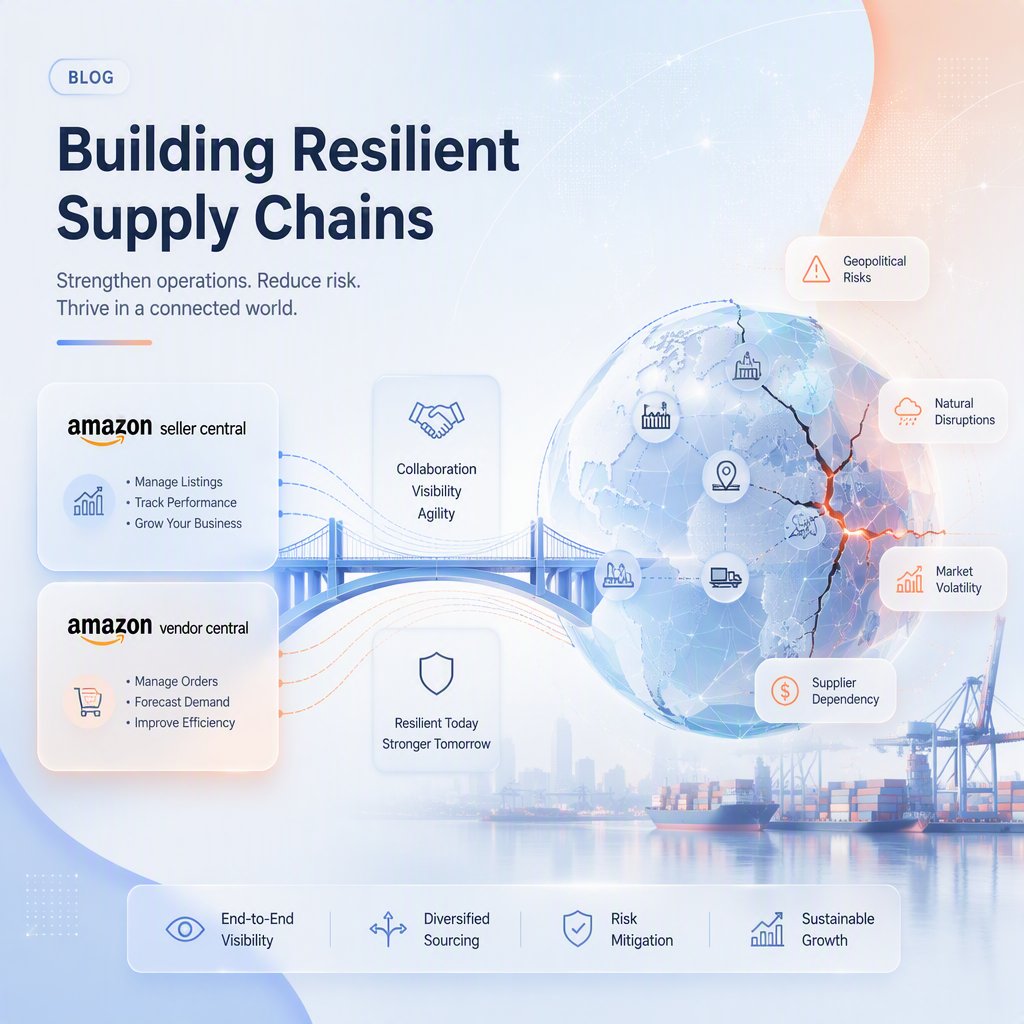
The Amazon rainforest depends on a distant nutrient source. Amazon sellers depend on distant inputs too, whether that’s a supplier in Vietnam, packaging stock from Ohio, or ad inventory availability inside Amazon’s auction system. In both cases, the system looks stable until a hidden dependency fails.
For sellers, this is a reminder to stress-test:
- inventory replenishment paths
- supplier lead times
- marketplace fee changes
- Buy Box performance under demand spikes
- FBA inbound capacity during peak periods
A supply chain that looks fine in a spreadsheet can fail when one node goes down.
2.
Variability is normal, not exceptional
The dust supply to the Amazon varies year to year. Rainfall in the Sahel affects how much dust is available later. That’s not a bug. It’s how the system works.
Amazon marketplace performance has a similar pattern. Traffic, conversion, CPCs, and even category demand fluctuate with seasonality, promotions, competition, and macroeconomic conditions. Vendors in Vendor Central often see this when Amazon’s replenishment logic shifts or when purchase order patterns change faster than their forecasting models expect. Sellers in Seller Central see it in ad performance, inventory sell-through, and suppression risk.
If your model assumes a perfectly steady environment, it’ll break under real conditions.
3.
Infrastructure is only as good as observability
The Bodélé dust story became clear because scientists had better observation tools. Without satellite lidar, the trans-Atlantic transport would’ve remained mostly inferred.
That’s a useful parallel for Amazon operators. If you can’t observe your system in detail, you can’t manage it well. That applies to:
- account health metrics
- stranded inventory
- detail page quality
- conversion funnels
- Vendor Central chargebacks
- forecasting error at ASIN level
Good visibility doesn’t just report problems. It lets you understand where the system is weak before the weakness becomes expensive.
Implementation Considerations
For Amazon sellers, vendors, and technical teams, the practical takeaway is to build for dependency, drift, and uncertainty.
For sellers in Seller Central
- Keep inventory buffers for your top ASINs, especially if your supplier lead time is long.
- Watch for concentration risk. If one factory or one shipping lane fails, your business can stall fast.
- Use demand forecasting that accounts for volatility, not just averages.
- Track conversion and ad efficiency by week, not just month, so you can spot sudden changes early.
For Vendor Central teams
- Review purchase order variability and fill-rate assumptions regularly.
- Align warehouse and freight planning with Amazon’s ordering patterns, which can change without much warning.
- Be careful with overcommitting to forecast baselines. Amazon’s demand signals can shift faster than your internal planning cycle.
- Monitor deduction trends and shortage claims, because disruptions often show up there before they show up in top-line sales.
For developers and analytics teams
- Build dashboards that separate signal from noise. Weekly averages alone hide too much.
- Include exception alerts for inventory age, lost buy box share, and abrupt traffic drops.
- Keep your data pipelines resilient. Amazon reporting delays, API lag, and feed errors happen more often than teams like to admit.
- When possible, model scenarios instead of relying on one forecast.
A useful rule: if a single assumption can take down your margin, it’s not an assumption. It’s a risk.
Future Outlook
This research is a reminder that Amazon’s own ecosystem, and the broader digital commerce world, is becoming more interdependent every year. Climate shifts can affect shipping routes, harvest cycles, consumer demand, and ultimately seller performance. A dust source in Africa may seem far removed from a catalog change in Seller Central, but both are parts of systems that run on continuity and adaptation.
Expect more pressure on businesses to think in terms of network resilience rather than linear growth. For Amazon operators, that means stronger supplier diversification, better observability, tighter replenishment control, and more realistic forecasting. For the platform itself, it means the importance of infrastructure, logistics, and data quality keeps rising.
There’s also a broader business lesson here. Hidden dependencies can be surprisingly valuable until they become fragile. The Amazon rainforest benefits from dust because its soils are nutrient-poor. Amazon sellers benefit from platform infrastructure because it concentrates demand. In both cases, the upside comes with exposure.
Conclusion
The dust traveling from Chad to the Amazon Basin is more than an environmental curiosity. It’s a rare example of a planetary-scale supply chain, one where wind, geology, chemistry, and rainfall all have to line up before phosphorus reaches the rainforest.
For Amazon sellers and vendors, that’s the real takeaway. Modern commerce works the same way. Your business depends on faraway inputs, shifting conditions, and systems you don’t fully control. The companies that perform best aren’t the ones that assume stability. They’re the ones that plan for variance, measure carefully, and keep a buffer between themselves and disruption.
If you’re managing inventory, forecasting demand, or optimizing vendor performance, think like the rainforest. Build for the nutrients you can’t fully control.