Amazon Seller Central and Vendor Central: What Wall Street’s AI Debt Worries Mean
Salevoyant Editorial · July 25, 2026
Introduction
Amazon’s AI push isn’t happening in a vacuum anymore. As Wall Street starts questioning how hyperscalers will pay for the next wave of data centers, chips, and power-hungry infrastructure, Amazon sellers and vendors should be watching the fallout closely.
This matters now because Amazon sits right in the middle of the AI capex race. The company is spending aggressively on cloud capacity, automation, and generative AI services, while the market is starting to ask a tougher question: how much of this investment actually turns into durable profit?
Core Development
Jefferies’ latest read on the AI infrastructure boom says the biggest cloud and platform companies are leaning harder on debt to finance their AI buildout. That includes Amazon, alongside Microsoft, Meta, and Alphabet. The report says these hyperscalers have already issued about
94 billion in investment-grade debt this year, and that the bond market is no longer treating AI expansion as a free pass.
For Amazon, that scrutiny lands at an interesting moment. The company has been pouring money into:
AWS data center expansion
Custom silicon, including Trainium and Inferentia
AI model access and developer tooling
Fulfillment automation and robotics
Power and network infrastructure
The Jefferies note highlights that combined capital expenditures from the four largest hyperscalers could reach $695 billion in 2026 and $870 billion in 2027. Those are eye-watering numbers, and they explain why investors are now watching earnings calls for clues about spending discipline, return timing, and financing mix.
The other number worth paying attention to is the growing pile of contractual commitments. Jefferies says remaining performance obligations, or RPOs, across Microsoft, Amazon, Alphabet, and Oracle hit about $2.1 trillion at the end of Q1 2026, up 184% year over year. That signals strong demand, but it also creates a bigger surface area for credit and execution risk if monetization takes longer than expected.
The market isn’t questioning whether AI demand exists. It’s questioning who pays for the infrastructure, how long it takes to earn it back, and which companies can keep funding the buildout without stressing margins.
Technical Deep Dive
From Amazon’s point of view, AI spending isn’t just about buying more servers. It’s a systems problem. Every new model deployment or inference service adds pressure across the stack:
GPU and accelerator capacity
Networking fabric and latency management
Storage throughput
Data center cooling and power density
Security, compliance, and identity controls
Availability engineering across regions
AWS has to provision for both training workloads and inference workloads, and those behave very differently. Training burns through enormous bursts of compute for short periods. Inference, especially at Amazon’s scale, can be steadier but far more persistent. That changes how capacity planning works. You can’t just buy hardware and call it a day. You need a continuously optimized supply chain for chips, power, and rack-level deployment.
The debt angle matters because AI infrastructure has a long payback period. Amazon can’t treat every build as an immediately cash-generating asset. It has to balance:
Capex timing
Utilization rates
Cloud pricing
Customer adoption
Model serving costs
Hardware depreciation
If AWS builds ahead of demand, margins can get squeezed. If it builds too slowly, it risks losing enterprise workloads to rivals with more available capacity. That’s the knife edge.
There’s also a technical nuance that doesn’t get enough attention. A lot of the AI economics depend on efficiency per token, per request, or per inference call. Amazon has been pushing custom silicon partly because it can lower the cost of serving workloads over time. That’s not just a hardware story, it’s a unit economics story. If Amazon can reduce cost per compute unit while keeping performance acceptable, it improves gross margin on AWS AI services and makes pricing more flexible for customers.
But the math only works if utilization stays high. Idle infrastructure is expensive. Very expensive.
Industry Impact
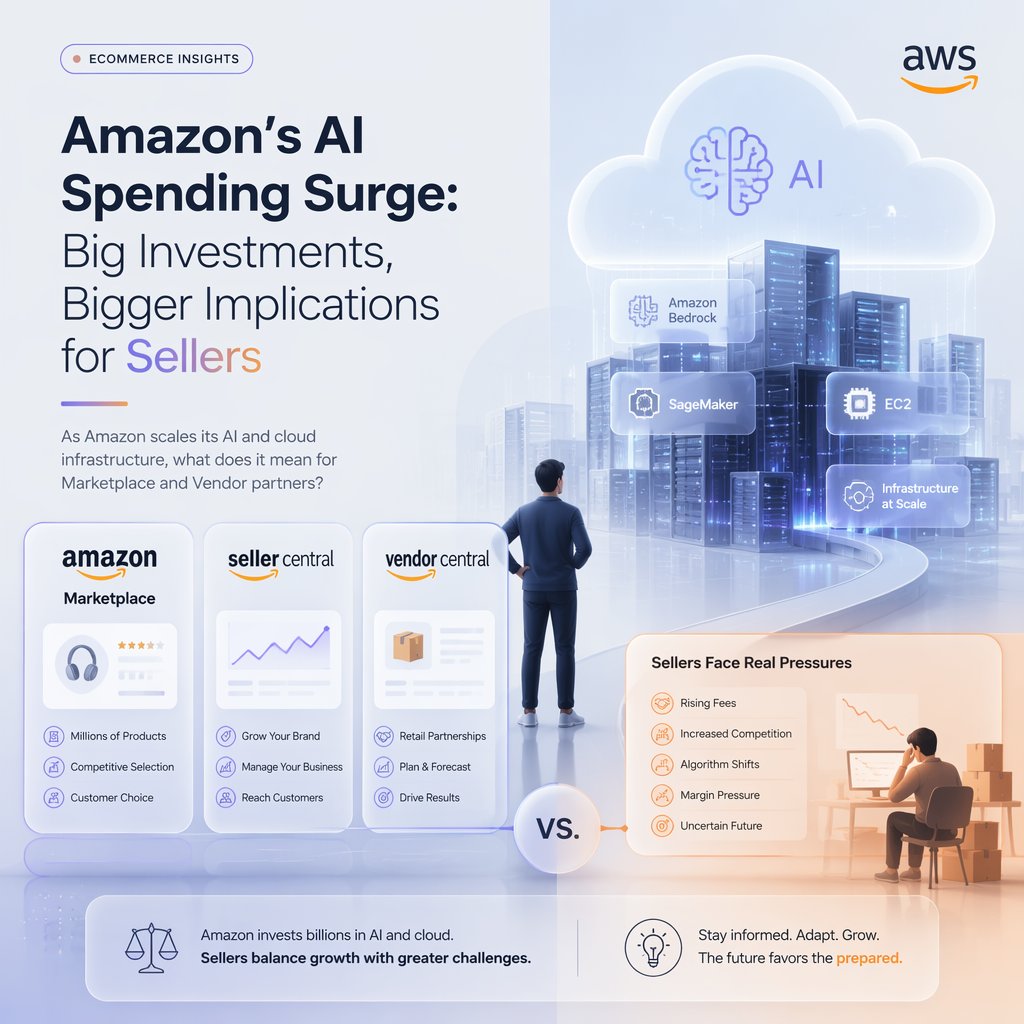
For Amazon sellers and Vendor Central users, this sounds far removed from catalog health or buy box performance. It isn’t.
A capital-intensive AWS and AI strategy influences Amazon’s entire ecosystem in at least four ways.
1.
More pressure on profitability discipline
When investors get nervous about capex returns, Amazon tends to face more questions about margin mix. That can ripple into every business unit. Advertising, fulfillment, logistics, and cloud all get judged more tightly. Seller fees and vendor terms may not change overnight, but Amazon becomes more sensitive to businesses that improve operating income.
For sellers, that means Amazon may keep pushing for:
Higher adoption of FBA
Better inventory placement efficiency
Cleaner catalog data
Stronger ads adoption
Faster content optimization through AI tools
These are all ways Amazon can improve throughput and monetization without throwing more fixed cost at the problem.
2.
Faster AI product rollout inside Seller Central
Amazon has strong incentives to use AI to reduce manual operations and support costs. That likely means continued expansion of AI-generated tools in Seller Central, Vendor Central, and advertising interfaces.
Expect more automation in areas like:
Listing creation and rewriting
A+ content assistance
Image enhancement and compliance checks
Forecasting and replenishment suggestions
Issue triage in support workflows
That’s good for efficiency, but there’s a trade-off. The more Amazon automates, the more sellers need to watch for generic outputs, policy mismatches, and subtle catalog errors. AI can draft faster than a human, but it can also multiply bad inputs at scale.
3. AWS pricing and packaging may stay aggressive
If Amazon wants to keep AI workloads flowing, AWS can’t afford to price itself out of enterprise adoption. We may see continued competition around:
Reserved capacity
Inference pricing
Managed AI services
Model hosting packages
Vertical-specific cloud offerings
That’s relevant to marketplace software vendors and agencies too. If AWS keeps introducing lower-friction AI services, the ecosystem around Amazon marketplace analytics, repricing, and content automation will likely get more crowded and more API-driven.
4.
Ecosystem dependency gets stronger
The more Amazon ties retail, logistics, AI, and cloud together, the harder it becomes for sellers and vendors to separate one decision from another. A new AI feature in Seller Central may look like a productivity tool, but it can also be a signal about how Amazon wants the marketplace to operate at scale.
For example, AI-assisted catalog normalization could reduce listing inconsistency across millions of ASINs. That helps search relevance and customer trust. It can also make it easier for Amazon to enforce standards more aggressively. Sellers who rely on messy legacy listings will feel that shift first.
Implementation Considerations
If you’re building for Amazon’s ecosystem, or selling in it, this is where the practical implications start showing up.
For sellers
Treat AI tools as assistants, not decision-makers. Use them to draft copy, summarize data, or identify patterns, but keep human review in the loop.
Watch inventory efficiency. If Amazon keeps prioritizing infrastructure return on investment, poor inventory management will get less forgiveness.
Use better product data. Clean titles, attribute completeness, and strong backend keywords matter more when Amazon’s systems become more automated.
Track ad spend by contribution margin. If Amazon tightens monetization expectations, you’ll want to know which SKUs can actually carry higher CAC.
For Vendor Central teams
Expect more data-driven pressure from Amazon. Forecast accuracy, replenishment discipline, and content quality will matter even more.
Monitor chargebacks and operational costs. When Amazon pushes efficiency, vendor terms can become less flexible.
Prepare for AI-assisted workflows. Content submission, issue resolution, and demand planning will likely get more algorithmic, which means your internal processes need cleaner inputs.
For developers and software vendors
Design for API reliability and cost sensitivity. As Amazon expands AI services, usage costs and throttling behavior can matter more.
Keep auditability built in. Sellers want to know why a recommendation was made, especially when it affects pricing, ads, or inventory.
Build human override controls. In a marketplace this large, automated mistakes scale fast.
Test for catalog edge cases. Amazon’s AI systems are only as good as the data model underneath them.
A simple rule applies here: if your tool touches catalog, pricing, or replenishment, it needs to be explainable.
Future Outlook
The next phase of Amazon’s AI strategy probably won’t be defined by flashy demos. It’ll be defined by whether the company can turn massive infrastructure spend into measurable operating gains.
That means three things to watch:
AWS AI revenue growth versus capex growth
Amazon’s margin trend in retail and cloud
How much of the AI stack gets funded through debt versus operating cash flow
If the market decides AI demand is real but returns are slower than expected, the winners won’t necessarily be the biggest spenders. They’ll be the companies with the best utilization, the cleanest unit economics, and the strongest pricing power.
For Amazon, that puts pressure on execution. It also creates opportunity. If the company can keep improving cloud efficiency, expand AI tooling inside Seller Central and Vendor Central, and automate more of the marketplace machinery, it can justify the spend. If not, investors may start asking whether Amazon is building too far ahead of demand.
Conclusion
Amazon’s AI investment story is still strong, but it’s entering a more demanding phase. The market now wants proof that all this spending, on chips, data centers, cloud capacity, and automation, will produce returns that show up in margins, adoption, and long-term customer retention.
For sellers and vendors, the message is straightforward:
Expect more AI inside Amazon’s tools
Expect more pressure on operational efficiency
Expect better automation, but also tighter standards
Expect Amazon to keep optimizing for scale and monetization
The AI boom isn’t slowing down. It’s just getting more expensive to fund, and that changes how every company in Amazon’s orbit needs to think about growth.