Amazon Seller Central: Black Friday 2026 Dates and Deal Planning Guide
Salevoyant Editorial · November 13, 2026
Introduction
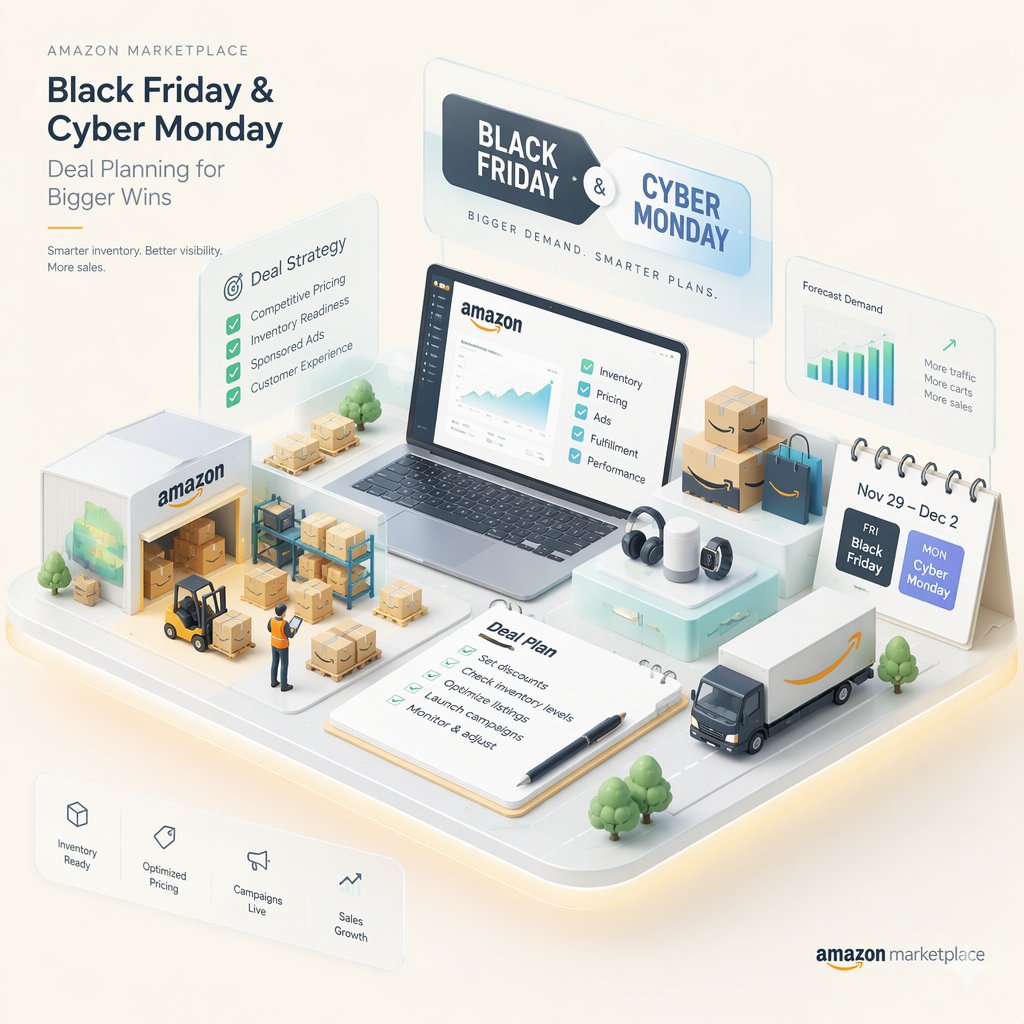
Amazon’s Black Friday Week and Cyber Monday promotions run from November 19 through November 30, according to reporting from The Economic Times. As of November 13, sellers and vendors have six days before that window opens, while competing retailers are already running holiday offers. The immediate challenge isn’t simply choosing a discount; it’s keeping pricing, inventory, advertising, and fulfillment aligned throughout a 12-day selling period.
Core Development
The report says Amazon plans to offer millions of deals across electronics, beauty, fashion, toys, and home products. Today’s Big Deals will feature discounts of up to 60%, with additional deal drops on Black Friday and Cyber Monday.
That maximum discount is a promotional headline, not a recommended markdown or a guarantee that every participating product receives comparable exposure.
Amazon’s schedule overlaps with several major competitors:
- Walmart: Early deals run November 12 15, its main event runs November 23 29, and Cyber Monday promotions continue November 30 December 2.
- Best Buy: Its 10-day Black Friday event begins November 19, followed by further cyber promotions.
- Costco: Holiday savings run in overlapping waves from October 30 through November 30.
- Target: Daily featured offers continue through December 24. The report’s proposed November 22 28 main-event dates remain projections, not confirmed dates.
The practical significance is the overlap. Amazon sellers aren’t competing only with other offers on an Amazon detail page. They’re competing with Walmart promotions, specialist electronics offers, membership benefits, and retailer reward programs.
This is a retail event announcement, not a Seller Central or Vendor Central product update. The supplied report doesn’t announce new APIs, seller eligibility rules, deal submission deadlines, or fulfillment requirements. Those details need separate verification in the relevant Amazon account.
Technical Deep Dive
Treat the promotion as several connected systems
A holiday offer depends on more than its displayed price. The advertised product needs a purchasable offer, available inventory, an acceptable delivery promise, and a detail page that accurately represents what the buyer receives.
For third-party sellers, Featured Offer eligibility and selection matter because a discount doesn’t automatically secure the principal purchase position. Price, availability, fulfillment, and seller performance can affect the outcome.
For vendors, the control model differs. Amazon generally controls the retail offer for inventory it purchases through Vendor Central. A vendor’s promotional plan therefore needs coordination around retail availability, purchase orders, and agreed funding, rather than assuming it can manage the consumer price like a third-party seller.
Analysis: A longer promotional window turns Black Friday into a coordination problem. A pricing change can happen quickly; inventory receipt, catalog correction, and replenishment often can’t.
Build around state, not just scheduled changes
An automated repricer or inventory integration should distinguish between a submitted update and a confirmed customer-facing result.
A useful operational pattern is:
- Read the current offer and inventory state.
- Check the proposed change against margin and stock constraints.
- Submit the permitted update.
- Check processing results or retrieve the resulting state.
- Alert an operator when the outcome differs from expectations.
The Selling Partner API, or SP-API, supports relevant listing, inventory, and reporting workflows, depending on account permissions and the operation used. It’s not one universal interface for holiday promotions, and the article doesn’t establish any new event-specific API capability.
At scale, integrations need operation-specific throttling controls, retry logic, and protection against duplicate business actions. Repeatedly resubmitting the same change can create unnecessary traffic and complicate troubleshooting. Use controlled backoff for transient failures, and keep an audit trail of requested and confirmed values.
Measure profit at the order level
A discounted item can generate more revenue while producing less contribution profit.
A practical calculation is:
Contribution profit = net sales revenue - product cost - marketplace fees - fulfillment costs - advertising spend - promotion costs - expected returns cost
Reconcile those components carefully so discounts or fees aren’t counted twice. Costs also differ between FBA, merchant-fulfilled, and vendor arrangements.
Advertising adds another complication. Advertising cost of sales, or ACoS, measures advertising spend relative to attributed sales. It doesn’t capture every expense, and attributed revenue isn’t necessarily incremental revenue. Holiday analysis should examine contribution profit, total advertising spend, and organic sales alongside campaign metrics.
Industry Impact
The calendar points to a broader pattern: retailers are stretching Black Friday across multiple shopping periods rather than concentrating every offer on one day.
Analysis: That creates more opportunities to reach shoppers, but also more chances for buyers to compare prices and postpone purchases. A strong opening-day result doesn’t establish how an offer will perform when Walmart’s main event begins on November 23.
For sellers, this increases the value of cross-channel consistency. Different pack sizes, bundles, accessories, and reward programs can make apparently similar offers economically different. Teams should compare the actual product configuration and delivered price, not just the discount percentage.
For vendors, promotion timing can affect demand forecasts and stock availability. A large early sell-through may leave insufficient supply for later deal drops. Conversely, an optimistic forecast can produce excess stock once the event ends.
Consumers benefit from more shopping windows, but availability and delivery expectations become part of the comparison. A modestly priced item that arrives reliably may be more attractive than a deeper discount with an uncertain delivery date.
Implementation Considerations
Prioritize what can still change
With six days until Amazon’s reported start date, teams should separate immediate fixes from work that depends on longer processing cycles.
- Audit active offers: Check price, purchasability, product variations, and inventory availability.
- Verify promotion status: Review the account’s actual eligibility, approval status, scheduling, and applicable charges.
- Check fulfillment readiness: Distinguish sellable inventory from stock that’s inbound, reserved, or otherwise unavailable.
- Review advertising destinations: Confirm campaigns point to the intended products and that those products remain buyable.
- Assign monitoring ownership: Identify who can pause campaigns, adjust permitted prices, or investigate listing problems.
Don’t assume inventory shipped now will become available before November 19. Shipment movement, receiving, and sellable availability are different stages. Use account-level information rather than a calendar assumption.
Set guardrails before increasing traffic
Define a minimum profitable price for each promoted SKU, including expected advertising and return costs. Where a repricer is involved, verify that its price floor reflects the holiday economics rather than an outdated baseline.
Advertising budgets also need stock-aware controls. Spending more on a product approaching depletion can waste money and weaken availability for later shopping peaks. Any automated pause rule should account for data latency and have a documented override.
For merchant-fulfilled offers, review warehouse capacity, carrier collection arrangements, and handling settings. The constraint may be daily processing capacity rather than total inventory.
Monitor exceptions, not every data point
A useful event dashboard highlights:
- Unexpected price changes.
- Featured Offer losses.
- Unavailable or suppressed listings.
- Inventory depletion relative to the remaining event window.
- Advertising spend without corresponding profitable sales.
- Integration errors or delayed updates.
For developers, observability should include timestamps and processing status. A dashboard showing yesterday’s inventory without identifying its age can support the wrong decision.
Future Outlook
Amazon’s November 19 30 schedule suggests that holiday planning should account for a sequence of competitive peaks, not one Friday.
That doesn’t prove Amazon is changing its ranking systems or seller tools. The source makes no such claim. The more defensible implication is operational: marketplace participants need systems that can accommodate repeated price comparisons, changing demand, and uneven stock consumption.
Sellers should evaluate whether discounts generate incremental contribution profit or mostly shift purchases forward. Vendors should compare forecast demand with actual sell-through and replenishment feasibility. Developers should build reusable event controls rather than one-off scripts that become difficult to maintain after November.
Conclusion
Amazon’s Black Friday 2026 window gives sellers and vendors 12 days of promotional exposure, but exposure alone won’t deliver a profitable result.
Before November 19, verify offer availability, confirm promotion status, protect margin floors, and connect advertising decisions to sellable stock. Vendor teams should also validate retail readiness and funding assumptions with their Amazon contacts.
The best preparation isn’t the deepest discount. It’s an offer that stays competitive, available, and profitable as the holiday calendar unfolds.