Amazon Seller Central Guide: Amazon Now’s Asset-Light Expansion in India
Salevoyant Editorial · September 3, 2026
Introduction
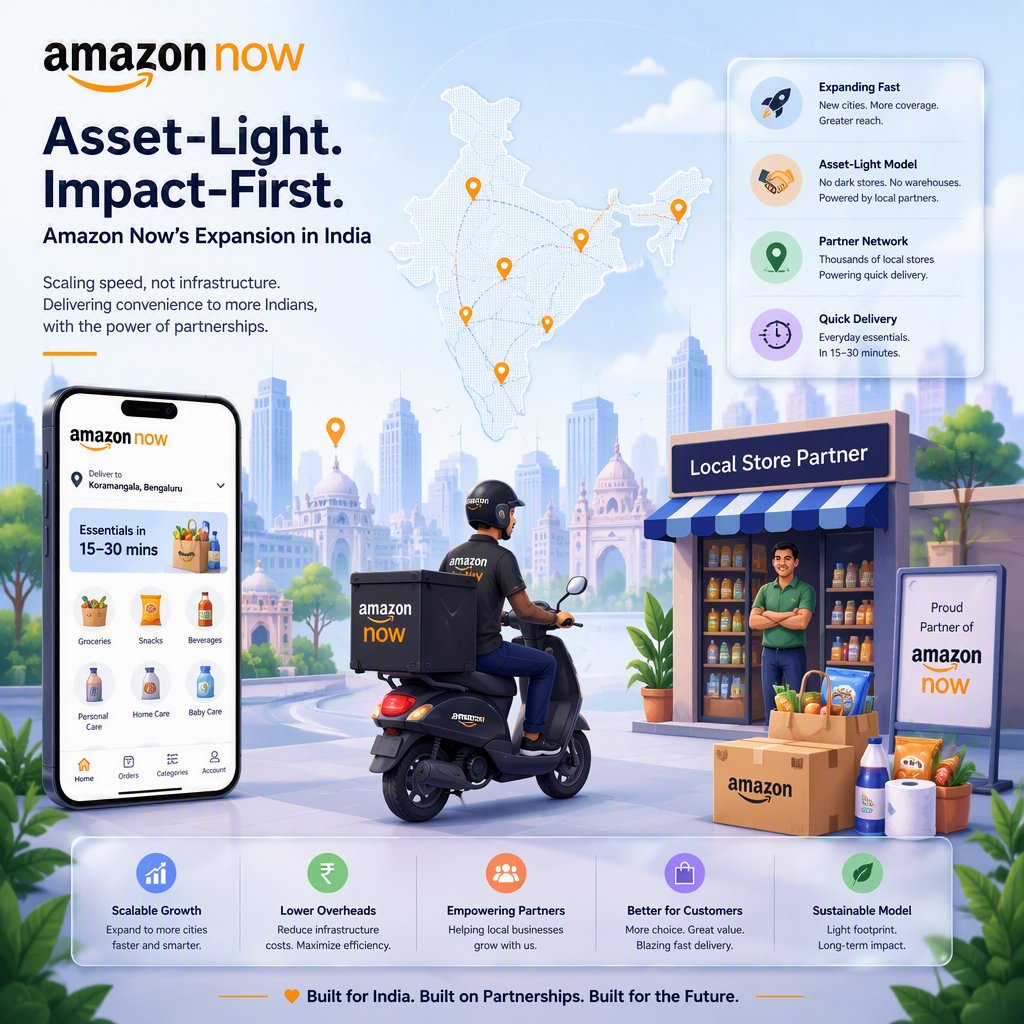
Amazon’s latest move in India says a lot about where quick commerce is headed. Instead of spending heavily to build a fresh network of dark stores, the company is taking a lighter route for Amazon Now, using More Retail’s existing stores to serve smaller cities.
That matters because the next wave of rapid delivery growth is no longer just about big metros. It’s about whether a marketplace giant can make sub-30-minute or same-day fulfillment work outside the obvious urban cores, without destroying unit economics in the process.
Core Development
Amazon Now is expanding its quick-commerce footprint in India’s tier-2 and tier-3 markets through an asset-light fulfillment model. Rather than opening and stocking a dense chain of dedicated dark stores, Amazon is tapping into More Retail’s physical locations and turning them into omnichannel fulfillment points.
In practical terms, this means a More Retail store can serve two roles at once:
- A normal walk-in retail outlet
- A local micro-fulfillment node for Amazon Now orders
That distinction is important. Dark stores are built purely for picking and dispatching online orders, which gives them speed and control but also creates high fixed costs. Rent, inventory holding, labor, and last-mile coordination add up quickly. By using stores that already exist, Amazon reduces the amount of capital it has to commit before demand is proven.
For Amazon, the timing is strategic. India’s quick-commerce market has become brutally competitive, with buyers in smaller cities expecting faster delivery windows and wider assortment. If Amazon can satisfy that demand through partner retail infrastructure, it avoids racing competitors into a costly network expansion battle.
Technical Deep Dive
The real story here is not just the partnership. It’s the fulfillment architecture behind it.
How the model likely works
At a systems level, Amazon Now needs to coordinate three things in near real time:
- Local inventory visibility
- Order routing and allocation
- Rapid dispatch orchestration
When a customer places an order, Amazon’s platform has to determine whether the nearest More Retail store has the item in stock, whether that stock is committed to in-store demand, and whether the order can be picked, packed, and handed to a delivery partner fast enough to meet the service promise.
That creates a tighter dependency on inventory accuracy than standard e-commerce. In a same-day model, stale stock data can cause cancellation spikes, substitution friction, or failed promise dates. For an asset-light setup to work, Amazon needs frequent inventory synchronization between the store POS system, the store backroom, and Amazon’s order management layer.
Why omnichannel stores are attractive
Converting stores into fulfillment points gives Amazon a few technical advantages:
- Lower node creation cost: no need to fully build and stock separate dark stores
- Better geographic coverage: retail stores already sit closer to demand pockets in smaller cities
- Higher inventory efficiency: one location can serve both offline and online demand
- Faster rollout: partner stores can be activated in stages instead of waiting for new infrastructure
This is classic network-density thinking. Quick commerce works best when delivery radii are short and order volume is dense enough to keep unit costs under control. In tier-2 and tier-3 cities, that density is harder to guarantee. A partner-store model helps Amazon test demand without overcommitting to expensive fixed assets.
The trade-offs are real
The model isn’t free of pain points.
- Picking speed depends on store layout
- Online and offline demand can compete for the same stock
- Staff training becomes a variable
- Service levels may be less consistent than in a dedicated dark store
A dark store is optimized for speed. A retail store is optimized for shoppers. Those are different operating environments. If Amazon wants dependable rapid delivery, it needs strong store-level process design, clear SKU zoning, and disciplined replenishment.
There’s also a systems integration challenge. Quick-commerce fulfillment needs cleaner APIs, tighter sync intervals, and better exception handling than standard marketplace orders. Think real-time inventory feeds, order routing rules, pick-path optimization, and delivery promise engines. If any of those layers lag, the customer sees late delivery or order splits.
The asset-light model works only if Amazon can keep inventory data fresh enough to make fast delivery promises with confidence. In quick commerce, bad data is expensive.
Industry Impact
This move has implications well beyond one India-specific rollout.
For
Amazon’s broader marketplace strategy
Amazon has spent years building fulfillment muscle through FBA, Seller Flex, regional fulfillment centers, and faster delivery programs. Amazon Now extends that logic into a more granular, city-level layer.
For sellers, this could mean:
- More opportunities for local assortment placement
- Faster demand signals from smaller cities
- Potential pressure to maintain better inventory depth in fast-moving SKUs
- A stronger bias toward products that can support rapid replenishment
If Amazon decides that certain products belong in quick-commerce assortments, sellers may need to think differently about pack sizes, case quantities, and replenishment cadence. A product that sells fine in standard marketplace fulfillment might not work in a rapid-delivery environment if it’s fragile, difficult to pick, or prone to stockouts.
For Vendor Central users
Vendor Central partners should pay close attention. If Amazon uses More Retail stores as regional execution points, it hints at a more blended retail supply chain where vendor-owned inventory, retail partner inventory, and marketplace demand all interact.
That can affect:
- Demand forecasting
- Purchase order patterns
- In-stock rate expectations
- Regional assortment planning
Vendors that already struggle with volatility in replenishment may see even tighter pressure on service levels if Amazon starts prioritizing quick-commerce-friendly SKUs in smaller cities. Products with stable velocity and simple handling characteristics are likely to get preference.
For the competitive quick-commerce market
India’s quick-commerce players have made dense dark store networks look like the default winning model. Amazon’s approach suggests that’s not the only path.
If the economics work, an asset-light model could let Amazon scale into lower-density markets where pure-play quick-commerce operators may hesitate. That’s significant. Smaller cities often have decent demand potential but not enough density to support a heavy dark-store footprint at first.
This is where Amazon’s broader logistics strength matters. It can combine marketplace demand, fulfillment intelligence, and partner retail infrastructure in a way newer entrants may find harder to copy.
Implementation Considerations
For engineers, operators, sellers, and vendors, the operational details matter more than the headline.
What technical teams should watch
- Inventory sync frequency
- Faster updates reduce oversells and cancellations
- Store-level SKU eligibility
- Not every item belongs in a rapid-delivery node
- Routing logic
- Orders need to be assigned to the nearest viable store, not just the nearest store
- Exception handling
- Substitution, partial fills, and short-pick workflows need clear rules
- Service-level monitoring
- Delivery-time accuracy should be measured by store, region, and SKU class
If Amazon is serious about this model, it’ll need robust operational dashboards. Store performance can’t be judged only on sales. It has to be tracked on order cycle time, pick accuracy, fill rate, and cancellation rate.
What sellers should do
Sellers with products that fit rapid delivery should think about:
- Compact packaging
- High turnover SKUs
- Low damage risk
- Predictable demand patterns
- Easy substitution options
If your product is a strong candidate for quick commerce, your listing quality matters even more. Clear titles, reliable dimensions, and accurate inventory feed updates reduce friction in a compressed fulfillment model.
What vendors should do
Vendor teams should revisit:
- Regional demand forecasting
- Case pack optimization
- Replenishment triggers
- Promotional timing
- SKU rationalization
Quick-commerce nodes are space constrained. That means Amazon will favor products with fast turns and low handling complexity. Large, slow-moving, or fragile items may get less attention.
Future Outlook
This is probably more than a local experiment. It looks like a test of a broader operating principle: can Amazon scale rapid delivery without building a heavy, expensive infrastructure stack from scratch?
If the answer is yes, the implications are big.
- Amazon could expand into more cities faster
- It could enter markets that don’t justify full dark-store economics
- It could make better use of retail partner networks
- It could blur the line between marketplace fulfillment and local retail execution
There’s also a data advantage here. Every order routed through a partner store improves Amazon’s understanding of local demand, peak windows, basket composition, and substitution behavior. That data can then feed assortment planning, pricing, and inventory placement.
The bigger picture is simple. Quick commerce is moving from a pure infrastructure race to a systems and economics race. The winners won’t just be the companies with the most stores. They’ll be the ones with the best inventory logic, the tightest store orchestration, and the most flexible fulfillment network.
Conclusion
Amazon Now’s asset-light expansion through More Retail stores is a smart signal of where the company thinks quick commerce is headed in India. It reduces capital intensity, widens geographic reach, and gives Amazon a faster path into smaller cities.
For sellers and vendors, the message is clear. Rapid delivery is no longer just about metros, and it’s no longer just about speed. It’s about inventory discipline, SKU fit, fulfillment accuracy, and regional execution.
Key takeaways:
- Amazon is reducing infrastructure risk by using existing retail stores
- Inventory visibility and order orchestration become central to success
- Sellers and vendors need to optimize for fast-turn, easy-to-pick products
- Smaller cities may become the next major battleground for quick-commerce growth
If Amazon executes well, this model could set a new pattern for marketplace logistics in India. Not every city needs a dark store. Sometimes the smartest move is to turn the stores that already exist into a faster, more flexible delivery network.