Amazon Seller Central Guide for 2026: What Sellers Need to Know
Salevoyant Editorial · September 7, 2026
Introduction
Amazon selling in 2026 isn’t just about listing a product and waiting for traffic. The setup path now reflects a much broader shift toward compliance, account quality, payments readiness, and operational discipline. WorldFirst’s updated step-by-step guide is a useful signal because it shows how much the seller onboarding process has matured, and why new sellers need to think like operators, not just merchants.
For brands, agencies, and marketplace teams, that matters right away. The first decisions you make around account structure, fulfillment, taxation, and cross-border money movement can shape margin, ranking stability, and scaling capacity months later.
Core Development
The headline change here isn’t one single policy update. It’s the fact that “how to sell on Amazon” in 2026 now needs to be framed as an end-to-end operating model, not a simple registration checklist.
WorldFirst’s guide reflects the current reality of Amazon onboarding, where sellers have to move through several connected steps:
- Choosing the right account type, usually Individual or Professional
- Setting up business identity and tax details
- Selecting a fulfillment model, typically FBA, FBM, or a hybrid mix
- Preparing product data and category compliance
- Handling payment collection, currency conversion, and settlement timing
- Managing launch readiness, from content to reviews to inventory placement
That might sound familiar, but the significance is in the sequencing. Amazon now expects sellers to arrive better prepared. The platform has tightened around identity verification, category gating, and listing quality. That raises the bar for new entrants, but it also rewards teams that build the right operational base early.
The real shift in 2026 is that Amazon onboarding is no longer just administrative. It’s strategic infrastructure.
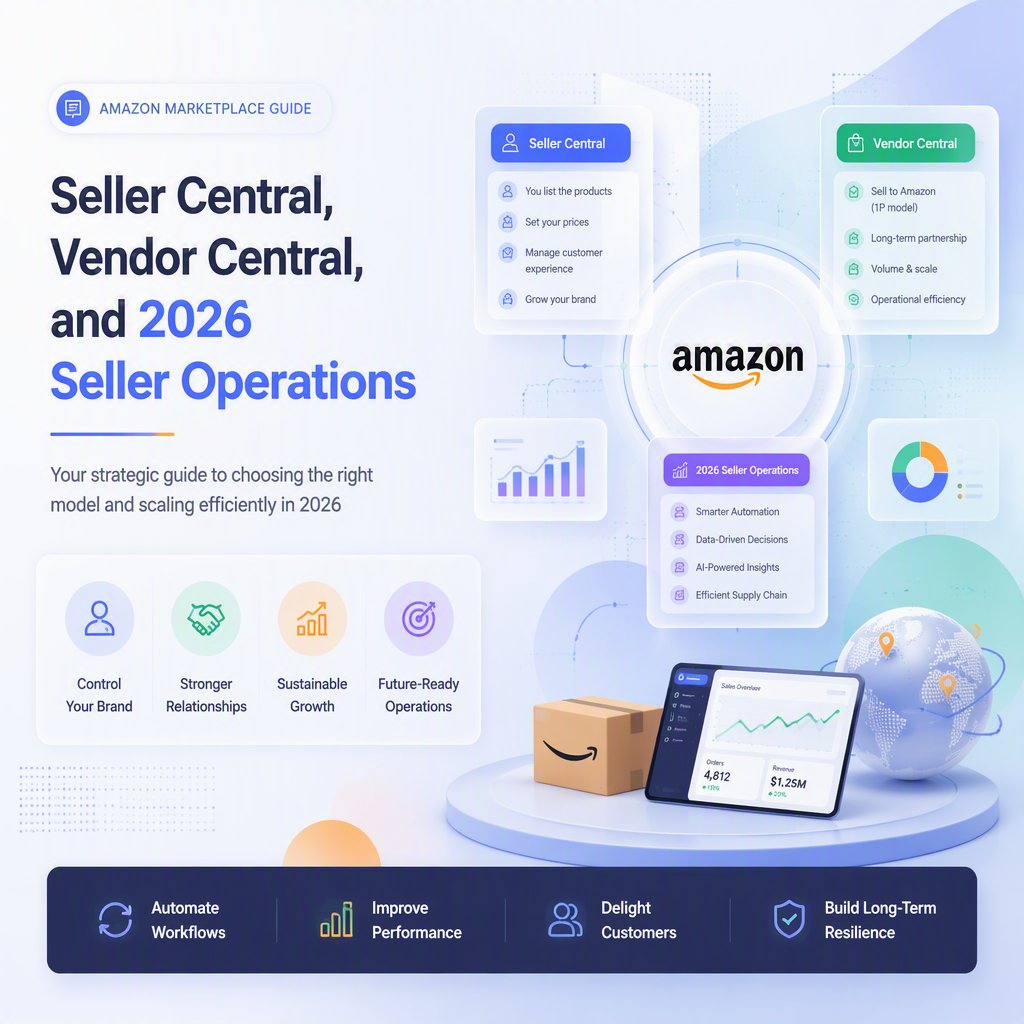
This also matters because sellers are often entering Amazon through multiple channels at once. A brand might be launching on Seller Central, supplying retailers through Vendor Central, and using third-party tools for ads, inventory, and international payments. The step-by-step guide format fits that environment because onboarding is now tied to the broader stack, not just the marketplace front end.
Technical Deep Dive
If you look under the hood, Amazon selling in 2026 depends on three technical layers working together: account architecture, catalog and compliance systems, and financial operations.
1. Account architecture
Amazon’s seller account model still starts with a basic choice between Individual and Professional, but the practical impact is much bigger than fees.
A Professional account usually makes sense for anyone serious about growth because it supports:
- Bulk listing and catalog management
- Sponsored ads access
- Brand Registry eligibility paths
- API-based integrations with ERP, inventory, and repricing tools
- Better fit for multi-SKU operations
The technical implication is that Professional sellers are more likely to integrate with systems like Amazon Selling Partner API (SP-API), which is now central to scalable operations. That means SKU creation, order handling, inventory sync, and performance monitoring can move into automated workflows instead of manual Seller Central updates.
For sellers at scale, that’s essential. Manual operations become fragile fast once you’re dealing with dozens or hundreds of SKUs.
2. Catalog and compliance systems
Amazon’s catalog is stricter than it used to be. Product detail page quality, GTIN validation, variation structure, and category-specific restrictions all affect whether a listing gets approved cleanly or stalls in review.
In 2026, the onboarding checklist has to account for:
- Accurate
ASINmapping - High-quality image and attribute data
- Brand ownership or authorization documentation
- Restricted category checks
- Safety and regulatory filings where required
This is especially important for sectors like beauty, supplements, electronics, and children’s products, where missing documentation can delay launch or trigger suppression later. The seller who treats catalog setup as a data engineering problem usually moves faster than the seller who treats it as a copywriting exercise.
There’s also a growing connection between listing quality and discoverability. Amazon’s search systems are increasingly sensitive to content completeness and relevance signals. Weak data upfront can hurt organic performance long after the listing goes live.
3.
Financial operations and settlement
This is where WorldFirst’s angle becomes especially relevant. Cross-border selling lives or dies on payment efficiency, currency management, and settlement visibility.
Most international sellers face a few recurring issues:
- Revenue arrives in one currency, expenses are in another
- Payout timing creates cash flow gaps
- Exchange-rate spread eats into margin
- Multi-marketplace expansion multiplies reconciliation work
A platform like WorldFirst matters because it helps sellers manage those flows with local collection and conversion workflows. For sellers shipping into the US from Europe, or expanding from the UK into the EU and North America, that can reduce operational friction. Even small FX differences become meaningful once monthly sales pass six figures.
That’s not a minor detail. It affects true contribution margin, not just gross sales.
Industry Impact
This updated guide says a lot about where Amazon commerce is heading.
Sellers are being pushed toward operational maturity
Amazon has spent years refining its seller ecosystem, and the result is clear: the platform now favors teams that can handle compliance, logistics, content, and finance as a connected system. That’s good for serious operators and tough on casual sellers.
The implication is straightforward. If your business can’t maintain clean records, accurate inventory, and stable cash flow, your growth will stall earlier than it used to.
Vendor
Central sellers face pressure from the seller model
For Vendor Central participants, this matters too. Amazon’s first-party model still plays a role, but many brands are running hybrid strategies because Seller Central offers more control over pricing, inventory, and customer relationship signals.
That creates a practical comparison:
- Vendor Central gives you wholesale simplicity, but less direct control
- Seller Central gives you control, but demands tighter operations
- Hybrid models require disciplined channel management to avoid conflicts
Brands that understand both sides can use Seller Central for margin-sensitive SKUs, long-tail items, or launch tests, while keeping high-volume wholesale relationships intact.
Marketplace competition is getting more technical
The days when a decent product photo and a few keywords were enough are mostly gone. Today’s winners are usually the teams with:
- Better data hygiene
- Faster replenishment cycles
- Stronger ad operations
- Lower payment friction
- Cleaner compliance records
That means Amazon is increasingly a systems competition. The best sellers aren’t just good at merchandising. They’re good at process design.
Implementation Considerations
If you’re setting up or auditing an Amazon operation in 2026, here’s what teams should pay attention to.
For sellers
- Pick the right account structure before launch. Switching later can be messy.
- Build your product data once, then reuse it across channels.
- Treat compliance docs as launch blockers, not afterthoughts.
- Model your real margin after fees, ads, fulfillment, returns, and FX.
- Use
FBAwhen speed and Prime eligibility matter, but watch storage and inbound costs. - Use
FBMwhen you need more control over inventory or specialized shipping.
For operations and technical teams
- Connect catalog, inventory, and order data through
SP-APIor approved middleware. - Set up monitoring for suppression events, Buy Box status, and stranded inventory.
- Create internal QA rules for titles, bullet points, images, and attributes.
- Build reconciliation workflows for payouts, chargebacks, and cross-border transfers.
- Align finance, logistics, and marketplace teams on the same SKU master data.
For brands with multiple channels
- Separate test SKUs from hero SKUs where possible.
- Use Amazon performance data to inform wholesale planning, not the other way around.
- Keep pricing policy consistent across Seller Central and Vendor Central.
- Watch for content drift between marketplace listings and DTC assets.
The sellers who scale cleanly are usually the ones who standardize early. They don’t wait for problems to expose weak processes.
Future Outlook
This guide is a reminder that Amazon’s seller ecosystem keeps moving toward higher automation and higher expectations. That trend will probably continue.
A few things to watch next:
- More verification at onboarding, especially around identity, business legitimacy, and category compliance
- Tighter catalog governance, with stronger penalties for poor data and unauthorized claims
- Deeper financial tooling, especially for cross-border sellers managing multiple currencies
- More integration pressure, since manual workflows don’t scale well on Amazon anymore
- Greater convergence between retail, ads, and operations, because performance now depends on all three
We should also expect sellers to become more selective about where they expand. Launching on Amazon used to be a broad “go everywhere” strategy. Now it’s more common to stage growth, starting with one marketplace, one fulfillment model, and one financial workflow, then expanding once the system is stable.
That’s a healthier approach. It’s also a more profitable one.
Conclusion
WorldFirst’s 2026 guide to selling on Amazon points to a simple truth: marketplace success now depends on readiness across operations, compliance, and finance, not just product demand.
For sellers, the big takeaway is to treat Amazon as a managed system. Build your account correctly, clean up your data, plan your fulfillment model, and pay attention to currency and settlement mechanics. For brands and marketplace teams, the opportunity is in integration. The companies that connect Seller Central, Vendor Central, logistics, and payments into one operating rhythm will scale with far less friction.
If you’re planning a new launch or reworking an existing Amazon business, now’s the time to audit the basics. The setup work may not feel exciting, but on Amazon in 2026, it’s often what separates steady growth from expensive chaos.