Amazon Seller Central Guide to Amazon’s $2B Latin America Prime Video Push
Salevoyant Editorial · August 22, 2026
Introduction
Amazon is putting serious money behind Latin America, and this isn’t just a streaming story. A planned $2 billion investment through 2030 in Prime Video originals, licensed content, and sports tells us Amazon still sees content as a strategic engine, not just entertainment inventory.
For sellers, vendors, and marketplace watchers, this matters because Amazon rarely spends at this scale without thinking about the wider ecosystem. Regional content can shape Prime membership retention, payment behavior, advertising reach, and even how Amazon positions itself against local competitors in fast-growing markets.
Core Development
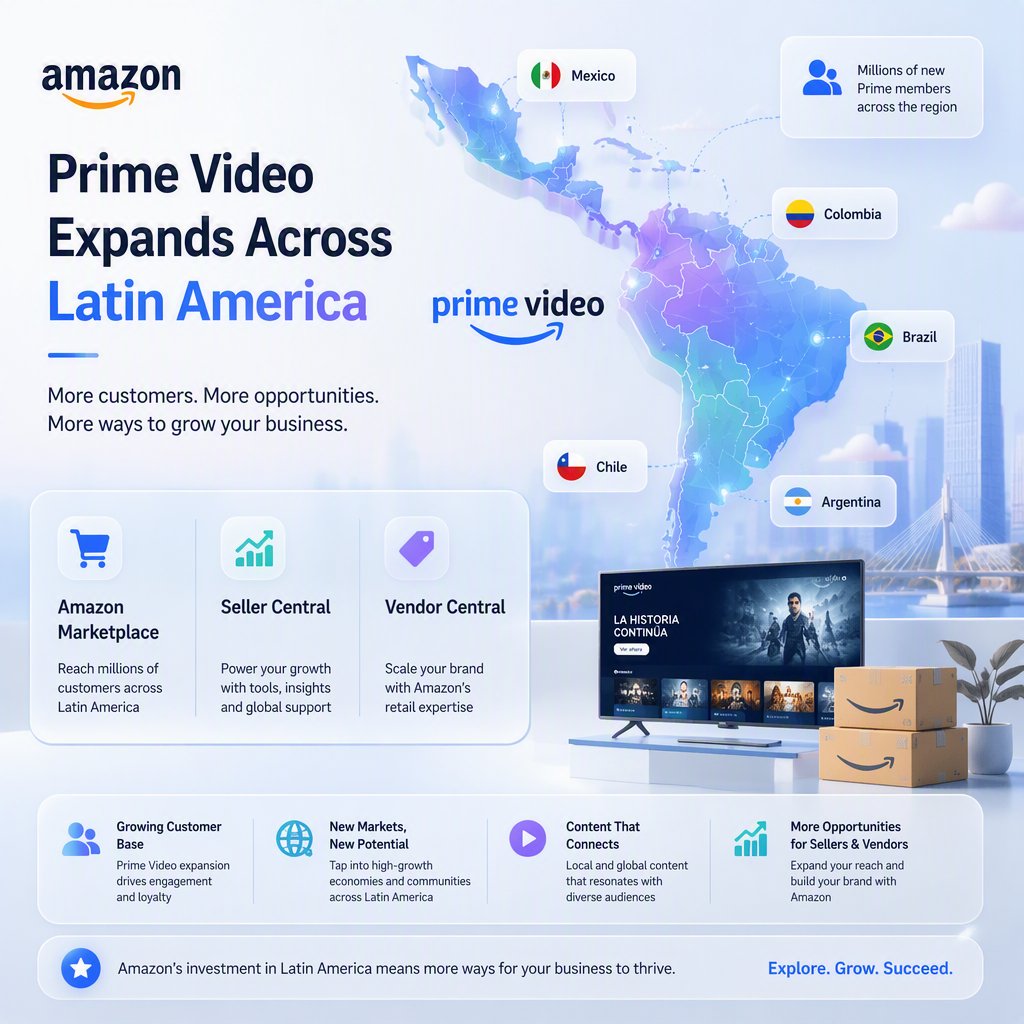
Amazon has announced that it will invest $2 billion in Latin American productions for Prime Video through 2030. The company says the funding will support original and licensed programming as well as sports content, with a clear goal of expanding its footprint across key markets including Mexico, Brazil, Argentina, Colombia, and Chile.
The company also plans to double original productions in those countries. That’s not a small adjustment. It signals a longer-term pipeline strategy, where Amazon wants a steady flow of locally relevant titles instead of sporadic breakout projects.
Two other details stand out:
- 25 new titles are set to premiere in 2027
- Another 25 titles are scheduled for 2028
That kind of staged rollout suggests Amazon is building a production calendar with predictable delivery windows, not just funding one-off experiments. It’s a classic platform move. Invest heavily, localize aggressively, then use scale to improve retention and audience stickiness.
Amazon’s recent Latin American productions, including “Menem” and “La Oficina”, show the direction of travel. These are locally grounded titles with recognizable cultural hooks. The company is also backing higher-profile creative talent, such as Oscar-winning screenwriter Armando Bo, who is directing an adaptation of “Las Malas”.
The competitive angle is obvious too. Netflix has been leaning hard into Latin American originals, with titles like “One Hundred Years of Solitude” and “El Eternauta” drawing attention. Amazon clearly doesn’t want to cede that region to a rival with stronger local storytelling momentum.
Technical Deep Dive
At first glance, this looks like a content budget announcement. Under the hood, it’s really a platform economics decision.
Prime Video sits inside Amazon’s broader Prime membership ecosystem, which means content isn’t judged only by view counts. It’s measured by how well it supports subscription retention, engagement frequency, and lifetime value across the Amazon customer base. In practice, a subscriber who watches locally relevant shows is more likely to keep paying for Prime, which then feeds shopping behavior, delivery adoption, and cross-service usage.
Why localization matters technically
A regional content strategy isn’t just about dubbing or subtitling. It usually involves:
- Local rights management
- Regional metadata pipelines
- Language-specific recommendation models
- Market-level content ranking
- Delivery optimization for variable bandwidth conditions
- Device compatibility across low-end and mid-tier mobile hardware
Latin America is especially important here because viewing often happens on mobile devices and networks with uneven performance. That means Amazon has to optimize streaming quality adaptation, content encoding, and content delivery network routing carefully. If playback stalls, the best content strategy in the world won’t save the user experience.
Content as a data and recommendation problem
Every new title feeds Amazon’s recommendation engine with more behavioral data. The more regional content it has, the better it can tune:
- Homepage personalization
- Autoplay sequencing
- Search ranking
- Audience segmentation
- Cross-promotion with related titles
That matters because localized originals tend to perform differently from global blockbusters. A show that resonates strongly in Mexico may have very different completion rates and click-through patterns in Brazil or Argentina. Those differences improve Amazon’s model training, especially for regional content discovery.
Sports adds another layer
Amazon included sports in the investment bucket, which is important. Sports rights are expensive, but they create predictable high-frequency engagement. That’s valuable for Prime Video because live events drive:
- Real-time concurrency
- Spike traffic management
- Subscriber reactivation
- Advertising inventory growth
- Second-screen behavior
From a technical standpoint, live sports are harder than scripted series. They demand lower latency, stronger failover, tighter CDN performance, and better observability. Amazon already has cloud infrastructure muscle through AWS, and content delivery at this scale likely benefits from that stack. But the stakes are higher in live environments. Buffering during a major match is a fast way to lose trust.
The real story here isn’t just “more shows.” It’s Amazon using content to strengthen the technical and commercial loops that keep Prime users engaged month after month.
Industry Impact
For the Amazon ecosystem, this move has ripple effects well beyond Prime Video.
For sellers
Latin America is still uneven across Amazon’s marketplace footprint, but investment in local entertainment can deepen Prime adoption and improve the value proposition for consumers in those countries. That can help sellers indirectly by making Prime feel more indispensable. More Prime usage often means more e-commerce frequency, better conversion, and stronger loyalty.
If Amazon can keep users inside the ecosystem longer through video, it has more chances to drive shopping behavior through:
- Prime offer placements
- Sponsored ads
- Retargeting
- Cross-surface promotions
- Seasonal buying campaigns tied to entertainment launches
For Vendor Central users
Vendors care because Amazon’s media investments can improve consumer attention density. When Amazon owns more of a customer’s weekly attention, it has more room to influence product discovery, content-adjacent merchandising, and brand storytelling.
That can show up in practical ways:
- Better campaign timing around regional premieres
- More localized storefront opportunities
- Co-marketing tie-ins for brands in entertainment, consumer electronics, snacks, and home goods
- Stronger demand signals during tentpole launches
Vendor teams that operate in Latin America should pay attention to how Amazon coordinates media launches with retail activity. Even if the connection isn’t public, the platform can align campaigns across shopping, video, and advertising surfaces.
For marketplace participants
Amazon’s Latin American media push also signals that the company is willing to commit capital to regions where local relevance matters more than raw global scale. That’s a reminder for sellers and agencies: local adaptation wins.
A generic, one-size-fits-all listing or campaign rarely performs as well as content tuned to regional language, cultural references, and media habits. The same principle applies to Amazon Ads, A+ Content, storefronts, and product imagery.
Implementation Considerations
If you’re operating in Amazon’s ecosystem, there are a few practical lessons here.
For sellers and brands
- Review your country-specific catalog strategy. Latin America isn’t one market. It’s several.
- Make sure translations are natural, not machine-lifted word salad.
- Use regional search terms and cultural references carefully in backend keywords and storefront copy.
- Align promotions with local entertainment moments when possible. A launch tied to a popular series can outperform a generic calendar date.
- Watch Prime-related traffic shifts if Amazon starts pairing video launches with retail campaigns.
For developers and ad-tech teams
If you’re building around Amazon surfaces, this is a reminder to think in terms of regional observability and content-aware targeting.
Important areas include:
- Localization pipelines for creative assets
- Event tracking across media and commerce touchpoints
- Latency monitoring for region-specific playback or ad delivery
- Attribution modeling that can separate entertainment-driven engagement from direct retail intent
- Audience segmentation based on viewing behavior and purchase history
For teams using Amazon Ads, this also means tightening integration between media spend and retail outcomes. If a Prime title drives traffic spikes in a country, you want measurement in place before the campaign goes live, not after.
For operations and finance teams
A $2 billion content commitment needs careful ROI management. The value won’t come from a single hit series. It’ll come from a portfolio approach.
Track metrics like:
- Subscriber retention in target countries
- Completion rates by genre
- Watch time per active user
- Incremental Prime sign-ups
- Cross-sell effects on retail spend
- Ad inventory growth in video-adjacent surfaces
That’s the only way to tell whether the investment is actually moving the business, or just inflating costs.
Future Outlook
This announcement points to a broader pattern. Amazon is using localized media investment as a strategic defense and growth tool, especially in markets where global streaming rivals are also intensifying their regional bets.
Expect a few things next:
- More region-specific originals rather than imported catalog fill
- Tighter integration between Prime Video, advertising, and commerce
- Greater use of sports to drive live engagement
- More competition for local creative talent and production infrastructure
- Better cross-market experimentation, where Amazon tests formats in one country and scales successful patterns to others
Latin America may also become a proving ground for how Amazon balances entertainment economics with marketplace economics. If Prime Video retention improves, Amazon gets more than viewership. It gets a stronger flywheel across its subscription, ad, and retail businesses.
Conclusion
Amazon’s $2 billion commitment to Latin American Prime Video production is more than a content headline. It’s a strategic bet on regional relevance, subscriber retention, and ecosystem depth.
For sellers and vendors, the takeaway is simple. Amazon is doubling down on markets where local taste matters, and that usually means more opportunity for businesses that adapt quickly. For developers and ad teams, the message is just as clear, build with regional data, performance, and measurement in mind.
This isn’t only about what people watch. It’s about what they buy, how long they stay inside Amazon’s ecosystem, and how much value Amazon can extract from every interaction. That’s the real story.