Amazon Seller Central Guide to FSSAI’s 150 Food Ad Notices
Salevoyant Editorial · August 23, 2026
Introduction
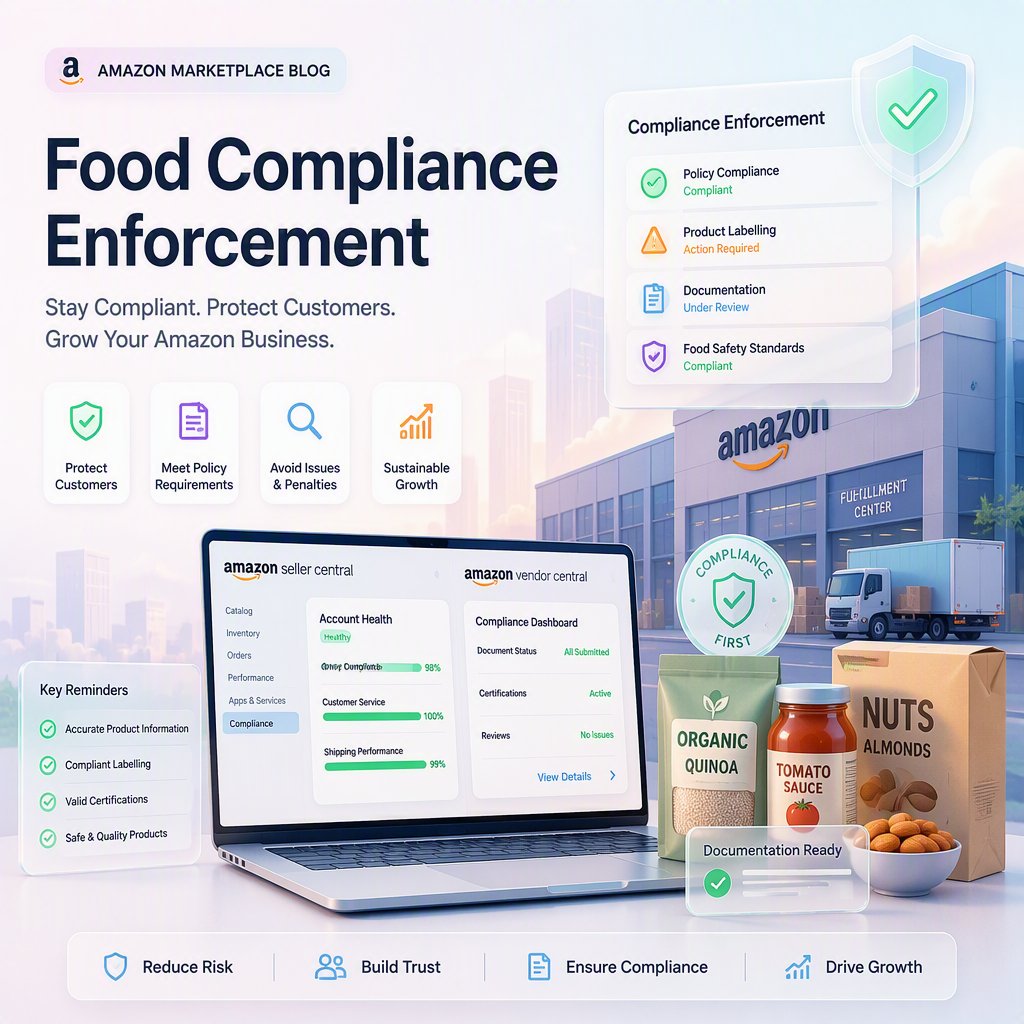
Amazon food sellers are entering a stricter compliance era, and this latest enforcement push from India’s FSSAI makes that very clear. With more than 150 notices issued to major brands, plus action involving Amazon warehouses and e-commerce operators, the message is simple: product claims, labels, and listing content are no longer just marketing details.
For sellers and vendors, that matters right now because marketplace enforcement is getting closer to regulatory enforcement. If your catalog, packaging, or A+ content stretches the truth, the risk isn’t only suppression. It can become a legal and operational problem.
Core Development
India’s food regulator, the Food Safety and Standards Authority of India (FSSAI), said it has issued over 150 notices in recent months for misleading advertisements, false claims, and labelling non-compliance. The list of companies mentioned includes some of the biggest names in packaged food and beverage, such as Nestle India, PepsiCo, Coca-Cola India, Abbott India, Red Bull India, Danone India, Mondelez India, Ferrero India, Kenvue, Diageo, and Pernod Ricard.
The regulator also disclosed that it has taken action against Amazon and Flipkart, with 12 notices sent to e-commerce companies. Even more notable for Amazon-focused sellers, FSSAI said one Amazon warehouse license has been cancelled.
That detail matters. It shows the regulator is not treating e-commerce as a passive channel. If a warehouse, fulfillment node, or marketplace-linked operator is part of the compliance chain, it’s in scope.
FSSAI also said it has sent more than 30 notices to food service chains such as KFC, McDonald’s, Pizza Hut, Domino’s, and Costa Coffee, and that five Domino’s licenses were suspended. The enforcement pattern is broad, but the common thread is clear: regulators are moving from warning letters to visible action.
The key takeaway for Amazon sellers is that product compliance is now being judged across the full commerce stack, from the listing page to the warehouse to the label on the pack.
Technical Deep Dive
At first glance, this sounds like a consumer protection story. In practice, it’s a data integrity and systems compliance story.
Amazon’s marketplace depends on structured product data. Listings are built from attributes like:
brandingredientsnutrition factscountry of originstorage instructionsallergen informationcertificationsclaimssuch as “sugar-free,” “high protein,” or “organic”
When a seller uploads content through Seller Central or a vendor feeds product data through Vendor Central, that information becomes part of Amazon’s catalog graph. It can flow into search indexing, detail pages, ads, browse nodes, and even downstream logistics or compliance workflows.
If any of that content conflicts with packaging, regulatory standards, or local labeling rules, the system creates friction at several points:
-
Listing suppression risk Amazon can flag missing or inconsistent compliance data. A listing may still exist, but it can lose buyability or ad eligibility.
-
ASIN-level contamination One bad claim on a parent or child ASIN can affect variation families. That’s a big issue for food catalogs where size, flavor, and region-specific packs often sit under the same parent.
-
Warehouse and fulfillment exposure If a fulfillment center stores or ships a non-compliant product, the problem moves from content moderation into operational compliance. That’s likely why warehouse licensing became part of the enforcement conversation.
-
Ad claim verification Sponsored Products and Sponsored Brands can amplify a claim fast. If a product says “clinically tested,” “zero sugar,” or “immune support,” the supporting documentation has to match what the regulator expects. Search ads don’t create the claim, but they spread it.
-
Cross-border complexity Imported food products often carry multiple label versions for different markets. That means Amazon’s catalog may need region-specific attribute handling, not just a single global template.
This is where Amazon’s data model gets tricky. A product detail page is not just a page. It’s a compliance object. The more food and beverage regulation tightens, the more Amazon needs clean attribute validation, better document checks, and tighter enforcement on seller-submitted content.
Industry Impact
This enforcement wave should worry more than just the brands named in the notices. It changes the operating environment for the entire food and beverage segment on Amazon.
For Amazon sellers
Private-label and reselling sellers often copy claims from packaging or competitor listings without checking whether those claims are legally defensible. That’s dangerous. A phrase like “healthy,” “detox,” “supports immunity,” or “fat-burning” can trigger scrutiny if there’s no approved substantiation.
Sellers also need to think about how Amazon surfaces content:
- main image text
- A+ Content
- bullet points
- backend search terms
- storefront banners
- coupon and ad copy
- variation naming
A claim that’s technically on-pack but contextually misleading online can still create liability.
For Vendor Central users
Vendors are in a tougher spot because the retailer relationship gives Amazon more control over content and replenishment workflows. If Amazon believes product data is weak, it can force corrections, delay catalog updates, or reject shipments. Vendors also tend to have more complex compliance dependencies because they’re managing packaging, co-packing, QA documentation, and retail readiness at scale.
For marketplace operations teams
This is a reminder that marketplace compliance can’t sit only with legal. It needs coordination across:
- content operations
- catalog management
- QA and regulatory
- logistics
- advertising
- customer support
If those teams aren’t aligned, one team can publish something another team can’t defend.
For consumers
Consumers may not see the backend mechanics, but they feel the result. Better enforcement can reduce exaggerated claims and improve trust. It also cuts down on the gray zone where listings sound healthier, cleaner, or more premium than the product actually is.
Implementation Considerations
If you sell food, beverages, supplements, or any regulated consumable on Amazon, this is the time to tighten your workflow.
Audit your catalog content
Check every live ASIN for:
- unsupported health claims
- ambiguous nutrition language
- incomplete allergen information
- label mismatches between image and description
- outdated certifications
- region-specific compliance gaps
Build a claim approval process
Don’t let marketing write directly into listing copy without review. A basic approval chain should include:
- regulatory review
- product QA review
- legal sign-off for sensitive claims
- marketplace content review
Use source-of-truth documents
Keep a single repository for:
- label artwork
- ingredient specs
- certificates
- lab tests
- nutritional panels
- importer declarations
If Amazon asks for proof, your team shouldn’t be hunting through email threads or old PDFs.
Validate fulfillment-linked products
If you use FBA, check whether the ASINs stored in fulfillment centers match the current packaging and label set. If a product version changed but the catalog didn’t, you’ve got a compliance gap.
Watch for ad-copy drift
A lot of compliance issues start small. A seller launches with a compliant title, then ads, storefronts, and A+ modules gradually add stronger claims. That drift can create a mismatch between approved packaging and live content.
Measure the cost of non-compliance
The ROI on compliance isn’t just avoiding fines. It includes:
- fewer listing suppressions
- fewer stranded units
- lower chargeback risk
- less inventory write-off
- fewer customer complaints
- stronger account health
That’s real money, especially for high-volume consumables.
Future Outlook
This FSSAI action likely signals a broader pattern, not a one-off crackdown. Regulators are getting more comfortable treating e-commerce platforms as part of the compliance chain, not just the sales channel.
For Amazon, that means more pressure to improve automated controls around regulated categories. Expect tighter checks on:
- product claims submitted through catalog feeds
- image text on detail pages
- health and nutrition descriptors
- warehouse-level traceability
- seller documentation for food and beverage items
We could also see more region-specific enforcement tools. India’s market has always been sensitive to labeling, but digital commerce makes misstatements scale faster than shelf retail ever could. One problematic ASIN can rack up sales across hundreds of pin codes before anyone catches it.
For sellers and vendors, the practical implication is pretty blunt. Compliance can’t be treated as a one-time launch task. It has to be part of the catalog lifecycle, from SKU creation to post-launch monitoring.
Conclusion
FSSAI’s recent enforcement push is a clear warning to Amazon’s food sellers and vendors. Claims, labels, and product detail content need to match the product exactly, and the regulator is now looking at the full supply chain, including e-commerce and warehouse operations.
If you sell in food, beverage, supplements, or adjacent categories, here’s the playbook:
- review every live claim
- align catalog content with approved packaging
- keep documentation ready
- monitor A+ content and ad copy
- treat compliance as an operational system, not a legal afterthought
The sellers who get ahead of this will avoid suppression, reduce risk, and build stronger trust with both Amazon and customers. The ones who don’t may find that a simple listing update becomes a regulatory headache.