Amazon Seller Central Guide to Quick Commerce’s Premium Grocery Shift
Salevoyant Editorial · July 15, 2026
Introduction
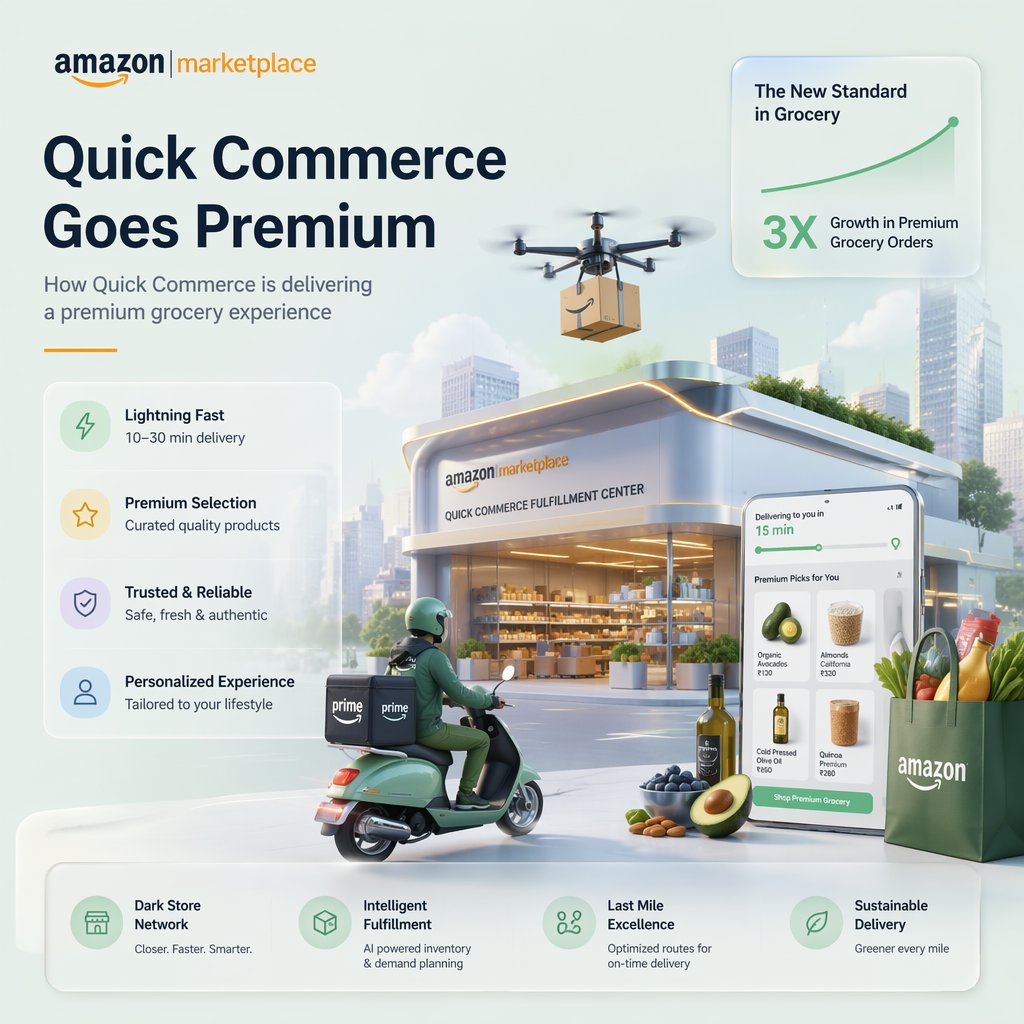
Quick commerce in India is no longer just about getting milk, bread, and chips in 10 minutes. The newest battleground is premium grocery, and Amazon Now’s pilot of Gourmet Picks makes that shift impossible to ignore.
This matters now because the category is changing fast. Platforms are trying to raise average order value (AOV), improve margins, and win higher-income shoppers who’ll pay more for imported, organic, and better-quality products.
Core Development
Amazon Now has started piloting a gourmet grocery segment in select Bengaluru pincodes, according to reports from The Economic Times. That puts Amazon into the same premium race as Zepto, Flipkart Minutes, Swiggy Instamart, and Blinkit, all of which are expanding beyond the standard quick-commerce basket.
Here’s the bigger picture:
- Zepto is preparing a dedicated Select section for imported products, premium grocery, and fresh produce.
- Flipkart Minutes is expected to launch a premium grocery range soon.
- Swiggy Instamart is broadening Nectr and Noice, its premium and D2C-led offerings.
- Blinkit has already expanded its Gourmet Store.
- Amazon Now is testing Gourmet Picks in Bengaluru.
This isn’t random product experimentation. It’s a response to a real shift in consumer behavior. The quick-commerce model originally scaled on convenience and necessity. Now the platforms want more margin per order, stronger retention in top metros, and a differentiated assortment that can’t be matched by a generic kirana-style catalog.
The premium grocery category is becoming a unit economics play, not just a demand play.
For Amazon, the timing is especially interesting. The company already has the machinery for catalog depth, fulfillment orchestration, and seller onboarding. If it can stitch gourmet inventory into its existing quick-commerce stack, it may be able to offer a broader premium selection than rivals that rely more heavily on tightly controlled dark-store assortments.
Technical Deep Dive
The move into gourmet grocery sounds simple on the surface, but it creates a bunch of operational and systems challenges.
At the platform level, quick commerce depends on inventory accuracy, location-based assortment control, and strict delivery promises. Gourmet products raise the bar on all three.
1.
Assortment logic becomes hyperlocal
Premium grocery can’t be treated as a national catalog item. A gourmet truffle oil or imported cheese isn’t going to make sense in every pincode. That means Amazon Now likely needs:
- Pincode-level assortment rules
- Demand prediction by micro-market
- Dynamic catalog surfacing based on fulfillment capacity
- Stock thresholds tied to spoilage risk and replenishment cadence
For Amazon, this is where its retail and marketplace infrastructure can help, but only if it’s integrated well. A premium grocery SKU list has to sync with fulfillment nodes quickly enough to avoid showing items that aren’t actually available.
2.
Storage and handling matter more than in commodity grocery
Premium grocery has a different failure mode. If a pack of cookies arrives crushed or a cold-chain item misses temperature controls, the customer may not come back.
That creates technical and operational pressure around:
- Temperature monitoring
- Shelf-life tracking
- FEFO inventory logic (
first-expiry, first-out) - Packaging integrity checks
- Returns and refunds workflows
For Amazon, this touches both fulfillment tech and seller-facing systems. Sellers in Vendor Central or those supplying through distribution partners need clean expiry-date data, tight ASN accuracy, and fewer reconciliation errors. On the Seller Central side, even a small mismatch between available inventory and actual shelf life can trigger complaints, suppression, or higher defect rates.
3.
Higher AOV changes the recommendation engine
A gourmet basket usually includes more planned purchases than impulse ones. That changes how ranking and recommendations work.
Amazon can use browsing and basket data to cluster shoppers into cohorts such as:
- premium household staples buyers
- health-conscious urban shoppers
- imported snack buyers
- occasion-based shoppers, like gifting or weekend hosting
That means search relevance, cross-sells, and substitution logic matter more than in standard grocery. If a shopper orders artisan pasta and olive oil, the system should suggest sauce, cheese, and wine-friendly pairings, not random add-ons.
This is where Amazon’s retail data advantage could matter. Its recommendation models already work across broad categories, but quick commerce needs those models to operate with tighter latency and more localized signals.
4.
Margin math improves, but only if execution stays tight
The source material notes that premium products can sell for up to 50% more than regular variants. That matters because quick commerce usually struggles with thin margins.
Premium SKUs can help with:
- higher order values
- better gross margin per delivery
- more efficient warehouse utilization
- stronger brand partnerships
But the economics only work if shrinkage stays low. Gourmet products are often more fragile, more perishable, and more expensive to replace. One bad batch can erase a lot of incremental margin.
That’s why assortment control and stock discipline are central. You can’t run premium grocery like a broad-market fast-moving consumer goods list.
Industry Impact
Amazon’s pilot says a lot about where the Indian grocery market is heading. The fight is no longer just about speed. It’s about which platform can own the premium weekly basket.
For Amazon sellers, this opens a few possible opportunities:
- Imported and specialty food brands may find a faster route into high-intent metro shoppers.
- Private label sellers could face stronger pressure if Amazon expands its own curated gourmet range.
- D2C food brands may get more exposure, especially if Amazon wants premium exclusivity or regional assortment depth.
Vendor Central users should pay close attention. Premium grocery changes how Amazon thinks about forecasting and replenishment. Vendors with strong fill rates, clean compliance, and reliable shelf-life reporting will be better positioned than those who rely on broad, undifferentiated grocery supply.
For marketplace participants, the competitive takeaway is clear. Amazon doesn’t need to win on lowest price in this segment. It needs to win on:
- selection depth
- freshness confidence
- fulfillment reliability
- curated discovery
That’s a different game from mass grocery.
It also hints at a broader Amazon strategy. If quick commerce becomes a premium discovery channel, Amazon can use it to defend urban customers who already shop across Amazon.in, Amazon Fresh, and now Amazon Now. The company doesn’t have to own the entire grocery spend. It just needs to capture the moments when shoppers care most about speed and quality.
Implementation Considerations
If you’re a seller, vendor, or operator in the Amazon ecosystem, this shift has practical implications.
For sellers
- Audit your catalog for premium-ready SKUs. Think organic, imported, artisanal, functional food, and clean-label products.
- Make sure product detail pages include clear ingredient data, origin info, expiry guidance, and storage instructions.
- Improve your image stack. Premium grocery buyers expect sharper packaging photography and cleaner PDP layouts.
- Watch pricing. If Amazon tests gourmet baskets by pincode, localized price elasticity will matter more than blanket national pricing.
For vendors
- Tighten your supply chain visibility. Premium grocery depends on accurate availability and expiry data.
- Reduce pack-size confusion. Gourmet shoppers don’t want ambiguous quantity or variant presentation.
- Prepare for higher service-level expectations. Late replenishment or poor fill rates can quickly kill assortment placement.
- Build for frequent forecasting updates. Quick commerce demand swings faster than standard retail.
For developers and operations teams
- Improve inventory sync latency across ERP, OMS, and Amazon feeds.
- Support location-aware catalog publishing so premium SKUs only appear where fulfillment is realistic.
- Use structured attribute data for
ingredients,country_of_origin,dietary_tags, andstorage_conditions. - Monitor substitution and cancellation rates closely. Premium shoppers tolerate less friction.
- Build alerting around temperature-sensitive or expiry-sensitive inventory classes.
For brands
- Don’t treat gourmet grocery as a passive listing opportunity. It’s a curated channel.
- Invest in packaging durability and cold-chain resilience.
- Watch review quality carefully. Premium buyers are far less forgiving of spoilage or crushed packaging.
- Plan for smaller, tighter replenishment cycles. Big-batch assumptions can backfire.
Future Outlook
This premium grocery race is likely to spread beyond metros if the economics hold. But it won’t scale evenly. Expect a pincode-by-pincode rollout, not a nationwide launch.
Amazon’s pilot in Bengaluru is a signal, not a finished product. If the test works, we could see:
- more premium clusters in Tier 1 cities
- broader gourmet assortments tied to households with higher AOV
- stronger integration between Amazon’s grocery stack and seller-supplied specialty products
- more private-label experimentation in premium food and wellness
There’s also a strategic defensive angle here. If premium grocery becomes sticky, it helps reduce churn. Shoppers who order specialty items regularly may be less likely to bounce between apps for one-off discounts.
The biggest question is whether Amazon can keep the premium experience consistent while scaling inventory density and delivery speed. That’s hard. Very hard. But if any player has the systems depth to do it, Amazon’s probably near the top of the list.
Conclusion
Amazon Now’s Gourmet Picks pilot isn’t just another grocery experiment. It’s part of a broader shift in quick commerce toward premium baskets, better margins, and more selective assortment design.
For sellers and vendors, the message is simple: premium grocery is becoming a real channel, not a niche add-on. If your catalog fits that world, now’s the time to tighten product data, sharpen operations, and get ready for more location-specific selling.
For Amazon watchers, the bigger lesson is this. Speed still matters, but quality perception and basket value are becoming just as important. The next phase of quick commerce won’t be won by whoever delivers fastest. It’ll be won by whoever delivers the right premium mix, in the right pin code, with the least friction.