Amazon Seller Central Insights: How Swiss SMEs Grew Exports in 2025
Salevoyant Editorial · August 5, 2026
Introduction
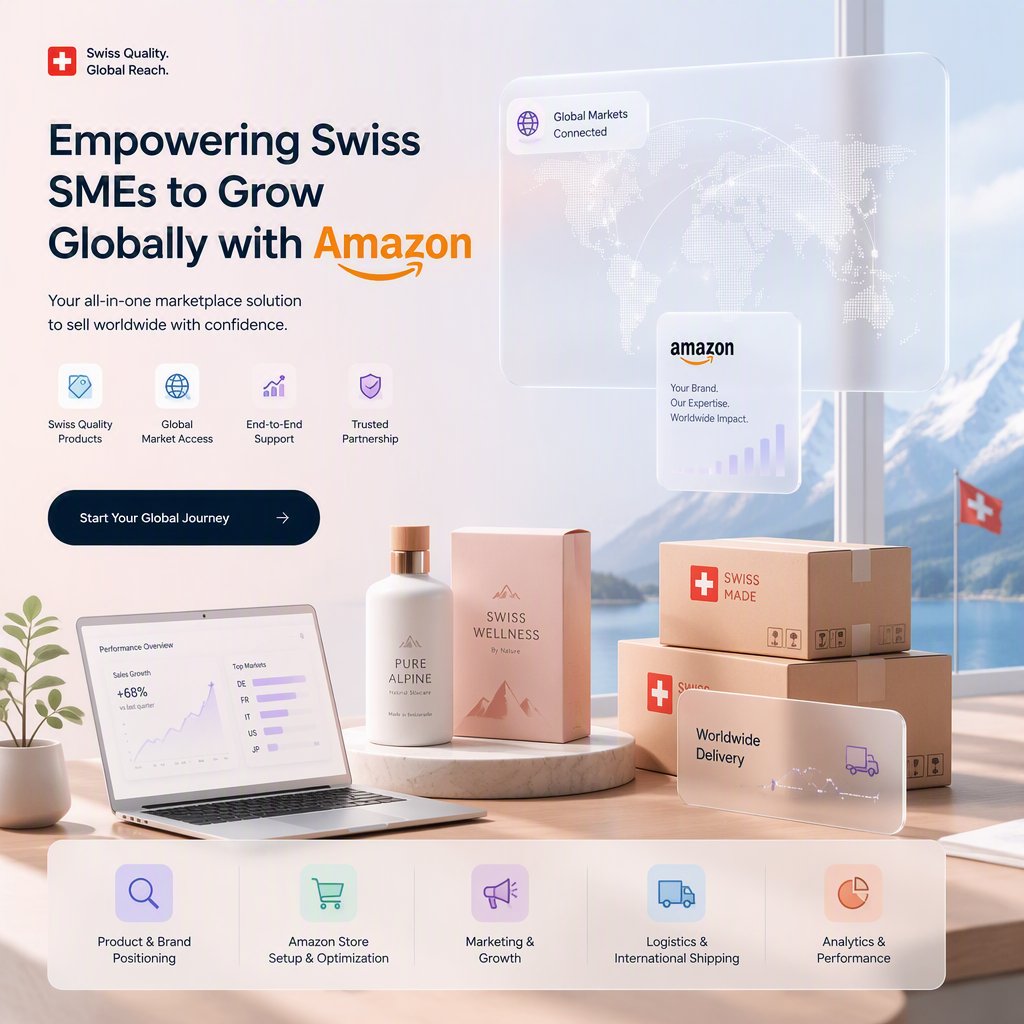
Amazon’s latest report on Swiss small and mid-sized businesses shows a pattern that’s hard to ignore. In 2025, these companies generated more than 160 million euro in export sales through Amazon, with growth of about 14% year over year. That matters now because it shows how marketplace infrastructure, not just brand size, is shaping international trade in real time.
For sellers, vendors, and e-commerce operators, the bigger story is how Amazon is acting as export rail, demand engine, and logistics layer all at once. Swiss SMEs are using that stack to reach customers in more than 130 countries and territories, and they’re doing it at scale.
Core Development
Amazon says Swiss SMEs selling through its marketplace increased export revenue to over 160 million euro in 2025, up from the prior year by roughly 14%. Even more striking, more than 95% of those businesses exported beyond Switzerland, which tells us this isn’t a niche success story. It’s a broad-based channel shift.
The European Union remains the most important export region, accounting for more than 120 million euro in sales, up 20% year over year. Germany is the top destination, followed by the United States, France, Austria, and Italy. That mix is important because it reveals two things:
- Cross-border commerce is still highly regional in practice, even when the platform is global.
- Amazon’s European marketplace infrastructure is doing the heavy lifting for SMEs that want international reach without building country-by-country operations.
One example in the report is heybee, a Swiss startup founded in 2023 that sells bee-derived wellness products such as propolis, royal jelly, and honey. The company says about 70% of its revenue comes from outside Switzerland, with Germany as its key market. Amazon now accounts for around 12% of total revenue, even though the company only started actively selling there in March 2025.
That’s a fast ramp. And it says a lot about how product discovery, trust signals, and fulfillment quality can compress market entry timelines.
Technical Deep Dive
This is really a story about Amazon’s marketplace stack working as a cross-border operating system.
At the front end, Swiss sellers list products in Amazon stores that can surface across multiple EU and global marketplaces. The catalog layer handles localization, compliance attributes, pricing, and browse placement. Once listings are live, Amazon’s ranking systems use a mix of sales velocity, conversion rate, availability, price competitiveness, and customer feedback to decide visibility. For SMEs, that’s huge. You don’t need a large field sales team or country subsidiaries to test demand.
At the back end, Fulfillment by Amazon (FBA) removes one of the biggest blockers to international expansion: logistics. Amazon stores inventory, picks and packs orders, ships them, handles customer service, and processes returns. For a Swiss business, that means it can sell into the EU without having to build warehouse contracts, parcel integrations, and returns operations from scratch.
That matters even more when the seller uses Multi-Channel Fulfillment (MCF). MCF lets businesses use Amazon’s logistics network for orders that originate outside Amazon, such as a direct-to-consumer shop or another marketplace. The effect is operational consistency. One inventory pool, one fulfillment backbone, multiple sales channels.
From a systems perspective, this is a scalability play:
- Inventory placement reduces shipping friction and can improve delivery speed.
- Localized storefronts improve conversion because customers see familiar language, currency, and delivery expectations.
- FBA and MCF reduce the need for custom logistics orchestration.
- Amazon Ads can create demand in target markets before a brand has local retail distribution.
There’s also a data advantage. Sellers like heybee point to customer feedback and demand signals as a reason the channel is useful. That feedback loop is more valuable than it sounds. Amazon gives sellers access to conversion metrics, search term data, review patterns, and in some cases advertising reports that can guide product iteration. For a smaller company, that’s a near real-time market research system.
The real value isn’t just reach. It’s the combination of reach, logistics, and market feedback in one environment.
Industry Impact
This report says a lot about where Amazon sits in the export economy right now. It’s not just a marketplace for retail arbitrage or consumer brands. It’s becoming a practical export layer for SMEs that would otherwise face steep fixed costs to sell internationally.
For Amazon, the strategic value is clear:
- More SME sellers mean more catalog depth.
- More cross-border sales mean stronger fulfillment utilization.
- More international activity means Amazon becomes harder to replace as a distribution channel.
For sellers and vendors, the implications are different.
For Amazon Sellers
If you’re a seller, this is a reminder that international expansion doesn’t always require a full local launch. Sometimes the better path is:
- Test in one nearby market.
- Use Amazon’s existing EU or global infrastructure.
- Measure conversion, ad efficiency, and return rates.
- Expand only when unit economics hold up.
That’s especially relevant for categories with lightweight, high-margin, or non-fragile products. Swiss SMEs in the report appear to be using Amazon exactly this way, as a low-friction entry point into large markets.
For Vendor Central Users
Vendors looking at this trend should pay attention too. Amazon’s vendor model depends on retail purchase orders, forecasting, and supply chain performance. But the same demand creation dynamics apply. When Amazon sees strong cross-border pull from SME sellers, it often validates category demand that vendors can use when planning assortments, replenishment, and regional expansion.
If you’re a Vendor Central account team, the lesson is simple. Demand isn’t just coming from domestic channels anymore. Marketplaces are signaling international appetite earlier than legacy retail planning cycles often do.
For the Broader Ecosystem
This kind of growth also pressures logistics providers, payment processors, and compliance tools to support more small exporters. Currency handling, VAT registration, local returns, and product compliance become more important as seller counts grow. The more Amazon scales SME exports, the more the supporting ecosystem needs to keep up.
Implementation Considerations
If you’re a seller or operator thinking about this model, the Amazon Swiss SME numbers are encouraging, but they don’t erase the operational work.
What to get right
-
Product compliance
-
Make sure your listings meet destination-market requirements.
-
Watch category-specific rules, especially for supplements, cosmetics, electronics, and food-related items.
-
Listing localization
-
Translate more than just the title.
-
Adapt bullets, images, measurements, and claims for the target market.
-
Pricing strategy
-
Build in currency conversion, VAT, referral fees, fulfillment fees, and returns.
-
Cross-border margins can vanish fast if you’re pricing off domestic assumptions.
-
Inventory planning
-
FBA works best when inventory forecasts are tight.
-
Stockouts hurt ranking and ad efficiency, while excess stock increases storage costs.
-
Advertising
-
Start with focused campaigns.
-
Use search term reports and ACOS/ROAS data to identify which markets can support scale.
-
Returns and customer service
-
Cross-border buyers expect fast, clear support.
-
If returns are slow or confusing, conversion takes a hit.
Engineering and systems notes
For teams integrating with Amazon APIs or managing marketplace operations at scale, this is where clean data architecture matters. You need reliable handling for:
ASINand SKU mapping across marketplaces- currency conversion logic
- inventory synchronization
- offer eligibility by market
- tax and compliance metadata
- fulfillment latency tracking
If you’re running multiple channels, MCF can simplify fulfillment, but it also creates dependency on Amazon’s warehouse network and service levels. That’s efficient until inventory planning slips. Then the same centralization becomes a bottleneck.
So yes, Amazon reduces complexity. It also concentrates risk.
Future Outlook
Swiss SME performance on Amazon points to a larger trend: international commerce is getting more modular. Smaller companies no longer need to build every layer themselves. They can plug into marketplace demand, outsourced fulfillment, and ad tools that once only major brands could afford.
Expect Amazon to keep refining programs that make this easier. The company already points sellers to onboarding and education tools like Seller University, Quickstart Online, and the small business badge. Those aren’t just support features. They’re acquisition and retention tools for the seller base.
The next phase will likely focus on three areas:
- Better cross-border tooling, especially for compliance and localization
- More intelligent product discovery, using data to suggest market opportunities
- Tighter logistics integration, so SMEs can expand without building their own infrastructure
There’s also a sustainability angle. Amazon’s accelerator programs for climate-tech startups suggest the company wants to pair marketplace growth with innovation branding. For European sellers, that can matter because buyers and regulators are both putting more pressure on sourcing and fulfillment transparency.
Conclusion
Swiss SMEs are proving that Amazon can function as a serious export platform, not just a sales channel. The numbers are clear: 160 million euro in export revenue, 14% growth, and sales in more than 130 countries and territories.
For sellers, the lesson is that international expansion is increasingly about execution, not company size. For vendors, it’s a signal that marketplace demand can shape broader category planning. And for Amazon itself, it reinforces a simple truth. The company’s strongest moat isn’t just traffic. It’s the infrastructure that helps smaller businesses act global without building everything from scratch.
If you’re evaluating your own cross-border strategy, start with one question: can your product, margins, and operational setup survive the added complexity of international fulfillment? If the answer is yes, Amazon’s model gives you a fast path to test that thesis.