Amazon Seller Central: Ring’s 4K and 2K Japan Launches Explained
Salevoyant Editorial · October 8, 2026
Introduction
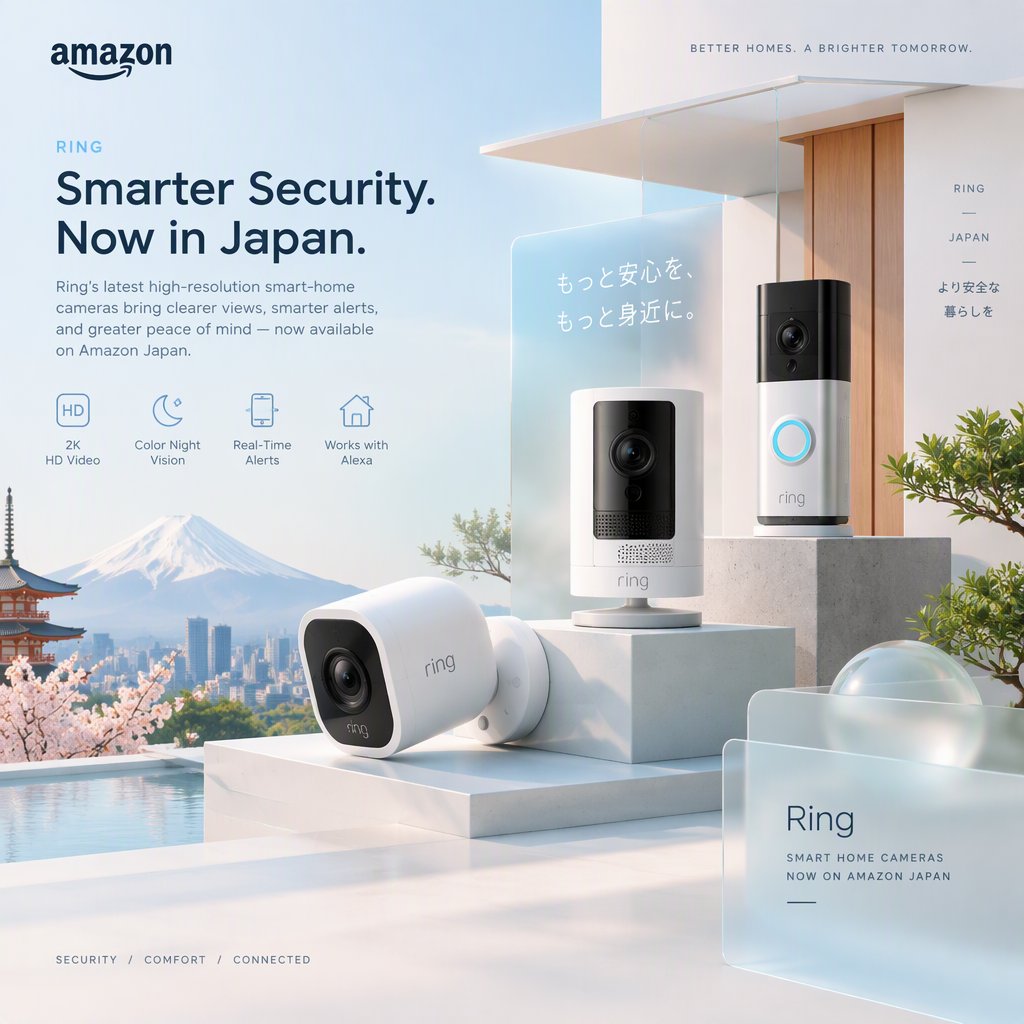
Amazon’s October 7 announcement of four new Ring product families in Japan brings battery-powered 4K video into its security lineup and makes 2K the common specification across the other launches. For sellers and vendors assessing their October 2026 assortment, the immediate story is sharper competition on Amazon.co.jp. The bigger question is how to compete when Amazon combines hardware, paid software features, and its own retail channel.
Core Development
The Amazon announcement covers four product families, with separate power variants for two of them:
| Product | Japan launch price, including tax | Availability announced October 7 | Main distinction | |---|---:|---|---| | Ring Outdoor Cam 4K Plus | JPY 15,980 | Preorders open; shipping scheduled November 5 | Ring’s first battery-powered 4K camera | | Ring Spotlight Cam 2K | JPY 24,800 | On sale | Battery or plug-in options; 550-lumen motion-activated light | | Ring Outdoor Cam 2K Plus | JPY 12,980 | On sale | Battery or plug-in options; flexible mounting | | Ring Battery Doorbell 2K | JPY 14,980 | On sale | Wide-angle visitor and package view; magnetic mounting base for Japan |
These are announcement-day Amazon.co.jp prices, not guaranteed future prices.
The pricing hierarchy matters. The 4K outdoor model costs JPY 3,000 more than the Outdoor Cam 2K Plus, while the Spotlight model commands the highest price despite its lower resolution. Amazon isn’t selling a simple progression from fewer pixels to more pixels. Lighting, installation, power supply, and intended use also determine positioning.
The doorbell’s magnetic mounting base adds a local installation feature. Sellers competing in this category should notice that detail: reducing setup friction can be as persuasive as improving image quality.
Technical Deep Dive
All four families feature Retinal Vision, Ring’s branding for its combination of imaging hardware and processing. The Outdoor Cam 4K Plus uses Retinal 4K with up to 10x zoom; the other three use Retinal 2K with up to 6x zoom.
Those numbers deserve careful interpretation. The release doesn’t specify optical zoom hardware, so sellers shouldn’t describe the advertised magnification as optical zoom. Enlarging an image also doesn’t guarantee that a face or package label becomes identifiable. Lens quality, compression, lighting, motion blur, and subject distance still govern usable detail.
Battery-powered 4K creates a performance trade-off
A battery-powered camera must balance image capture, processing, wireless transmission, and power consumption. Higher resolution can increase the workload, although the actual effect depends on the codec, bitrate, recording duration, and firmware behavior.
Ring hasn’t disclosed those parameters or battery-runtime figures in this release. That leaves important buying questions unanswered.
Consider a camera covering a quiet side entrance versus one facing a busy pavement. More motion-triggered activity can mean more recording and transmission, increasing power demand. A battery installation removes the need for nearby mains power, but it doesn’t remove maintenance.
Bandwidth matters too. As an illustrative calculation, a camera uploading at 4 Mbps for one accumulated hour transfers roughly 1.8 GB, excluding overhead. That’s not a measured Ring specification. It shows why deployment planning needs actual bitrate and activity data rather than a resolution label alone.
Low-light color still requires light
Ring says the cameras can provide color footage in low-light conditions. The Outdoor Cam 4K Plus and Outdoor Cam 2K Plus switch to monochrome when illumination becomes insufficient.
The announcement explicitly states that color viewing at night requires a certain level of illumination. “Color night vision” shouldn’t become “color video in complete darkness” in a seller’s listing.
The Spotlight Cam 2K addresses this constraint with a 550-lumen adjustable light that activates on motion. That offers a practical reason to choose it over the cheaper 4K model: lighting can improve the scene more than additional pixels can.
The 4K model also includes 3D motion detection and configurable zones. These can help focus monitoring on relevant areas, but the release provides no detection-accuracy benchmarks.
Paid software changes the product calculation
The Ring app requires an internet connection. Basic live viewing, two-way audio, motion detection, and applicable siren functions remain available without a paid plan.
Other capabilities require a compatible Ring Protect plan, including:
- Event history of up to 180 days.
- Person, vehicle, and package detection.
- Keyword searches of recordings.
- Notifications that summarize detected activity.
Feature eligibility needs checking by device and plan. The release doesn’t establish that every paid capability works identically across all models.
The hardware price is only part of the comparison. Recording history and advanced detection can make the subscription more important than the resolution upgrade.
Industry Impact
For Amazon, this lineup supports a familiar hardware-and-services model: sell the device, then offer ongoing value through paid features. The announcement doesn’t disclose subscription conversion or profitability, so it can’t prove the strategy’s financial performance. It does show how the commercial offer extends beyond the camera.
For competing smart home sellers, the pressure is specific. At the announced prices, “2K video” alone is a weak differentiator. Stronger arguments may include local storage, clearer ownership costs, documented battery endurance, wider interoperability, or easier installation, provided those claims are supported.
This is not a Seller Central or Vendor Central platform update. Amazon announces no changes here to fees, ranking rules, advertising tools, or vendor terms. Its relevance is category competition.
Seller Central users should review product detail pages and A+ Content for meaningful comparisons: power requirements, recording access, mounting options, and nighttime limitations. Vendor Central teams should assess assortment and replenishment against the distinct launch dates. Three families went on sale October 7; the 4K model is scheduled to ship November 5.
For accessory sellers, multiple power and mounting configurations create potential demand for compatible installation products. Compatibility must be verified for the exact model. A familiar product-family name isn’t sufficient evidence.
Implementation Considerations
Start with the deployment site, not the specification sheet.
For a small retailer monitoring a stockroom entrance, stable plug-in power may be more useful than cable-free placement. For an entrance without a nearby outlet, battery power may simplify installation, but someone still has to manage charging. The Outdoor Cam 2K Plus also supports separately sold solar power options.
Before purchasing or recommending a system:
- Check Wi-Fi at the mounting location. Indoor coverage doesn’t establish reliable outdoor connectivity.
- Test the actual viewing angle. Doorbell coverage should include both visitors and packages without unnecessary intrusion into neighboring spaces.
- Assess lighting after dark. Street lighting, glare, and shadows affect results.
- Confirm subscription requirements. Don’t assume live viewing includes stored footage.
- Plan maintenance and access. Define responsibility for charging, account permissions, and camera repositioning.
For engineers, connectivity isn’t the same as integration. This release announces no new developer API, webhook support, or direct links to Seller Central order records. Any workflow involving package detection or business systems requires separate validation.
ROI should include hardware, subscriptions, accessories, installation labor, and ongoing maintenance. Better footage can help investigate an incident, but the announcement provides no evidence that these devices reduce losses or insurance costs.
Ring also states that it doesn’t provide monitoring, emergency dispatch, guard response, or emergency-service contact. Businesses shouldn’t treat these cameras as a substitute for services requiring those functions.
Future Outlook
The lineup suggests that higher-resolution security video is becoming a baseline expectation rather than a premium feature on its own. Amazon’s approach combines that image quality with different power options, lighting, installation methods, and paid software.
Battery-powered 4K deserves attention, but runtime and real-world image quality will determine its practical value. The release doesn’t provide enough information to settle either question.
For marketplace participants, differentiation is likely to move toward the complete ownership experience: dependable alerts, straightforward setup, transparent subscriptions, privacy controls, and support. More pixels help. They don’t fix weak connectivity or confusing recording policies.
Conclusion
Amazon’s new Ring lineup gives Japanese buyers more choice while tightening the competitive benchmark for smart home sellers. The standout isn’t just battery-powered 4K. It’s the combination of accessible hardware pricing, installation flexibility, and subscription-dependent capabilities.
Sellers and vendors should audit their comparisons now, especially claims about nighttime color, battery performance, and recording access. Buyers should choose around the location and ongoing cost first, then resolution. That’s where the difference between an impressive specification and a useful security system becomes clear.