Amazon Seller Central: What to Know About the $3.6B Housing Fund
Salevoyant Editorial · November 12, 2026
Introduction
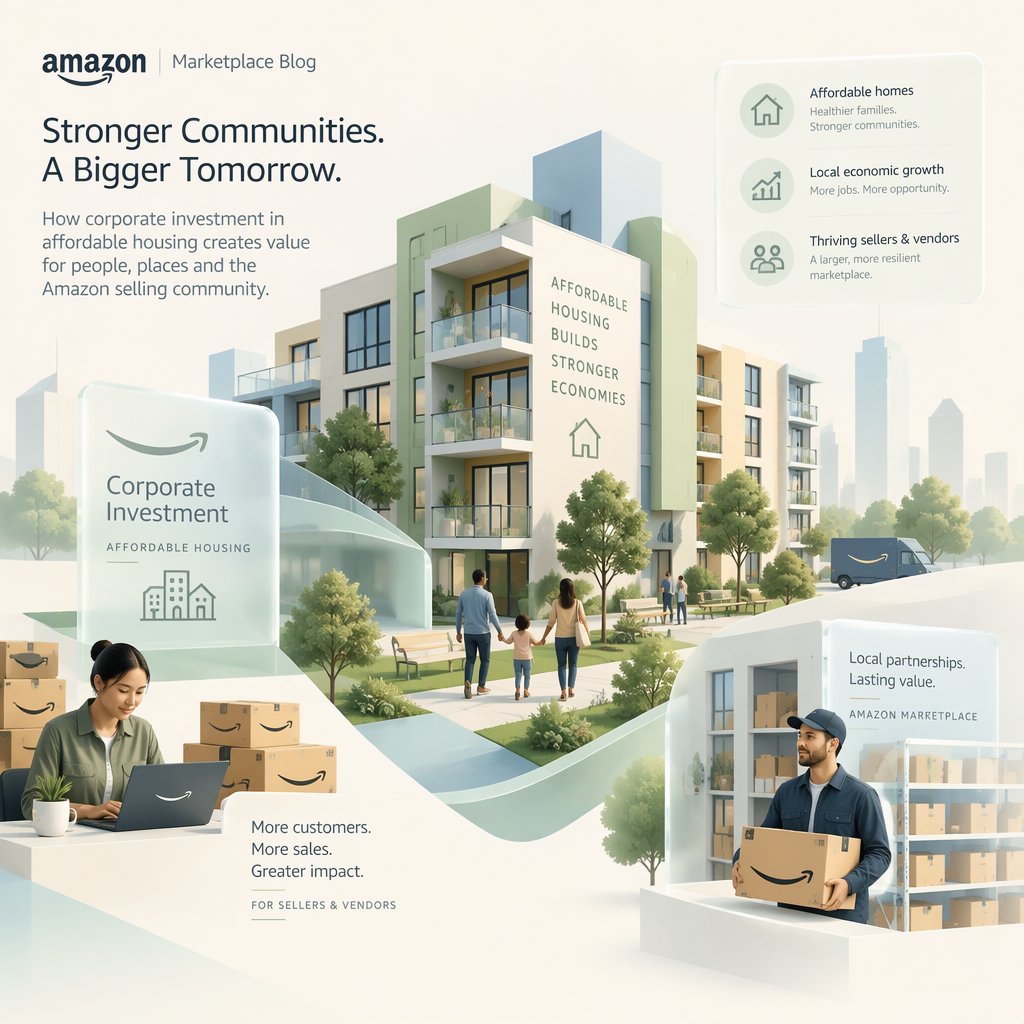
Amazon’s housing investment deserves attention from marketplace businesses, even though it doesn’t change a single Seller Central setting. As of November 12, 2026, the supplied Amazon overview describes a $3.6 billion commitment to affordable housing, raising questions about how the company supports communities around its major offices. For sellers and vendors, the useful story is the financing model, the limits of Amazon’s reported results, and the distinction between community investment and marketplace operations.
Core Development
Amazon launches its housing fund in 2021 to finance affordable homes in three regions: Washington’s Puget Sound, Arlington and the National Capital region, and Nashville, Tennessee.
The initial commitment is $2 billion, with a target of creating or preserving 20,000 affordable homes. Amazon says it exceeds that target within three years and adds
More than $2.7 billion in funding supporting projects totaling over 27,000 affordable homes.
More than 60,000 residents accessing affordable housing.
A broader ambition to create or preserve more than 35,000 homes.
These figures describe different things. A commitment isn’t the same as funding provided, and neither automatically establishes how many newly constructed homes are complete.
There’s also a reporting limitation. The source carries an August 19, 2024 publication timestamp but includes references to later activity. Its stated $2 billion initial commitment and
.4 billion expansion don’t fully reconcile with the $3.6 billion headline total. The excerpt doesn’t explain that difference, so these numbers should be treated as Amazon’s reported program figures, not a newly announced November 2026 expansion.
The program serves households earning 30% to 80% of area median income, or AMI. Amazon identifies teachers, first responders, and health care workers among the people it aims to reach. It’s a regional affordable-housing initiative, not a benefit restricted to Amazon employees.
Technical Deep Dive
The fund’s technical substance lies in its financing and affordability requirements, not software.
Amazon provides low-interest loans and grants to developers building or preserving multifamily affordable housing. It says loan payments return to the community to support further housing and other initiatives.
That creates two different capital paths. Grants don’t require repayment. Loans can recycle capital, although the pace depends on repayment terms and borrower performance. Amazon’s excerpt doesn’t disclose interest rates, maturity schedules, underwriting standards, or default figures, so it doesn’t support a precise financial-return calculation.
Preservation and construction solve different problems
Preservation keeps existing homes affordable instead of allowing them to convert to prevailing market rents. New construction increases housing supply.
The distinction matters. Preserving 200 apartments can protect current tenants without adding 200 units to a region’s housing stock. Building 200 apartments adds capacity but introduces construction schedules, permitting requirements, and delivery risk.
Amazon’s combined home count covers both approaches. It shouldn’t be read as a count of newly built apartments.
Amazon says nearly all the housing it funds must remain affordable for 99 years. That extends the program’s intended effect well beyond a conventional corporate grant cycle.
In practice, a long-duration affordability requirement needs enforceable documentation and ongoing compliance administration. Relevant tasks can include checking eligible household incomes, applying rent restrictions, and preserving obligations when ownership changes. Those are general implementation considerations, not mechanisms confirmed in the supplied excerpt.
For operators managing such properties, structured records would matter: project identifiers, affordability expiration dates, income bands, unit counts, and compliance status. Software can support those records, but Amazon doesn’t identify a particular platform, API, or reporting architecture.
The meaningful measure isn’t simply how much capital Amazon commits. It’s how many homes remain affordable, for whom, and for how long.
Location changes the value equation
Amazon reports estimated average annual rent savings of $4,900, daily commute savings of 80 minutes, and locations with 11 times more nearby jobs.
These are company-reported impact estimates. The excerpt doesn’t supply enough methodology to test the comparison groups, geographic boundaries, or measurement periods.
Still, the underlying principle is sound: rent alone doesn’t determine housing affordability. Transportation expense and access to employment also shape household budgets. A cheaper apartment far from work can carry costs that its rental price doesn’t reveal.
Industry Impact
Analysis: The fund fits a broader question facing large employers: what happens when their office communities become difficult for moderate-income residents to afford?
Amazon explicitly ties the program to communities around its offices. Housing investment can plausibly support more stable local communities and relationships with public-sector partners. The supplied material doesn’t establish a measurable effect on employee retention, recruiting costs, or business performance.
For marketplace participants, the implications are indirect.
A seller employing staff in one of these regions may care about housing costs because they affect workers’ ability to live near their jobs. A vendor with a local office faces similar concerns. But there’s no evidence here that the fund reduces fulfillment expenses, improves delivery speed, or changes Amazon’s purchasing decisions.
Nor does this announcement introduce a Seller Central or Vendor Central update. It contains no changes to:
FBA fees or inventory placement.
Account health requirements or selling eligibility.
Vendor purchase orders, chargebacks, or payment terms.
Advertising access or product discovery.
SP-API functionality.
That boundary matters. Community spending belongs in an assessment of Amazon’s corporate strategy, but it shouldn’t be presented as evidence that the economics of selling on Amazon have improved.
Implementation Considerations
For most sellers and vendors, no account-level action is required. Don’t adjust inventory, bids, or sourcing plans solely because of this housing program.
There are, however, practical ways to use the information responsibly.
Keep marketplace ROI separate from community impact
Marketplace dashboards should continue to measure contribution margin, advertising efficiency, returns, inventory aging, and relevant fulfillment or wholesale costs.
Housing outcomes belong in a separate analysis. Mixing the two can imply a commercial benefit that hasn’t been demonstrated.
Businesses assessing their own regional employment costs should use local evidence: applicant availability, wages, turnover, commute patterns, and facility expenses. Amazon’s aggregate housing figures aren’t a substitute for those measurements.
Evaluate housing projects with project-level data
Potential development partners have a more direct implementation path. Amazon invites experienced multifamily affordable-housing developers working in the three named regions to contact housing-fund@amazon.com.
Before treating the fund as a financing option, developers should establish eligibility and request actual terms. Questions worth asking include:
Is the project preservation, new construction, or a combination?
Which AMI bands and affordability obligations apply?
How does Amazon’s funding interact with other financing?
What reporting, repayment, and compliance requirements apply?
Which milestones govern funding availability?
The source provides a contact route, not a complete underwriting manual.
Avoid misleading cost calculations
Dividing $2.7 billion by 27,000 homes produces roughly
00,000 per home. That’s a crude ratio of reported funding to supported homes, not a construction-cost benchmark.
It combines loans and grants, preservation and construction, and projects that may include other capital sources. It also says nothing about repayment or timing. A credible ROI assessment needs those distinctions.
Future Outlook
Analysis: The fund suggests that Amazon sees affordable housing around major offices as a long-term commitment rather than a one-time donation.
Its scalability depends on more than capital. Developers, suitable sites, public-sector coordination, construction capacity, and workable financing all influence delivery. Amazon’s free, 18-month Housing Accelerator Fellowship, with 83 graduates reported in the supplied overview, addresses one part of that challenge by supporting emerging developers.
The next useful evidence would be more granular reporting: completed versus financed projects, preserved versus newly built units, occupancy, affordability compliance, and repayment performance.
Those details would make the program easier to evaluate and compare. Larger commitments alone don’t establish better outcomes.
Conclusion
Amazon’s housing fund is a substantial regional financing initiative, not a marketplace product release. Its defining features are low-interest loans and grants, support for both preservation and construction, and affordability requirements that generally extend for 99 years.
Sellers and vendors should track it as corporate-strategy context while keeping commercial decisions tied to their own operating data. Developers have a direct reason to investigate funding eligibility. For everyone assessing Amazon’s impact, the next question is straightforward: how consistently does committed capital translate into durable, documented affordability?