Amazon Vendor Central Explained: Inside the $2.4B Generac Supply Deal
Salevoyant Editorial · September 18, 2026
Introduction
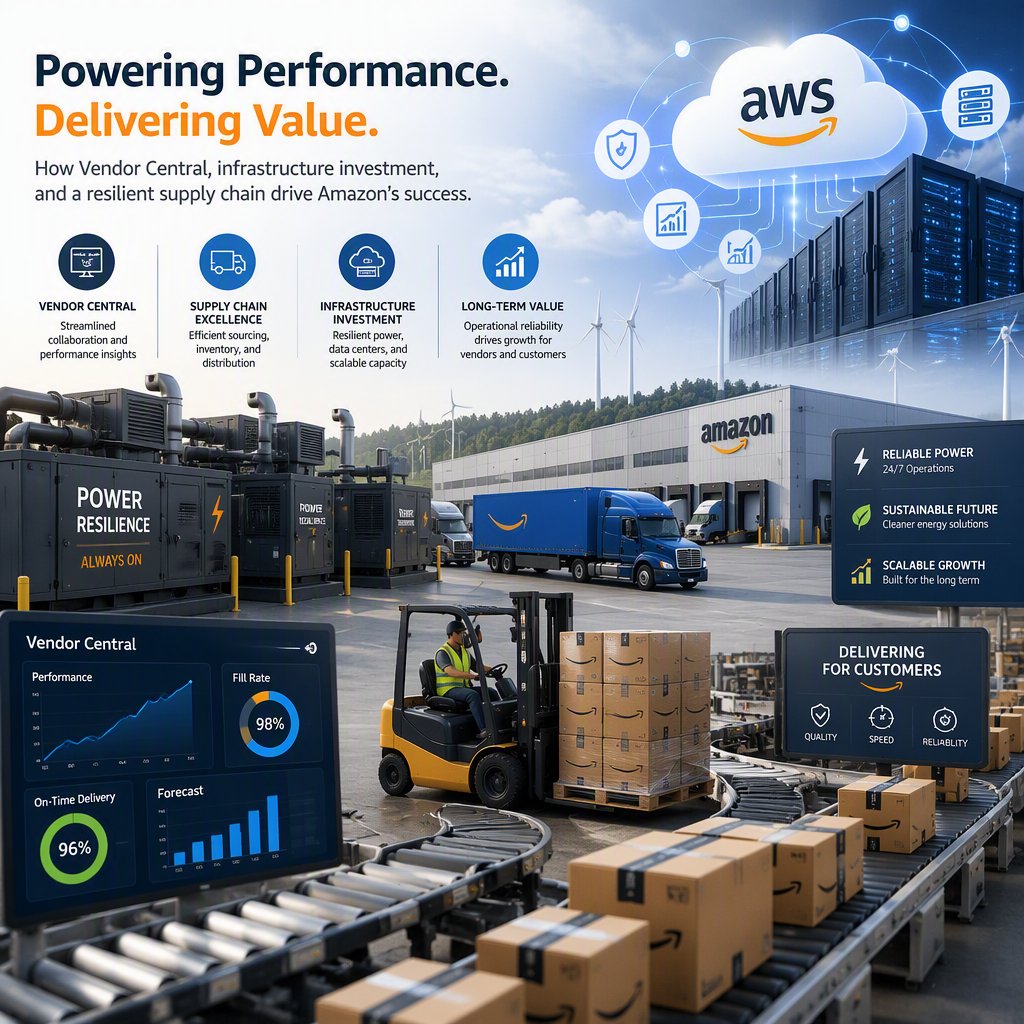
Amazon’s latest infrastructure move isn’t about retail, ads, or even logistics. It’s about electricity, and lots of it. The company has reportedly lined up a long-term agreement with Generac for backup generators worth about $2.4 billion in initial deliveries across 2027 and 2028, a reminder that the AI and cloud race is now as much about power capacity as it is about compute.
For anyone watching Amazon’s ecosystem closely, this matters because it shows how aggressively Amazon is hardening its data center stack. That has ripple effects well beyond AWS, touching suppliers, Vendor Central relationships, capital allocation, and the way Amazon thinks about scale.
Core Development
According to the regulatory filing referenced in the report, Generac will supply backup generators for Amazon data centers under a long-term arrangement. The initial delivery window points to roughly $2.4 billion in shipments during 2027 and 2028, with the deal structured to potentially expand much further.
The contract includes a warrant issued to Amazon.com NV Investment Holdings, giving Amazon the right to acquire up to 1.69 million Generac shares at $200.93 per share. About 307,954 shares vested immediately, while the rest are tied to Amazon’s purchases of backup generators. The warrant can be exercised through September 2033 and represents nearly 3% of Generac’s outstanding shares.
That structure is worth paying attention to. This isn’t just a purchase order. It’s a hybrid commercial and equity-linked relationship, which gives Amazon a deeper stake in the supplier’s performance and capacity planning. Generac’s stock jumped more than 40% in extended trading, which tells you the market sees the scale of the deal immediately.
Amazon has used similar arrangements before. It’s not new for the company to secure suppliers through warrants when it’s building out strategic infrastructure, especially around AI, cloud, and logistics capacity. The pattern has shown up in deals tied to companies like Plug Power and ATSG.
Technical Deep Dive
Backup power sounds mundane until a hyperscaler depends on it to keep cloud regions alive. Then it becomes critical infrastructure.
Amazon’s data centers run with layered redundancy, but the electrical stack still needs physical backup systems that can handle sudden grid instability, generator switchover, cooling loads, and failover timing. At AWS scale, a power interruption isn’t just a hardware issue. It can affect tenant workloads, service-level commitments, and the trust customers place in Amazon’s cloud platform.
Why generator supply matters so much
Data centers typically use a combination of:
- Utility power feeds
- UPS systems for instant short-term backup
- Diesel or gas backup generators for sustained outage coverage
- Switchgear, controls, and monitoring systems to coordinate the transition
The generator layer sits at the end of that chain. It’s the one that has to take over when the UPS batteries buy only a few minutes of breathing room. If Amazon is scaling new facilities for AI training, inference, and cloud expansion, then power resilience becomes a planning constraint, not just an engineering checklist item.
A deal like this suggests Amazon is locking in:
- Long-term equipment availability
- Standardized backup architecture
- Predictable pricing for large deployments
- Supply chain priority during a period of heavy demand
That last point matters a lot. Generator manufacturing capacity is not infinite, and the data center boom has tightened the market for electrical gear, transformers, batteries, cooling units, and switchgear. By signing a large, structured agreement, Amazon helps ensure it won’t be stuck waiting for essential infrastructure while competitors keep building.
The warrant structure is strategically interesting
The warrant isn’t just a financial sweetener. It aligns incentives.
Amazon gets a path to ownership in the supplier, while Generac gets a clearer, longer-term demand signal. If Amazon keeps buying and the relationship expands, the warrant becomes more valuable. If not, Amazon still benefits from the supply agreement itself.
This kind of setup does a few things technically and financially:
- It gives Amazon more influence over supplier capacity planning
- It can help stabilize procurement for high-volume, standardized equipment
- It creates a quasi-strategic sourcing relationship rather than a one-off transaction
- It may support custom engineering, testing, or integration work around Amazon’s facility standards
For a company operating at Amazon’s scale, that matters. Standard procurement doesn’t always work when you’re ordering thousands of units for distributed infrastructure with strict uptime requirements.
Industry Impact
This deal says a lot about where Amazon’s infrastructure priorities are heading.
1. AWS growth is increasingly power-bound
For years, cloud competition centered on server count, network speed, and region expansion. Now power availability is a gating factor. The rise of AI workloads has changed the equation. Training clusters and inference infrastructure pull far more electricity than traditional enterprise workloads, and the supporting systems need to scale alongside them.
Amazon isn’t just buying more compute. It’s buying the ability to keep compute online under stress.
2.
Supplier relationships are becoming more strategic
The warrant structure shows how Amazon is tightening ties with core suppliers. That’s not unusual in aerospace, automotive, or semiconductor supply chains. It’s becoming more visible in cloud infrastructure too.
For vendors, the message is clear. Amazon prefers suppliers that can support:
- Large-volume commitments
- Multi-year production planning
- Custom specs and integration support
- Financial and operational stability
That has implications for Vendor Central-style relationships as well. While this specific deal sits far outside consumer retail, it reflects the same Amazon instinct, concentrate demand, secure supply, and build tighter control around critical inputs.
3.
It raises the bar for infrastructure vendors
Generac isn’t just selling generators here. It’s participating in a hyperscale supply chain where uptime, lead times, and serviceability are as important as unit price.
That creates pressure on peers across the electrical and industrial equipment market. Suppliers that can’t support Amazon-level procurement will increasingly lose out to those that can offer:
- Faster manufacturing cycles
- Stronger field service networks
- Remote monitoring and telemetry
- Integration with facility management systems
4.
It signals how serious Amazon is about AI infrastructure
A lot of companies talk about AI expansion. Amazon is spending around the boring parts that make it possible. Backup power isn’t glamorous, but it’s foundational. If Amazon is committing to generator capacity this far out, it suggests it expects sustained demand growth across AWS regions and likely large new facility builds.
Implementation Considerations
If you’re an Amazon seller, vendor, or e-commerce operator, this might feel distant. It isn’t. Infrastructure decisions like this shape the platform you sell on.
For sellers
More durable AWS capacity can mean a more stable backend for:
- Listing performance tools
- Repricing and analytics platforms
- Advertising systems
- Search and recommendation services
- Marketplace operations that depend on AWS uptime
If Amazon keeps expanding cloud resilience, that can reduce the risk of platform-wide bottlenecks during peak periods. It won’t change your ACoS overnight, but it does support a more reliable marketplace environment.
For Vendor Central users
Vendors should watch Amazon’s infrastructure spending because it often foreshadows broader capacity priorities. A company investing heavily in power, data centers, and supplier integration is usually getting ready for more compute-intensive operations, which can affect:
- Demand forecasting systems
- Retail media automation
- Search ranking models
- Supply chain optimization
- Customer service tooling
If you’re managing Vendor Central operations, that means your own readiness matters too. Cleaner EDI feeds, better inventory sync, and stronger content quality become even more important when Amazon’s systems get faster and more automated.
For developers and ops teams
The technical lesson here is about resiliency and planning. Amazon is making a long-horizon bet on physical infrastructure because cloud scale still depends on it.
A few practical takeaways:
- Design systems assuming underlying infrastructure can scale, but not instantly
- Build for failover and graceful degradation
- Keep an eye on region-level dependencies and service health patterns
- Treat energy and facility constraints as part of platform strategy, not just facilities management
The cloud may look abstract from the outside, but it still runs on concrete, wire, fuel, and contracts.
For marketplace participants
Expect Amazon to keep tightening control over the infrastructure that supports its marketplace. That can mean better uptime, but also more internal discipline around cost, capacity, and automation. In practical terms, Amazon tends to pass those efficiencies through in the form of faster systems and stricter operating standards for partners.
Future Outlook
This agreement likely won’t be the last one of its kind.
As Amazon expands AI infrastructure and cloud capacity, it’ll keep looking for suppliers that can deliver not just product, but certainty. That means more long-term deals, more structured incentives, and probably more supplier financing or equity-linked arrangements where it helps secure capacity.
We may also see Amazon place more emphasis on:
- On-site power resilience
- Alternative backup fuel systems
- Microgrid and energy storage integration
- Monitoring software for power assets
- Regional diversification of critical suppliers
There’s also a broader market signal here. If hyperscalers are locking in backup generator supply years in advance, the whole industrial supply chain is being pulled toward the demands of AI-era infrastructure. That affects lead times, pricing, and product development far beyond Amazon.
For Generac, the deal could deepen its transition from a consumer-facing backup power brand into a more central player in industrial and data center infrastructure. For Amazon, it’s another sign that the company is building a moat not just with software and logistics, but with physical control over the systems that keep its cloud running.
Conclusion
This is more than a big purchase. It’s a glimpse into how Amazon is preparing for the next phase of cloud and AI growth. The company is securing power infrastructure years ahead, tying supplier incentives to usage, and treating backup generation as a strategic asset rather than an afterthought.
For sellers and vendors, the takeaway is simple. Amazon’s platform gets stronger when its infrastructure gets stronger, but that also means tighter standards, more automation, and deeper dependence on Amazon’s technical systems. For anyone operating in the ecosystem, it pays to watch these infrastructure moves closely.
They often tell you where Amazon is headed before the product teams do.