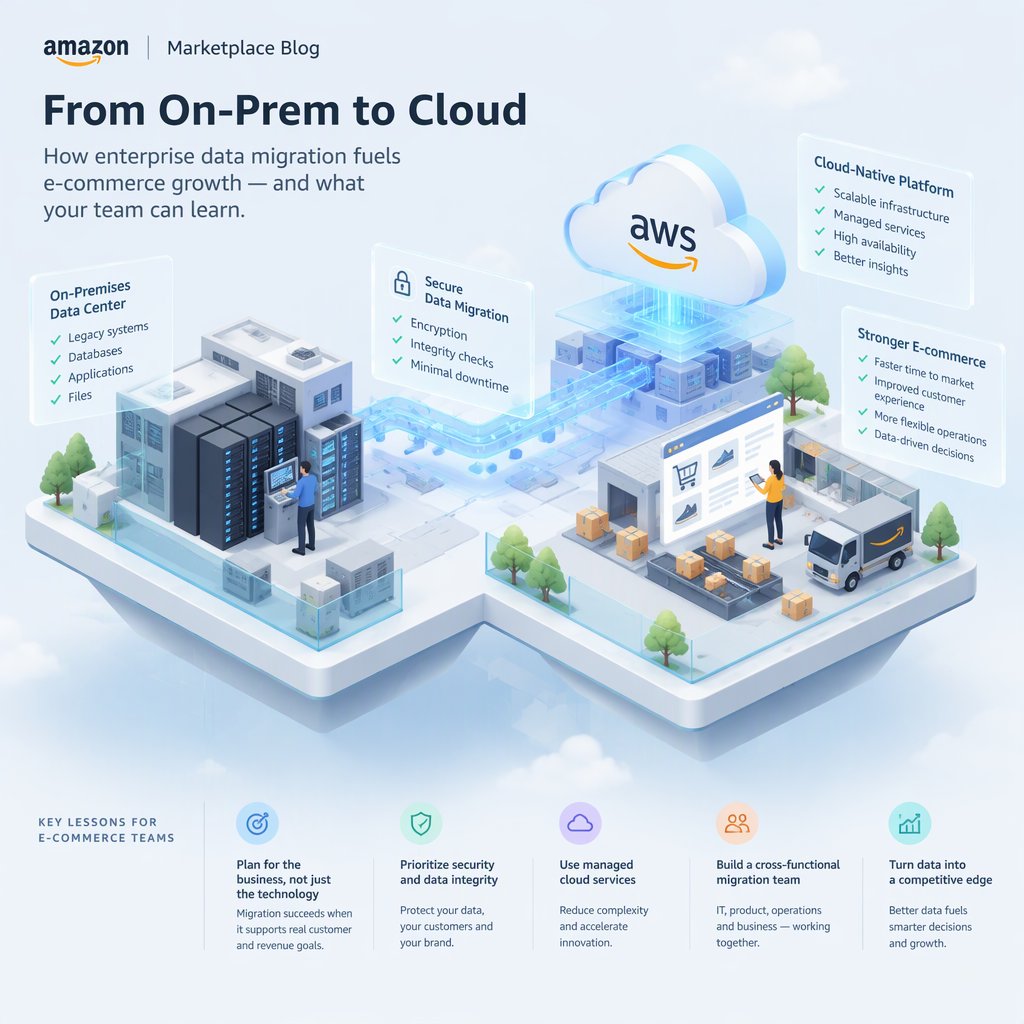
ANZ’s Six-Month AWS Data Migration: Lessons for Amazon Sellers and E-Commerce Teams
Salevoyant Editorial · November 17, 2026
Introduction
ANZ has moved one of its largest data platforms to Amazon Web Services in six months, against an anticipated 18-month schedule, according to Amazon’s November 17 announcement. The banking project isn’t a Seller Central or Vendor Central update, but it offers a useful case study for commerce businesses modernizing reporting, reconciliation, and analytics systems. Its strongest lesson isn’t simply that AI accelerates migration: reliable data foundations still determine whether that speed produces business value.
Core Development
ANZ migrated its Enterprise Big Data platform from an on-premises environment to Amazon EMR, AWS’s managed platform for running big-data frameworks. The system supports payments, business banking, and customer remediation.
The scale is substantial:
1.7 petabytes of data
300 million files
142,000 tables
4,500 automated data workflows
4,000 views
Those figures describe more than a storage transfer. Tables, views, and workflows represent dependencies: scheduled transformations, business rules, downstream reports, and applications that expect data to arrive in a particular form.
ANZ and AWS Professional Services engineers used AI-assisted engineering to analyze, convert, test, and optimize workloads. A troubleshooting assistant powered by Amazon Bedrock helped engineers identify and fix performance bottlenecks without manually searching through code and configurations.
The announcement reports an estimated 35% reduction in migration effort compared with traditional approaches and approximately 50% less defects and rework through testing and validation. These are reported project outcomes, not independently verified benchmarks.
There’s also an important distinction: completing the project in one-third of the anticipated time doesn’t mean AI alone made every task three times faster. Delivery time depends on sequencing, staffing, automation, and how much work teams can perform in parallel.
Technical Deep Dive
Moving Dependencies, Not Just Data
Amazon EMR manages infrastructure for big-data processing frameworks, including Apache Spark and Hadoop. ANZ’s announcement doesn’t specify its framework versions, cluster configuration, storage design, or orchestration tools, so those implementation details remain unknown.
The architectural significance is clearer. Moving away from an on-premises platform can give teams more flexibility to adjust processing capacity around workload demand, rather than sizing everything around fixed infrastructure.
That flexibility matters in e-commerce. A business may need modest processing capacity for routine reporting, then much more during peak trading periods, catalog updates, or financial reconciliation.
But managed infrastructure doesn’t fix inefficient workloads automatically. Poor partitioning, unnecessary data scans, excessive small files, and expensive joins can still drive long runtimes and high bills. ANZ’s 300 million files make file organization a relevant engineering question, although the source doesn’t explain how the team addressed it.
AI Helps With Investigation, Not Proof
The Bedrock-powered assistant supported troubleshooting. That’s a practical use of generative AI: helping engineers investigate bottlenecks across code and configuration.
The announcement also describes agentic AI across discovery and migration activities. It doesn’t disclose which models ANZ used, the assistant’s permissions, or how much execution was autonomous.
For commerce teams, the transferable opportunity is assistance with mapping dependencies, proposing conversions, and generating tests. The boundary is equally important.
Analysis: AI can propose a migration fix. Reconciliation must demonstrate that the fix preserves the business result.
A migrated settlement workflow, for example, should still distinguish sales, refunds, fees, and adjustments correctly. Producing valid code isn’t enough if the resulting margin report changes meaning.
Treat the Cost Figures Carefully
Amazon reports that a solution processed data approximately seven times faster than an initial alternative approach, had tokenized almost 80 terabytes, and reduced operating costs from more than US
0,000 per day to less than US$3,000 per month.
The announcement doesn’t provide enough detail to establish the scope of that cost comparison or apply it to the entire migrated platform. It also doesn’t explain the tokenization method.
In data-security contexts, tokenization generally means substituting sensitive values with tokens. It shouldn’t automatically be read as language-model token processing.
The commercial lesson is to compare costs for a clearly defined workload, with equivalent throughput, security, and service requirements. A dramatic headline number isn’t a complete ROI model.
Industry Impact
Analysis: This case positions AWS as both an infrastructure provider and an engineering partner. EMR supplies the processing platform, Bedrock supports AI-assisted investigation, and Professional Services contributes delivery expertise.
That combination addresses a common obstacle in enterprise modernization: customers don’t just need somewhere to run their data. They need to understand existing systems, reproduce their behavior, and migrate without disrupting operations.
For Amazon marketplace participants, the connection is indirect but useful. Sellers and vendors often combine Seller Central or Vendor Central reports with inventory systems, advertising data, logistics records, and accounting software. Larger operators may also build integrations through Amazon’s Selling Partner API, or SP-API.
These businesses face smaller versions of the same dependency problem. A changed schema can break a report. A delayed feed can distort inventory planning. A duplicated transaction can undermine profitability analysis.
ANZ’s announcement doesn’t introduce new marketplace reporting capabilities, alter API permissions, or change seller fees. Instead, it demonstrates an engineering approach that could inform the systems businesses operate around Amazon.
Consumers benefit only if better infrastructure leads to better execution: more accurate availability, fewer fulfillment errors, or faster issue resolution. Those outcomes require operational changes, not merely a cloud migration.
Implementation Considerations
Start With One Business Outcome
Most sellers don’t need a banking-scale platform. They need trustworthy answers to specific questions.
A sensible first project might combine settlement data, advertising spend, and product costs into a reconciled profitability dataset. Another might connect inventory positions with sales velocity to improve replenishment planning.
Choose the outcome before the infrastructure. A smaller database or warehouse may suit the workload better than EMR.
Build Validation Into the Migration
Before introducing AI-assisted changes, document what correct output looks like:
Reconciliation: Do totals match trusted source reports?
Completeness: Are expected orders, transactions, and inventory records present?
Freshness: Does data arrive within the required reporting window?
Repeatability: Can a job rerun without duplicating records?
Business definitions: Are fees, refunds, taxes, and advertising costs treated consistently?
Parallel runs can expose differences between old and new pipelines before teams switch production reporting. Investigate discrepancies rather than assuming the newer system is correct.
Constrain the Assistant
If an AI assistant can access logs, schemas, or code, establish what it can read and what it can change. Review proposed fixes before production execution.
Commerce datasets may contain customer information, commercially sensitive pricing, and operational credentials. Apply least-privilege access, audit logging, and appropriate data-handling controls. ANZ reports enhanced security controls, but it doesn’t disclose a configuration that readers can copy.
Measure the Full Return
Track more than processing speed. A useful ROI assessment includes engineering effort, compute and storage, model usage, support, licensing, and the expense of running old and new systems together.
Don’t confuse a faster job with a cheaper operation. Extra capacity can reduce runtime while increasing cost.
For sellers, the business return may come from fewer reconciliation hours or more dependable purchasing decisions. For vendors, it may come from consistent reporting across retail, finance, and supply-chain teams. Measure those outcomes directly.
Future Outlook
Analysis: ANZ’s project suggests that AI-assisted migration is becoming a credible part of enterprise delivery, particularly for repetitive discovery, conversion, and troubleshooting work. It doesn’t establish that complex modernization can run unattended.
For AWS, the strategic opportunity extends beyond hosting completed workloads. AI services can participate in the engineering work that brings those workloads onto AWS.
For e-commerce organizations, that could make aging data systems less expensive to modernize. Yet technical portability still matters. Teams should understand dependencies on service-specific tooling, security policies, and orchestration before committing.
The next useful evidence would be sustained operating results: reliability, ongoing costs, maintenance effort, and measurable improvements in customer or employee experiences. Migration speed is an opening result, not the final score.
Conclusion
ANZ’s migration offers a credible example of AI-assisted engineering at substantial scale, with reported reductions in delivery effort and rework. Its relevance to Amazon sellers and vendors lies in the method, not in a new marketplace feature.
Start with one valuable workflow. Establish trusted outputs, use AI to assist investigation and conversion, and validate every material change. Then assess whether the new system delivers better economics and more dependable decisions.